By Bader Dairy | Traditional Jordanian Dairy Producers in Worth, Illinois | Updated October 14, 2026
Not all ghee tastes the same. If you’ve ever prepared a traditional Jordanian meal using cow ghee and wondered why the aroma was different from the version your family makes with sheep ghee, the milk source may be part of the answer.
Both cow ghee and sheep ghee belong to the family of clarified dairy fats commonly used in Middle Eastern cooking. Both can add richness to rice, meat, vegetables, and traditional dishes. However, they are not always interchangeable when flavor is an important part of the recipe.
The biggest difference between cow ghee and sheep ghee is their flavor profile. Cow ghee often has a familiar, relatively mild buttery character, while sheep ghee can be more pronounced and aromatic. The actual difference depends on the milk, the processing method, and any traditional flavoring ingredients used.
In Jordan, traditional ghee is commonly known as samneh baladi. Sheep ghee, sometimes referred to as samneh ghanam, is especially associated with traditional meals such as mansaf.
Understanding the differences can help you choose a ghee that complements your cooking rather than overpowering it.
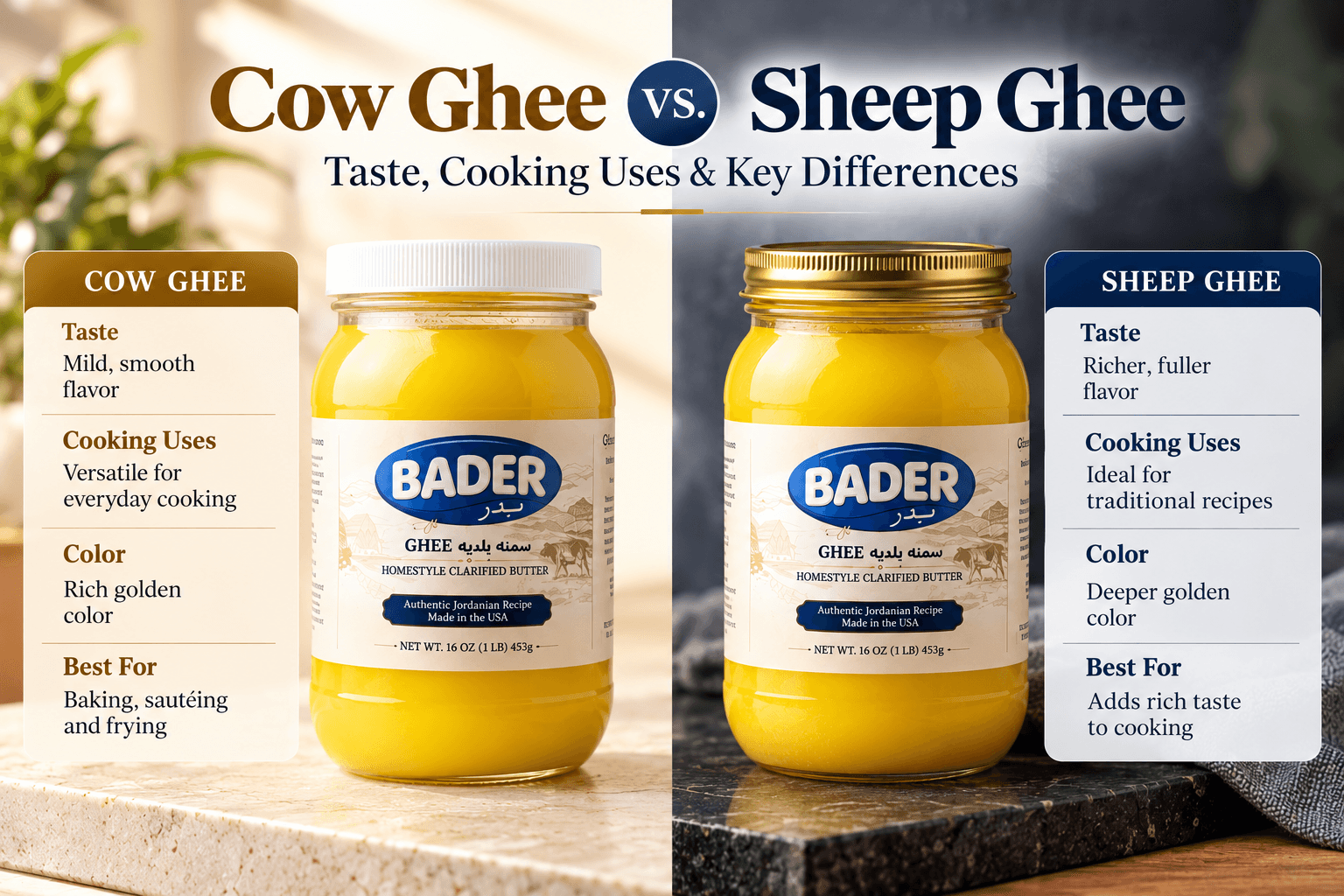
Cow Ghee vs. Sheep Ghee: Quick Comparison
| Feature | Cow Ghee | Sheep Ghee |
|---|---|---|
| Milk source | Cow dairy | Sheep dairy |
| Common flavor | Familiar, buttery, often milder | Fuller, more distinctive |
| Aroma | Generally softer | Can be more pronounced |
| Common culinary uses | Rice, vegetables, baking, everyday cooking | Mansaf, lamb, rice, traditional celebrations |
| Traditional name | Samneh Baladi / Cow Samneh | Samneh Ghanam / Sheep Samneh |
| Cooking versatility | Broad everyday use | Broad use, especially in dishes benefiting from a stronger flavor |
| Milk allergen | Contains milk-derived ingredients | Contains milk-derived ingredients |
| Best choice | When you want a familiar buttery flavor | When you want a distinctive traditional dairy aroma |
These are general culinary characteristics, not universal standards. A mild sheep ghee and a strongly flavored cow ghee can have overlapping flavor profiles.
What Is Cow Ghee?
Cow ghee is a clarified dairy fat made from cow-derived butter or another suitable cow-milk fat preparation.
During clarification, much of the moisture and nonfat milk material is separated from the fat.
The result is a concentrated dairy cooking ingredient that can be used in a wide variety of dishes.
In traditional Middle Eastern households, cow ghee is valued for its versatility.
It can add a buttery finish to rice, enrich vegetables, or be used in recipes that call for samneh without necessarily introducing a particularly strong sheep-dairy flavor.
What does cow ghee taste like?
Cow ghee typically has a rich buttery character.
Depending on its preparation, the flavor may include toasted, nutty, or caramel-like notes.
Some varieties are relatively mild, while others develop a stronger aroma through traditional processing or flavoring.
The milk source is only one factor.
Cooking temperature, preparation time, and the ingredients used during production also influence the final result.
This is why two jars labeled “cow ghee” may not taste identical.
When is cow ghee a good choice?
Cow ghee is useful for dishes where you want buttery richness without a particularly assertive dairy flavor.
Consider using it for:
- Everyday rice dishes
- Sautéed vegetables
- Pan-cooked potatoes
- Toasted nuts
- Certain pastries and baked foods
- Cooking eggs
- Roasting vegetables
- Finishing warm flatbread
For someone trying traditional ghee for the first time, cow ghee may be a familiar starting point.
Bader Dairy produces Cow Ghee — Samneh Baladi as part of its Jordanian dairy collection.
What Is Sheep Ghee?
Sheep ghee is a clarified dairy fat produced from sheep-derived dairy.
Like cow ghee, it undergoes processing to reduce moisture and separate much of the nonfat milk material from the fat.
Its distinctive identity comes largely from the milk source and the traditional preparation methods.
Sheep dairy has a different fat composition from cow dairy, which can influence the aroma, mouthfeel, and flavor of the finished product.
In Jordanian cuisine, sheep ghee is particularly associated with traditional family meals and festive cooking.
What does sheep ghee taste like?
Sheep ghee can have a richer and more pronounced dairy aroma than cow ghee.
Some people describe its flavor as robust, savory, or distinctly pastoral.
However, sheep ghee should not automatically be described as unpleasantly strong or gamey. A well-prepared product can have a balanced aroma that complements the food.
The intensity varies with the dairy source and production process.
For cooks who grew up with traditional Jordanian dishes, the aroma of sheep ghee may be one of the most recognizable parts of the meal.
Why is sheep ghee used in traditional cooking?
Traditional recipes are often developed around ingredients available in a particular region.
Sheep dairy has a long culinary history in Jordan and other parts of the Levant.
The flavor of sheep ghee became associated with foods such as mansaf, rice dishes, and meals served at family celebrations.
In these dishes, the ghee is not simply a neutral cooking fat.
Its aroma is part of the intended flavor.
Bader Dairy offers Sheep Ghee — Samneh Baladi Ghanam for customers looking for this traditional ingredient.
Why Do Cow Ghee and Sheep Ghee Taste Different?
The distinction begins with the milk.
Cow milk and sheep milk differ in fat composition, protein composition, and other naturally occurring components.
During butter production and clarification, these differences can influence the finished product.
1. Different fatty acid profiles
Milkfat contains numerous fatty acids.
Their proportions vary by animal species, diet, and other factors.
These differences influence the physical behavior of the fat and can contribute to the aroma compounds that develop during processing.
Scientific research comparing cow and sheep ghee has documented measurable differences in their chemical compositions.
However, these differences do not mean that one variety is automatically healthier or superior.
2. Different aromatic compounds
Flavor involves more than basic taste.
Much of what people experience as the flavor of ghee comes from its aroma.
Heating, dairy-fat composition, and processing conditions can influence the aromatic compounds present in the finished product.
This helps explain why some varieties of ghee smell noticeably different when warmed.
3. Preparation methods
Not all traditional ghee is made using identical methods.
Some producers heat the dairy fat longer than others.
Certain regional recipes also include herbs or other flavoring ingredients during preparation.
These differences may create a distinctive flavor even when the original milk source is the same.
For this reason, it is important to compare actual products, not just their names.
4. How much ghee is used
The amount added to a dish changes the final experience.
A teaspoon used to finish rice may provide a subtle aroma.
Several tablespoons in a large traditional recipe can have a much stronger influence.
The right quantity depends on the dish, serving size, and personal preference.
Which Ghee Is Better for Mansaf?
For traditional Jordanian mansaf, sheep ghee is often the preferred choice when cooks want a rich, distinctive dairy aroma.
Mansaf is built around several important ingredients, including lamb, rice, and jameed, a dried fermented dairy product used to prepare the dish’s characteristic sauce.
Ghee may be used in preparing the rice, finishing the meat, or adding richness and aroma to the dish.
Why sheep ghee is a traditional favorite
Sheep ghee can complement the strong savory flavors of lamb and the tangy richness of jameed.
Its distinctive aroma is familiar in many traditional Jordanian preparations.
For cooks looking to recreate a particular family recipe, using the type of ghee traditionally called for can make a noticeable difference.
But sheep ghee is not the only ingredient that determines whether mansaf tastes authentic.
Jameed quality, cooking technique, meat preparation, rice texture, and seasoning are all important.
Can you make mansaf with cow ghee?
Yes.
Cow ghee can be used in mansaf, particularly when sheep ghee is unavailable or someone prefers a milder flavor.
The resulting dish may have a different aromatic profile, but that does not mean the recipe cannot work.
If you’re comparing the two, prepare the same rice recipe with each type of ghee.
This gives you a practical way to understand the difference before using it in a larger family meal.
For the traditional dairy base of mansaf, explore Bader Dairy’s Jameed product.
Which Ghee Is Better for Rice?
Both cow ghee and sheep ghee can work extremely well with rice.
The difference is the flavor you want to achieve.
Cow ghee for everyday rice
Cow ghee is a practical choice for rice served alongside vegetables, chicken, beans, and other everyday dishes.
Its familiar buttery character can enrich the grains without becoming the dominant flavor.
For cooks who want a subtle finish, start with a small amount and increase gradually.
Sheep ghee for traditional rice dishes
Sheep ghee can be especially appealing in rice served with lamb, toasted nuts, or traditional Jordanian meals.
Its aroma may remain noticeable even when combined with other rich ingredients.
Because its flavor can be more pronounced, a little may be enough.
A simple comparison you can try at home
Prepare two small portions of the same plain rice.
For each portion:
- Use the same rice variety and cooking method.
- Add the same measured amount of ghee.
- Use cow ghee in the first portion.
- Use sheep ghee in the second portion.
- Taste both while warm.
Pay attention to the aroma before tasting.
Then notice how each ghee changes the flavor of the rice.
This is one of the easiest ways to decide which product you prefer.
Which Ghee Is Better for Baking and Desserts?
Cow ghee is often the more approachable choice for baked goods when a mild, buttery flavor is desired.
It can work in certain traditional pastries, cookies, and desserts.
Sheep ghee is also used in some heritage recipes where its stronger flavor is part of the expected result.
Neither type should be considered universally better for baking.
Cow ghee in baking
Cow ghee may be suitable for:
- Certain shortbread-style cookies
- Traditional semolina desserts
- Some filled pastries
- Recipes specifically developed for clarified butter
- Baked foods that benefit from a mild dairy flavor
Because ghee has much less moisture than regular butter, substituting it for butter may require adjusting the recipe.
Sheep ghee in traditional pastries
Some regional pastries are traditionally prepared with aromatic samneh.
In these recipes, sheep ghee can contribute a characteristic flavor that regular butter or neutral vegetable oil would not reproduce.
However, a dessert with delicate flavors may be overwhelmed by a particularly strong ghee.
Follow the intended recipe and adjust only after understanding how the ingredients work together.
Can You Mix Cow Ghee and Sheep Ghee?
Yes. From a culinary perspective, the two can be combined.
Mixing a mild cow ghee with a stronger sheep ghee allows cooks to create a flavor profile between the two.
This can be useful when someone enjoys the aroma of sheep ghee but prefers it in moderation.
For example, you might begin with three parts cow ghee and one part sheep ghee for a rice dish.
That is a suggested flavor experiment, not a traditional or standardized ratio.
Taste the result and adjust according to personal preference.
When mixing products, use clean utensils and follow the most restrictive storage instructions of the products involved.
Cow Ghee vs. Sheep Ghee: Nutrition Differences
Both cow ghee and sheep ghee are concentrated sources of dairy fat.
Their exact nutritional compositions can differ, but both contain substantial amounts of total fat and saturated fat.
Neither should automatically be considered a healthier alternative based solely on the animal source.
Is sheep ghee more nutritious than cow ghee?
The answer depends on what nutrient is being measured and the composition of the specific products.
Milk-derived fats can contain different concentrations of fatty acids and fat-soluble nutrients.
However, differences in laboratory composition do not automatically establish meaningful health benefits in everyday diets.
For an accurate comparison, use the Nutrition Facts information on the actual packaging.
Does sheep ghee contain more calories?
The calorie content of both products primarily comes from fat.
Because both are concentrated dairy fats, their calorie values per gram are generally similar.
Differences between individual products are better established through verified nutrition labeling than assumptions about the animal species.
Is either type suitable for someone with a milk allergy?
Neither should be assumed safe.
Clarification removes much of the nonfat milk material, but residual milk proteins may remain.
Both cow ghee and sheep ghee are milk-derived products.
Additionally, people with cow’s milk protein allergies may react to sheep milk proteins because of similarities between the proteins.
Anyone with a milk allergy should seek appropriate medical guidance rather than treating ghee as a dairy-free substitute.
Does sheep ghee have less lactose?
Both types of properly clarified ghee generally contain much less lactose than the original dairy material.
However, remaining lactose depends on the product and preparation process.
Do not assume either product is completely lactose-free unless that claim has been verified for the particular product.
Is Sheep Ghee More Expensive Than Cow Ghee?
Sheep ghee can be more expensive, although prices vary considerably by producer and market.
Several factors may contribute.
Milk availability
Cow dairy is produced at a much larger commercial scale in many markets.
Sheep dairy production may be more limited, depending on the region.
Production volume
Smaller production batches can increase the cost per unit.
Traditional demand
In markets where sheep ghee is associated with important cultural dishes, consumers may specifically seek it out.
Processing and sourcing
The cost of dairy fat, labor, processing, and packaging also affects the final price.
A higher price does not automatically mean a product is better for every recipe.
A more useful question is whether the flavor justifies the choice for the particular dish you’re preparing.
How to Choose Between Cow Ghee and Sheep Ghee
Instead of selecting a ghee solely because of its name, consider how you plan to use it.
Choose cow ghee when:
- You want an everyday cooking fat with a familiar buttery flavor.
- You’re introducing ghee to someone who hasn’t tried it before.
- You’re cooking vegetables, eggs, potatoes, or simple rice dishes.
- You want a generally milder dairy flavor for recipes.
- You’re preparing foods where other ingredients should remain the main focus.
Choose sheep ghee when:
- You’re preparing traditional Jordanian recipes that call for it.
- You want a more distinctive dairy aroma.
- You’re cooking lamb or richly seasoned rice dishes.
- You’re making mansaf according to a family recipe.
- You’re trying to recreate a familiar traditional flavor.
The most important consideration is personal preference.
Someone who enjoys sheep ghee may use it every day. Someone else may prefer cow ghee even for traditional meals.
Both have a place in the kitchen.
Does Sheep Ghee Have a Different Smoke Point Than Cow Ghee?
Both varieties are generally suitable for a range of cooking methods because they have been clarified.
Removing much of the moisture and milk solids generally improves high-temperature cooking performance compared with regular butter.
However, there is no single universal smoke point for all cow ghee or all sheep ghee.
The smoke point of a specific product depends on processing, purity, free fatty acid levels, residual components, and other factors.
It is therefore inaccurate to claim that sheep ghee always withstands higher heat than cow ghee, or vice versa.
For everyday cooking, use temperature control appropriate to the specific recipe and avoid heating either fat until it produces excessive smoke.
For more information on how clarification changes cooking performance, read our guide to Ghee vs. Butter vs. Clarified Butter.
How Should Cow Ghee and Sheep Ghee Be Stored?
Proper storage helps preserve the aroma and quality of both products.
Clarification removes much of the water present in ordinary butter, but that does not automatically make every packaged ghee product shelf-stable.
Shelf life depends on factors such as processing, moisture, packaging, storage temperature, and exposure to contamination.
General handling tips
- Follow the storage directions printed on the jar.
- Keep the container sealed when not in use.
- Use a clean, dry spoon.
- Avoid introducing water or food particles.
- Protect the product from unnecessary heat and direct sunlight.
- Observe the manufacturer’s best-by date.
Can ghee change texture in the jar?
Yes.
Ghee can appear liquid, semi-solid, or grainy at different temperatures.
Milkfat contains different components that crystallize at different temperatures.
These changes do not automatically indicate a problem.
However, unusual odors, visible mold, or other obvious signs of spoilage mean the product should not be used.
Can cow ghee and sheep ghee be stored together?
They can be stored in the same kitchen area as long as each is maintained according to its label.
Keeping them in separate, clearly marked containers can also help prevent flavor transfer and accidental mixing.
Traditional Samneh Baladi in Jordanian Food Culture
Understanding the difference between cow ghee and sheep ghee also means understanding their place in Jordanian kitchens.
Samneh baladi has long been associated with food preparation, family gatherings, and traditional cooking methods.
Different households have their own preferences.
Some prefer the familiar aroma of cow ghee.
Others consider sheep ghee essential to the flavor of particular family dishes.
For many families, the aroma of samneh heating in a pan brings back memories of rice served at gatherings, warm bread, and holiday meals.
These preferences are not simply technical decisions about cooking temperature.
They are part of the food traditions passed from one generation to another.
Traditional methods may also involve ingredients and preparation techniques that differ between regions and producers.
That is why authentic samneh can vary in aroma, flavor, and appearance.
At Bader Dairy, preserving these traditional dairy products is central to our story.
We produce Jordanian dairy products in Worth, Illinois, bringing familiar foods and flavors to customers in the United States.
You can learn more about our heritage and production on our Our Story page.
Frequently Asked Questions About Cow Ghee and Sheep Ghee
Is sheep ghee better than cow ghee?
Not necessarily. Sheep ghee can offer a more distinctive flavor, while cow ghee may be preferable for everyday cooking. The best choice depends on the dish and your taste preferences.
Does sheep ghee smell stronger?
It often has a more pronounced dairy aroma, although the intensity varies by production method and product.
Can cow ghee be used for mansaf?
Yes. Cow ghee can be used in mansaf, although some traditional recipes specifically favor sheep ghee for its flavor.
What is samneh ghanam?
Samneh ghanam is a term used for traditional ghee associated with sheep dairy. In Jordanian cooking, it is particularly familiar in traditional savory dishes.
What is samneh baladi?
Samneh baladi refers to traditional clarified dairy fat or ghee. Regional recipes and production methods can vary, and it may be made using different dairy sources.
Is sheep ghee made from sheep milk?
Yes. Sheep ghee is produced from dairy fat obtained from sheep milk.
Can you cook eggs with sheep ghee?
Yes. Sheep ghee can be used to cook eggs, although its flavor may be stronger than butter or mild cow ghee. Use moderate heat and adjust the quantity to taste.
Which ghee is better for rice?
Cow ghee can provide a relatively mild buttery character, while sheep ghee can create a more pronounced traditional aroma. Either may work depending on the recipe.
Is sheep ghee dairy-free?
No. Sheep ghee is a dairy product and should not be considered dairy-free.
Can I use sheep ghee instead of cow ghee in a recipe?
Usually, yes, when the purpose is to add cooking fat. However, the flavor may change noticeably. In baking, recipe adjustments may still be required.
Why does traditional Jordanian ghee taste different?
Differences in milk source, preparation techniques, heating, and traditional flavoring ingredients can influence the finished aroma and taste.
Is cow ghee or sheep ghee better for everyday cooking?
Many people find cow ghee more versatile because of its familiar buttery flavor. However, those who enjoy the stronger flavor of sheep ghee may prefer using it regularly.
Explore Cow Ghee and Sheep Ghee From Bader Dairy
Both types of ghee have an important place in traditional Jordanian cooking.
Cow ghee offers a familiar buttery richness suitable for many everyday dishes.
Sheep ghee adds a distinctive traditional character that can be especially appealing in mansaf, lamb dishes, and special family meals.
Neither is universally better. Understanding the differences allows you to choose the product that fits your recipe and your preferences.
At Bader Dairy, we make traditional Jordanian dairy products in Worth, Illinois.
Explore our ghee collection:
- Cow Ghee — Samneh Baladi: Available in 16 oz glass, 16 oz plastic, and 32 oz plastic containers.
- Sheep Ghee — Samneh Baladi Ghanam: Available in a 16 oz glass jar.
Looking for Bader Dairy products?
Visit our Where to Find Bader page to learn where to find our products or contact us about availability.
Own a grocery store, restaurant, or specialty food market?
Visit our Wholesale Inquiry page to ask about carrying Bader Dairy products.
Bader Dairy
6903 W 111th St, Worth, IL 60482
Phone: (708) 827-5174
Website: https://baderdairy.com/
Traditional Jordanian dairy, made in Illinois.