By Bader Dairy | Traditional Jordanian Dairy Producers in Worth, Illinois | Updated October 21, 2026 | 10-minute read
Nabulsi cheese is known for its salty flavor, firm texture, and important role in traditional Palestinian and Jordanian cuisine. Whether you’re frying it for breakfast, serving it alongside fresh vegetables, or preparing traditional knafeh, knowing how to control its saltiness makes a noticeable difference.
But there’s a common problem: Nabulsi cheese can taste much saltier straight from the jar than you want in a finished dish.
Some cooks rinse the cheese briefly. Others soak it for several hours. And sometimes, after soaking, the cheese becomes too soft, watery, or difficult to handle.
So how do you remove excess salt while maintaining the texture that makes Nabulsi cheese special?
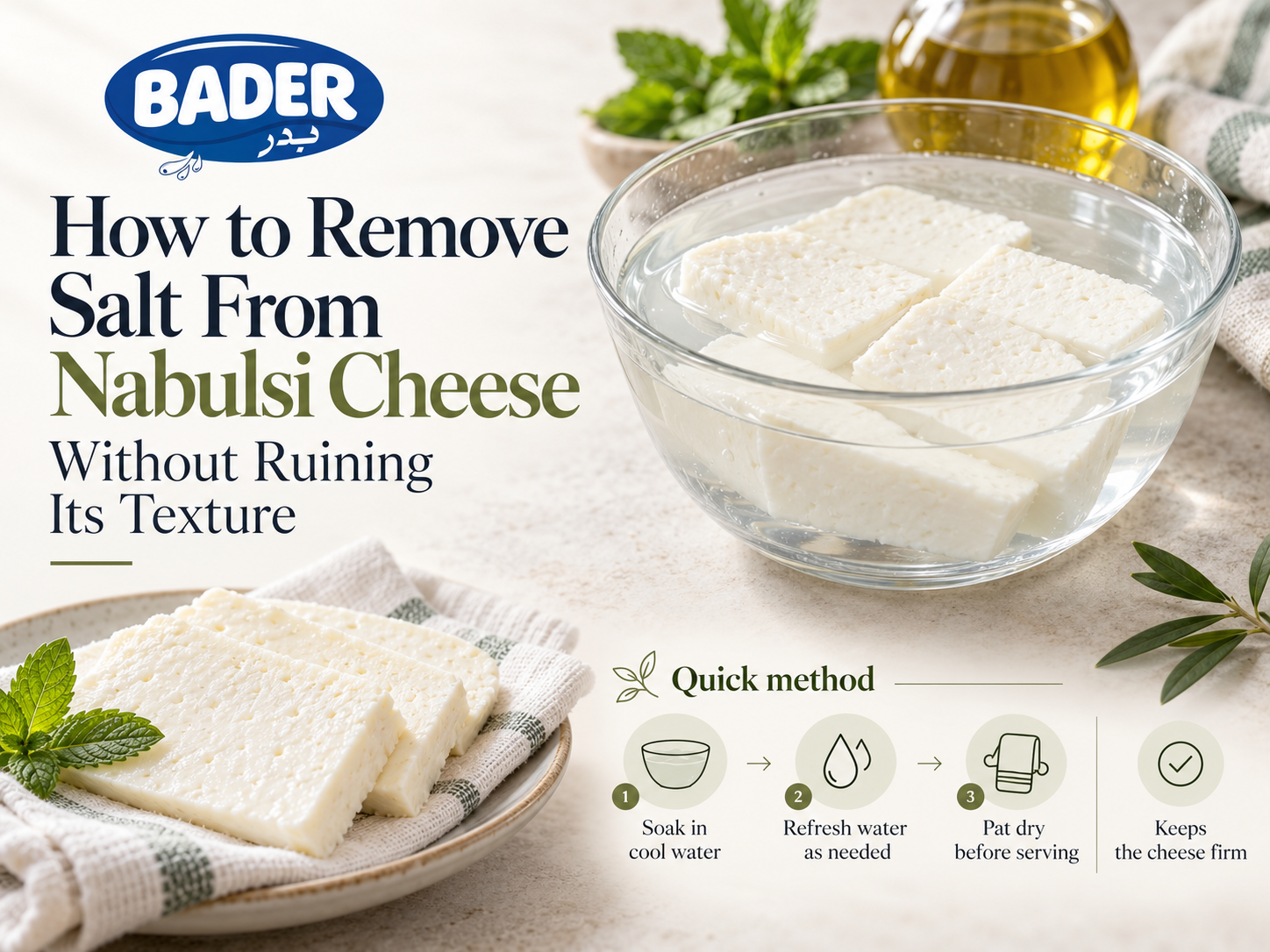
Quick answer: To reduce salt in Nabulsi cheese, cut the cheese into slices, place them in a bowl of cold drinking water, and refrigerate while soaking. Replace the water periodically and taste a small piece until the salt level suits your recipe. Drain the cheese thoroughly before frying, grilling, or adding it to knafeh.
The amount of soaking required depends on the cheese’s original salt content, its thickness, and how you plan to cook it.
This guide explains how to desalt Nabulsi cheese properly, what changes during soaking, and how to avoid the most common mistakes.
Why Is Nabulsi Cheese So Salty?
Nabulsi cheese, also called Jibneh Nabulsieh, is a traditional white-brined cheese originating in Nablus, Palestine.
It is widely enjoyed throughout Jordan and the Levant.
Unlike many fresh cheeses, traditional Nabulsi is prepared and stored in a salty brine.
Brining contributes to the cheese’s flavor, physical structure, and preservation.
Salt influences how moisture moves through the cheese and affects the behavior of its proteins.
This is part of why Nabulsi develops its characteristic texture.
What is brine?
Brine is a solution of salt and water.
During traditional Nabulsi production, the cheese is exposed to brine as part of the manufacturing and storage process.
Salt moves into the cheese while moisture and other components can move between the cheese and the surrounding liquid.
The result is a cheese with a concentrated salty flavor.
Is Nabulsi supposed to taste salty?
Yes.
Saltiness is one of its defining characteristics.
However, that does not mean the cheese must be eaten at its original salt concentration in every recipe.
Many traditional preparations call for rinsing or soaking the cheese before serving.
The goal is not necessarily to remove every trace of salt.
It is to create the flavor and texture appropriate for the finished dish.
How Long Should You Soak Nabulsi Cheese?
There is no universal soaking time for every jar of Nabulsi cheese.
The amount of salt, thickness of the pieces, water volume, and intended recipe all affect how long the process takes.
Use these approximate times as preparation starting points rather than guarantees.
| Intended use | Suggested approach | Desired result |
|---|---|---|
| Breakfast cheese | Rinse or briefly soak, tasting as needed | Pleasantly salty |
| Fried Nabulsi cheese | Short refrigerated soak if too salty | Balanced flavor, firm slices |
| Grilled cheese | Rinse or soak as necessary | Firm enough to handle |
| Knafeh | Begin with approximately 2 hours, changing water periodically | Mild enough for dessert |
| Very salty, thick pieces | Longer refrigerated soaking may be needed | Evenly reduced salt |
Important: Bader Dairy’s Knafeh with Nabulsi Cheese recipe uses a two-hour soak with three water changes.
Other Nabulsi products and recipes may require different times.
Always keep the cheese refrigerated during extended soaking.
Step-by-Step: How to Remove Salt From Nabulsi Cheese
Step 1: Remove the cheese from its brine
Open the container and use clean utensils to remove the amount of cheese you plan to prepare.
Place it on a clean cutting board or plate.
Leave the remaining cheese in its original container and brine according to the manufacturer’s storage instructions.
Avoid handling the entire jar unnecessarily if you’re only preparing a few pieces.
Step 2: Cut the cheese into slices
Use a clean knife to cut the cheese into reasonably even slices.
For many recipes, slices approximately ½ inch thick are a practical starting point.
Smaller or thinner pieces generally lose salt more quickly because more surface area is exposed to water.
Very thick pieces may remain salty in the center even when the outside tastes relatively mild.
For knafeh, smaller pieces can help produce more even desalting.
For frying, keep the slices thick enough to hold their shape during cooking.
Step 3: Rinse briefly under cold water
A quick rinse can remove some brine clinging to the cheese’s surface.
Place the slices in a strainer and rinse gently with cold drinking water.
This is often enough when the cheese is only slightly saltier than desired.
However, a brief rinse will not remove substantial amounts of salt from deep inside the cheese.
For a stronger reduction, soaking is necessary.
Step 4: Place the cheese in fresh water
Transfer the slices into a clean food-safe bowl.
Add enough cold drinking water to cover the cheese completely.
Separate pieces that are stacked tightly together so the water can reach their surfaces.
Cover the bowl and place it in the refrigerator.
Keep the cheese at 40°F (4°C) or below during soaking.
This is especially important when preparing cheese for several hours.
Step 5: Change the water periodically
As the cheese soaks, salt moves from the cheese into the surrounding water.
Over time, the water becomes saltier.
Replacing it with fresh water can help maintain the concentration difference that drives further salt removal.
For a two-hour knafeh preparation, Bader Dairy’s recipe recommends changing the water three times.
For other recipes, the frequency can be adjusted according to the amount of cheese, saltiness, and soaking period.
Use clean utensils when handling the pieces.
Step 6: Test the saltiness
After an initial soaking period, remove a small piece and taste it.
Ask yourself:
- Is it still too salty for the dish?
- Does the cheese have a pleasant dairy flavor?
- Has the saltiness become mild enough?
- Is the cheese still firm enough for the intended cooking method?
For breakfast, some saltiness may be desirable.
For sweet knafeh, the cheese generally needs to be much milder.
If the cheese is still too salty, replace the water and continue refrigerated soaking.
Step 7: Drain the cheese thoroughly
Once the salt level is satisfactory, remove the cheese from the water.
Place it in a clean strainer and allow excess water to drain away.
For frying or grilling, gently pat the pieces dry using a clean paper towel.
For knafeh, drain thoroughly before chopping or grating.
Excess surface moisture can interfere with browning and make pastry fillings watery.
Step 8: Cook according to your recipe
Your cheese is ready for its intended preparation.
You can fry it, grill it, serve it with bread, or use it in traditional knafeh.
If you are not cooking immediately, keep the prepared cheese refrigerated.
Why Does Soaking Remove Salt?
The process is based on diffusion.
When salty cheese is placed in water containing little salt, dissolved salt tends to move from the cheese into the surrounding water.
This happens because of the difference in salt concentration.
Over time, the salt levels begin moving toward equilibrium.
Replacing the soaking water with fresh water creates a new concentration difference, allowing more salt to leave the cheese.
Why does thickness matter?
Salt must move from the inside of the cheese toward the surface.
With thin slices, the distance is shorter.
With thick blocks, salt in the center has farther to travel.
This is why a large block may require a longer soak than several thin slices.
Does soaking remove all the sodium?
No.
Soaking can reduce sodium, but it does not guarantee complete removal.
The amount remaining depends on the original product and preparation method.
Anyone managing sodium intake for medical reasons should not assume that soaked Nabulsi cheese is low-sodium without verified nutritional information.
How to Keep Nabulsi Cheese From Becoming Too Soft
Reducing salt can also change the cheese’s texture.
This happens because salt, water, and milk proteins interact within the cheese.
During soaking, water can move into the cheese as salt moves out.
The degree of change depends on the cheese’s original moisture content, composition, and processing.
Use cold water
Cold water allows you to reduce salt while maintaining appropriate refrigeration temperatures.
It also avoids exposing the cheese to unnecessary warmth before cooking.
Avoid soaking longer than necessary
Check the saltiness periodically.
Once the flavor is suitable for your recipe, stop soaking.
Continuing far beyond the desired point may alter the flavor and physical characteristics.
Keep the pieces relatively even
Uniform slices help the cheese desalt more consistently.
A mixture of very thick and thin pieces may produce uneven results.
Handle the cheese gently
Soaked cheese may become more delicate.
Use a slotted spoon or clean spatula when transferring pieces.
Drain properly
A wet exterior can make cheese difficult to brown and may cause splattering when placed in a hot pan.
Remove surface water before frying.
Preparing Desalted Nabulsi Cheese for Knafeh
Knafeh is one of the most important reasons cooks need to know how to reduce salt in Nabulsi cheese.
The dessert traditionally combines cheese, pastry, and sweet syrup.
For this application, the cheese should have a relatively mild salt level.
If too much salt remains, the finished dessert may taste unpleasantly savory.
Recommended preparation
For Bader Dairy’s traditional knafeh recipe:
- Measure approximately 500 g of Nabulsi cheese.
- Cut it into manageable slices.
- Cover with cold drinking water.
- Refrigerate while soaking for approximately two hours.
- Change the water three times.
- Taste a small piece to check the salt level.
- Continue soaking if necessary.
- Drain thoroughly.
- Grate or chop the cheese before assembling the dessert.
The cheese should be barely salty before it is added to the pastry.
This is a practical starting method for the Bader recipe, not a guarantee that all Nabulsi cheeses will desalt identically.
Why does wet cheese make knafeh soggy?
Excess water introduced into the pastry can interfere with the desired texture.
Instead of developing a well-defined pastry layer, the filling may release moisture during baking.
Draining the cheese helps prevent unnecessary water from entering the dessert.
Why does Nabulsi cheese become stretchy?
When heated, the protein structure of properly prepared Nabulsi cheese allows it to soften and become elastic.
Its behavior depends on factors including moisture, salt, acidity, and processing.
Removing excess salt helps make the flavor appropriate for dessert, but soaking alone does not guarantee a particular amount of stretch.
For the full recipe, visit Knafeh with Nabulsi Cheese.
Preparing Nabulsi Cheese for Frying
Fried Nabulsi cheese is a traditional breakfast favorite.
Unlike knafeh, which typically requires substantially reducing the salty flavor, fried cheese can retain more of its original character.
Do you need to soak Nabulsi before frying?
Not always.
If you enjoy its original saltiness, a brief rinse may be enough.
If the cheese tastes too salty, a short refrigerated soak may improve the result.
The correct approach depends on your preference and the specific product.
How to fry Nabulsi cheese
- Remove the amount needed from the jar.
- Rinse or soak if desired.
- Drain and pat the slices dry.
- Heat a nonstick pan over medium heat.
- Add a little suitable cooking fat if needed.
- Place the slices in the pan.
- Cook until the underside becomes golden.
- Turn gently and cook the other side.
- Serve warm.
The precise cooking time depends on slice thickness and pan temperature.
Avoid excessive heat that burns the outside before the interior warms.
What should you serve with fried Nabulsi cheese?
Traditional accompaniments include warm flatbread, cucumbers, tomatoes, olives, and sweet tea.
For more serving ideas, explore Bader Dairy’s Recipes & Inspiration.
Can You Remove Salt From Nabulsi Cheese Quickly?
If you only need to reduce salt on the surface, a cold-water rinse is the quickest option.
However, if the cheese is heavily salted throughout, there is no reliable instant method for removing most of the salt without affecting other characteristics.
The salt needs time to move out of the cheese.
Cutting it into smaller pieces and changing the soaking water can help.
Does hot water remove salt faster?
Warmer water can accelerate certain diffusion processes, but it can also change the cheese’s texture and introduce food-safety concerns.
For prolonged soaking, use cold water under refrigeration.
Do not leave dairy soaking in warm water on the counter for hours.
Can you boil Nabulsi cheese to remove salt?
Boiling is not a recommended general substitute for refrigerated desalting.
It may soften the cheese, change its structure, and alter the finished texture.
Boiling may appear in certain traditional manufacturing or cooking processes, but those are not the same as soaking cheese to reduce its saltiness before a recipe.
Common Mistakes When Desalting Nabulsi Cheese
Mistake #1: Soaking without changing the water
As salt enters the surrounding water, the concentration difference becomes smaller.
Replacing the water can help the process continue.
Mistake #2: Using pieces of completely different thicknesses
Thin pieces may become sufficiently mild while thick pieces remain salty inside.
Use reasonably uniform pieces for predictable results.
Mistake #3: Soaking at room temperature overnight
Nabulsi cheese is a perishable dairy product.
Bader Dairy requires refrigeration at 40°F (4°C) or below.
Keep it refrigerated during extended soaking.
Mistake #4: Removing too much salt for a savory dish
Nabulsi’s saltiness is part of its traditional flavor.
A breakfast preparation may taste flat if the cheese has been excessively desalted.
Stop when the cheese tastes appropriate for the intended dish.
Mistake #5: Adding wet cheese directly to hot oil
Surface water can cause splattering.
Drain and pat dry before frying.
Mistake #6: Assuming soaking always makes cheese stretchier
Soaking changes salt and moisture levels, but the final heating behavior also depends on how the cheese was manufactured.
Not every Nabulsi cheese will behave identically.
Mistake #7: Putting soaked cheese back into the original jar
Soaked cheese has a different salt and moisture balance from the original product.
Do not return it to the original storage brine or mix it with unprepared cheese unless the manufacturer provides specific instructions.
Prepare only what you need and handle leftovers as refrigerated perishable dairy.
What If Nabulsi Cheese Is Still Too Salty?
First, determine whether the saltiness is coming from the surface or throughout the cheese.
If the surface is salty, rinsing may help.
If the inside remains too salty, continue soaking under refrigeration with fresh water.
For thicker pieces, consider cutting them into smaller portions before continuing.
Taste periodically rather than relying solely on the clock.
If the cheese remains too salty for knafeh after the usual preparation period, it may require additional soaking.
For a savory dish, a little extra saltiness may be acceptable when paired with less salty ingredients.
What If Nabulsi Cheese Becomes Too Soft After Soaking?
First, drain the cheese thoroughly.
If it is intended for frying, gently pat dry and use a pan that supports the slices rather than placing them directly on open grill grates.
For knafeh, some softness is acceptable because the cheese will form a filling.
However, if the cheese has become excessively watery or structurally unstable, additional soaking will not necessarily fix it.
Use the cheese according to its current condition and avoid forcing it into a preparation requiring firmer slices.
If the cheese shows signs of spoilage or has been stored improperly, discard it.
Does Removing Salt Change the Taste of Nabulsi Cheese?
Yes.
Salt is an important component of Nabulsi’s flavor.
When salt is reduced, the dairy character and any aromatic ingredients may become more noticeable.
Traditional Nabulsi recipes can include mahlab, mastic, or black seed.
Bader Dairy’s Nabulsi Cheese lists cow milk, goat milk, salt, mahlab, rennet, mastic gum, and black seed.
These ingredients contribute to the product’s distinctive identity.
When the cheese is properly desalted, the resulting flavor can be more suitable for desserts while still retaining the qualities that make it Nabulsi.
How to Store Nabulsi Cheese After Soaking
After removing cheese from its original brine and placing it in fresh water, its storage conditions have changed.
Keep desalted cheese refrigerated until use.
If you are not preparing the recipe immediately:
- Transfer it to a clean, covered food-safe container.
- Refrigerate at 40°F (4°C) or below.
- Avoid unnecessary handling.
- Use promptly.
- Do not assume its original unopened shelf life still applies.
- Follow any applicable instructions from the producer.
For cheese remaining in its original jar, follow Bader Dairy’s instructions to keep it refrigerated in its brine or original container and observe the package date.
Frequently Asked Questions
How do you make Nabulsi cheese less salty?
Rinse it under cold drinking water or soak sliced pieces in fresh cold water under refrigeration. Change the water periodically and taste until the salt level is suitable.
How long do you soak Nabulsi cheese for knafeh?
Bader Dairy’s knafeh recipe uses approximately two hours with three water changes. Other products may require longer or shorter soaking.
Can you soak Nabulsi cheese overnight?
Yes, extended soaking may be appropriate for particularly salty or thick pieces, but always keep the cheese refrigerated and avoid soaking longer than necessary.
Do you need to remove salt before frying Nabulsi cheese?
Not always. If you enjoy its salty flavor, rinsing may be sufficient. Soak it if the saltiness is stronger than desired.
Can you remove salt from Nabulsi cheese without water?
Water soaking is the most straightforward traditional method. Simply wiping the cheese will not remove substantial salt from its interior.
Should you use warm water to soak Nabulsi cheese?
Cold water under refrigeration is preferable for extended soaking. Warm water may increase food-safety risks and change the cheese’s texture.
Does soaking Nabulsi cheese reduce sodium?
Yes, soaking can remove some sodium-containing salt. The amount removed varies, so the finished cheese should not automatically be called low-sodium.
Why is my Nabulsi cheese rubbery?
Texture depends on the cheesemaking process, salt content, moisture, and cooking temperature. Overcooking can also produce an unpleasantly firm result.
Can I use desalted Nabulsi cheese for sandwiches?
Yes. You can serve appropriately prepared cheese with bread, tomatoes, cucumbers, olives, and herbs.
Can you freeze desalted Nabulsi cheese?
Freezing may alter its moisture distribution and texture. Follow manufacturer recommendations and avoid assuming the cheese will behave identically after thawing.
Is Nabulsi cheese supposed to be stored in brine?
Many traditional Nabulsi cheeses are stored in brine. Follow the manufacturer’s instructions for the specific product.
Where can I find Nabulsi cheese in Illinois?
Bader Dairy produces traditional Nabulsi cheese in Worth, Illinois. Customers can inquire about purchasing through the website.
Discover Traditional Nabulsi Cheese From Bader Dairy
Removing excess salt from Nabulsi cheese is a straightforward technique that becomes easier with experience.
The main principles are simple: use cold water, cut the cheese evenly, change the soaking water, taste periodically, and drain thoroughly.
For savory breakfasts, you may want to retain more of the cheese’s traditional salty flavor.
For knafeh, a milder cheese is generally preferred.
At Bader Dairy, we produce traditional Nabulsi cheese in Worth, Illinois, using a recipe that includes cow and goat milk, mahlab, mastic gum, and black seed.
Our Nabulsi cheese is available in 32 oz glass and plastic jars.
Explore Bader Dairy Nabulsi Cheese to learn about the product.
For the next step in preparing a traditional dessert, follow our Knafeh with Nabulsi Cheese Recipe.
Looking for more traditional Jordanian dishes? Visit Recipes & Inspiration.
Looking for Bader Dairy products?
Visit Where to Find Bader to ask about product availability.
Interested in stocking Nabulsi cheese?
Grocery stores, specialty markets, restaurants, and distributors can contact our team through the Wholesale Inquiry page.
Bader Dairy
6903 W 111th St, Worth, IL 60482
Phone: (708) 827-5174
Website: baderdairy.com
Traditional Jordanian dairy, made in Illinois.