By Bader Dairy | Traditional Jordanian Dairy Producers in Worth, Illinois | Updated October 14, 2026
Nabulsi cheese and halloumi are two popular white cheeses used throughout Middle Eastern and Mediterranean cooking. Both are known for their salty flavor, firm texture, and ability to hold their shape when heated. Yet despite their similarities, they are not the same cheese.
If you’ve ever wondered whether you can substitute halloumi for Nabulsi cheese, which one works better for frying, or why traditional knafeh recipes call for particular white cheeses, understanding the differences can make a noticeable improvement in your cooking.
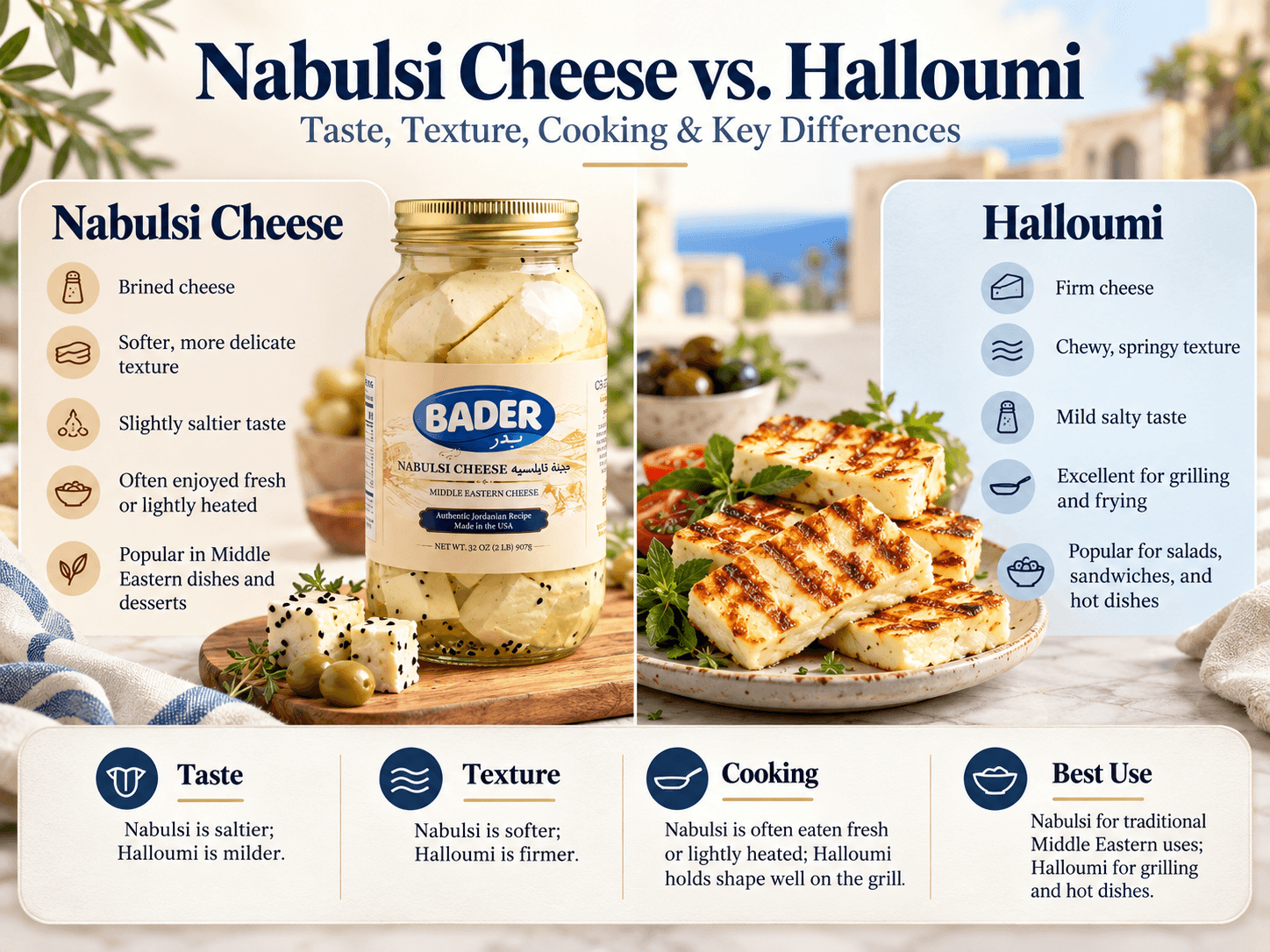
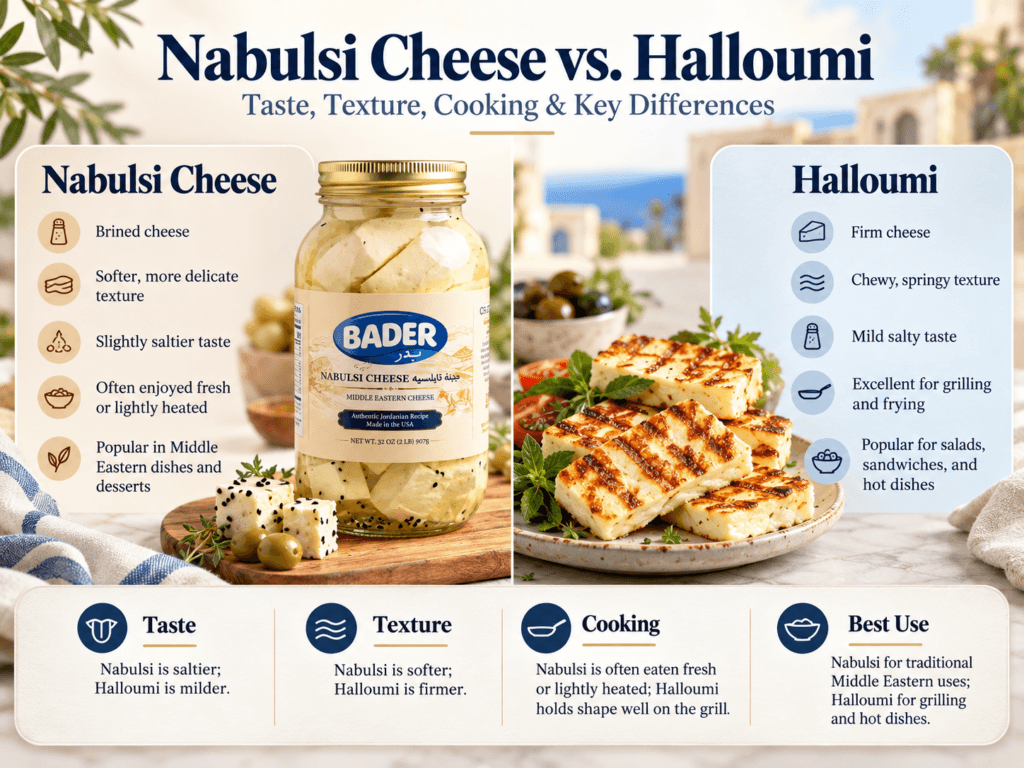
The main difference between Nabulsi cheese and halloumi is their traditional preparation, flavor, and texture. Nabulsi is a brined cheese originating in Nablus, Palestine, and deeply associated with Jordanian and Levantine cuisine. Halloumi originates in Cyprus and is particularly known for its firm, elastic texture and excellent grilling properties.
Both cheeses are versatile, but each has culinary characteristics that make it better suited to certain dishes.
Nabulsi Cheese vs. Halloumi: Quick Comparison
| Feature | Nabulsi Cheese | Halloumi |
|---|---|---|
| Origin | Nablus, Palestine | Cyprus |
| Culinary tradition | Palestinian, Jordanian, Levantine | Cypriot, Mediterranean |
| Milk source | Traditionally sheep or goat milk; cow milk also used | Traditionally sheep and goat milk; cow milk also used |
| Texture | Firm, becoming softer and more elastic when heated | Firm, elastic, often squeaky |
| Flavor | Salty, milky, sometimes aromatic | Salty, tangy, mildly milky |
| Common flavorings | May include mahlab, mastic, or black seed | Traditionally associated with mint |
| Frying | Suitable | Excellent |
| Grilling | Suitable | Excellent |
| Knafeh | Traditional choice | Possible substitute, but different result |
| Salt reduction | Frequently soaked before certain uses | Depends on the product and recipe |
| Storage | Refrigerated, often in brine | Refrigerated according to packaging |
These are typical characteristics rather than fixed rules. Cheese recipes vary by producer, milk source, moisture level, and processing methods.
What Is Nabulsi Cheese?
Nabulsi cheese, also called Jibneh Nabulsieh, is a traditional white-brined cheese originating in the Palestinian city of Nablus.
Over generations, it became an important part of food culture throughout Jordan and the wider Levant.
Nabulsi is usually semi-hard, with a relatively firm, close texture. It is known for becoming softer and more elastic when heated while often retaining enough structure for frying or grilling.
The cheese is traditionally associated with sheep and goat milk, although modern producers also make versions using cow milk or combinations of different milk sources.
One of Nabulsi cheese’s defining characteristics is its preparation and preservation in salted brine.
This contributes to its characteristic flavor and texture.
What does Nabulsi cheese taste like?
Nabulsi cheese typically has a pronounced salty, milky flavor.
Depending on the recipe, it can also contain aromatic ingredients such as:
- Mahlab, also called mahlab or mahleb
- Mastic
- Black seed, also known as nigella seed
Not every Nabulsi cheese uses the same seasoning ingredients.
These traditional flavorings can create a more complex taste than an ordinary unspecialized white cheese.
Some varieties have subtle aromatic notes, while others emphasize the salty dairy character.
How is Nabulsi cheese traditionally served?
Nabulsi cheese is particularly versatile.
It can be served:
- As part of a traditional Jordanian breakfast
- Fried until golden
- Grilled and served with vegetables
- Alongside olives, bread, and tomatoes
- In selected savory pastries
- In traditional knafeh after removing excess salt
Its ability to work in both savory and sweet preparations makes it especially valuable in Levantine cooking.
At Bader Dairy, we produce Nabulsi Cheese in Worth, Illinois, using a traditional recipe featuring cow and goat milk, salt, mahlab, rennet, mastic gum, and black seed.
What Is Halloumi Cheese?
Halloumi is a traditional cheese originating in Cyprus.
It is widely recognized for its ability to withstand grilling and frying temperatures without completely melting into a liquid.
Halloumi is traditionally made with sheep and goat milk, although some modern commercial varieties contain cow milk.
The cheese is usually semi-hard and elastic.
One of its most recognizable characteristics is the slightly squeaky sensation it can produce when chewed.
This is related to its protein structure and the way the cheese is manufactured.
What does halloumi taste like?
Halloumi usually has a salty, mild dairy flavor with a slight tang.
Compared with some traditionally seasoned Nabulsi cheeses, halloumi may have a less complex aromatic profile.
However, different brands can vary significantly.
Some halloumi contains mint, an ingredient associated with traditional Cypriot preparation.
Other versions are simpler.
Why is halloumi popular for grilling?
Halloumi is known for its ability to develop a golden exterior while remaining relatively firm.
When grilled or pan-fried, it can form browned surfaces without spreading across the pan like mozzarella or many other melting cheeses.
This makes it useful for:
- Grilled cheese slices
- Mediterranean salads
- Vegetable skewers
- Sandwiches
- Pan-fried appetizers
- Meat-free grilled dishes
Its firm texture makes it easy to handle during cooking.
Why Are Nabulsi and Halloumi So Similar?
The similarities between these cheeses come partly from their manufacturing methods.
Both belong to the broader category of brined cheeses.
Both can undergo heating during production, which affects the structure of the milk proteins.
These processing steps help produce cheeses with distinct cooking properties.
When heated, many cheeses soften significantly because their protein structures allow the fat and moisture to flow.
Nabulsi and halloumi generally maintain more structure than conventional melting cheeses.
This helps explain why both can be sliced and fried.
However, their exact behavior varies.
Halloumi typically stays firmer and more resistant to melting, while Nabulsi can become softer and more elastic when heated.
That difference matters when selecting cheese for different recipes.
Which Cheese Is Better for Frying?
Both Nabulsi cheese and halloumi are suitable for frying.
The better choice depends on the final texture and flavor you want.
Frying Nabulsi cheese
Fried Nabulsi cheese is a familiar dish in traditional Levantine breakfasts.
The cheese is usually sliced, drained, and cooked until the exterior develops light golden color.
The inside becomes warm and softer while the cheese generally maintains its overall shape.
The result combines a slightly browned outside with a salty, tender interior.
To prepare it:
- Remove the cheese from its brine.
- Rinse briefly if desired.
- Reduce excess salt through soaking if necessary.
- Pat the slices dry with a clean paper towel.
- Heat a nonstick or well-seasoned pan over medium heat.
- Add a small quantity of cooking fat if needed.
- Cook until lightly golden, then turn carefully.
- Serve immediately with warm bread and vegetables.
Different Nabulsi products may soften at different rates, so start with one slice to establish the right cooking temperature.
Frying halloumi
Halloumi is especially convenient for frying because of its firm, elastic structure.
It can often be cooked in a dry nonstick pan.
Slice the cheese, pat it dry, and place it in a moderately hot pan.
Allow the surface to brown before turning.
Halloumi typically develops a firm golden exterior while maintaining a chewy interior.
Which produces the better result?
Choose Nabulsi cheese when you want a traditional Levantine breakfast flavor, potentially with characteristic aromatic seasonings.
Choose halloumi when you prefer a firmer, chewier grilled-cheese texture.
Both work well, but their eating experiences are different.
For a traditional serving idea, explore Bader Dairy’s Recipes & Inspiration collection.
Can You Grill Nabulsi Cheese Like Halloumi?
Yes.
Nabulsi cheese can be grilled, although its softer behavior during heating may require more careful handling.
The most important factors are slice thickness, moisture, and cooking temperature.
Tips for grilling Nabulsi cheese
For best results:
- Cut the cheese into relatively thick slices.
- Drain excess brine.
- Pat the surface dry.
- Avoid leaving thin slices over high heat for too long.
- Use a grill pan if the cheese is too delicate for open grates.
- Turn only after the first side has developed a stable surface.
A grill pan is particularly useful because it supports the entire slice.
Tips for grilling halloumi
Halloumi is generally easier to handle on an outdoor grill.
Its firm structure often allows it to be placed directly on clean grill grates.
A light coating of oil can help prevent sticking.
Cook just until grill marks form and the cheese is heated through.
Overcooking can create an unnecessarily tough texture.
What should you serve with grilled cheese?
Both cheeses pair well with:
- Fresh tomatoes
- Cucumber
- Olives
- Warm flatbread
- Fresh mint
- Grilled vegetables
- Olive oil
- Fresh herbs
The cheese provides the salty element, while vegetables and bread balance the overall dish.
Is Nabulsi Cheese Saltier Than Halloumi?
Both cheeses can be relatively high in salt because brining is an important part of their preparation.
However, it is not accurate to say every Nabulsi cheese is saltier than every halloumi.
Salt content varies according to:
- Brine concentration
- Length of brining
- Cheese moisture content
- Slice thickness
- Manufacturing methods
- Storage conditions
Some Nabulsi varieties are particularly salty because they are intended to be soaked before use.
Many packaged halloumi varieties can be cooked without soaking, although certain products may still benefit from a rinse.
For an accurate sodium comparison, check the Nutrition Facts labels.
Why is Nabulsi cheese stored in brine?
Brining serves several purposes.
Salt influences flavor, texture, moisture movement, and microbial activity.
In traditional cheese production, brining has also been an important preservation technique.
However, brine does not make cheese automatically safe to store at room temperature.
Commercial Nabulsi cheese should be handled according to the manufacturer’s storage instructions.
Bader Dairy recommends keeping its Nabulsi cheese refrigerated at 40°F (4°C) or below.
How to Remove Excess Salt From Nabulsi Cheese
Soaking is a common technique used when preparing salty Nabulsi cheese, particularly for desserts.
The goal is to allow some of the salt to move from the cheese into fresh water.
Step-by-step salt reduction
Step 1: Cut the cheese
Cut the cheese into slices or smaller pieces. Smaller pieces expose more surface area and can lose salt more quickly.
Step 2: Place it in clean water
Put the cheese into a food-safe container with enough cold drinking water to submerge it.
Step 3: Refrigerate
Keep the cheese refrigerated during soaking.
Step 4: Change the water
Replace the water periodically to help continue the salt-reduction process.
Step 5: Taste a small piece
After soaking, check whether the salt level is suitable for your recipe.
Step 6: Drain
Drain thoroughly before cooking.
There is no universal soaking time.
The time needed depends on the original salt level, thickness of the cheese, and intended recipe.
Thin slices for breakfast may require little preparation, while cheese used in a sweet dessert may need more extensive soaking.
Does soaking remove all the salt?
No.
Soaking can reduce the salt content, but it does not guarantee complete sodium removal.
People who need to limit sodium should consult the actual product’s nutrition information rather than treating soaked cheese as sodium-free.
Nabulsi Cheese vs. Halloumi for Knafeh
This is one of the most important distinctions between the two cheeses.
Knafeh, also written kunafa or kanafeh, is a traditional Middle Eastern dessert made with cheese, pastry, and sweet syrup.
The cheese filling plays a major role in the finished texture.
Why is Nabulsi cheese used for knafeh?
Nabulsi cheese is closely associated with traditional knafeh, particularly the famous Nabulsi style.
After reducing its salt content, the cheese can soften and become elastic when heated.
This helps produce the warm, tender cheese layer beneath the pastry.
The balance between salty cheese and sweet syrup is an important part of the dessert.
Nabulsi cheese also contributes a traditional flavor that is difficult to reproduce exactly with unrelated cheeses.
Can you make knafeh with halloumi?
You can experiment with halloumi, but it may not produce the same result.
Halloumi is generally more resistant to melting and may remain firmer and chewier when heated.
This can make it less suitable for recipes that require a soft, cohesive cheese filling.
For that reason, a recipe specifically developed for halloumi may work better than directly replacing Nabulsi with an equal amount.
What is a substitute for Nabulsi cheese in knafeh?
Other cheeses commonly used in knafeh preparations include Akkawi and selected combinations of mild melting cheeses.
The goal is to achieve an appropriate balance of saltiness, moisture, and stretch.
Mozzarella can contribute elasticity, but its flavor differs from traditional Nabulsi cheese.
Feta has a stronger tang and a more crumbly structure, making it a less straightforward substitute.
For a traditional Nabulsi-style result, use cheese suited to the recipe rather than relying only on appearance.
Bader Dairy features a Knafeh with Nabulsi Cheese recipe in our Recipes & Inspiration section.
Can You Substitute Halloumi for Nabulsi Cheese?
Sometimes.
The answer depends on the dish.
| Dish | Can Halloumi Replace Nabulsi? | What Changes? |
|---|---|---|
| Fried breakfast cheese | Usually yes | Firmer, chewier texture |
| Grilled cheese slices | Yes | Halloumi often holds its shape more firmly |
| Traditional knafeh | Not an ideal direct substitute | Less soft, stretchy filling |
| Cheese sandwiches | Yes | Different saltiness and bite |
| Fresh cheese plates | Yes | Different aroma and texture |
| Savory pastries | Sometimes | Depends on desired melting behavior |
| Salads | Yes | Halloumi is often especially convenient for grilling |
Best substitution for frying
Halloumi is a practical alternative when Nabulsi cheese is unavailable.
Both can produce browned slices with a salty dairy flavor.
However, the traditional aromatic profile of Nabulsi may be missing.
Best substitution for grilling
Halloumi works particularly well.
Its firm texture makes it useful for direct grilling and skewers.
Best substitution for traditional desserts
Akkawi or a carefully selected blend of appropriate cheeses may be closer to the texture required for knafeh than halloumi alone.
The exact selection should follow the dessert recipe.
Nabulsi Cheese vs. Halloumi vs. Feta
These three cheeses are often grouped together because they are white and salty.
However, their cooking properties are quite different.
| Cheese | Typical Texture | Heating Behavior | Common Uses |
|---|---|---|---|
| Nabulsi | Firm, semi-hard | Softens and becomes elastic | Breakfast, frying, knafeh |
| Halloumi | Firm, elastic | Maintains shape well | Grilling, frying, salads |
| Feta | Soft to crumbly | Softens and breaks down | Salads, spreads, baked dishes |
Feta is not usually the best choice when a recipe requires slices of cheese to remain intact during frying.
That does not make feta inferior. It simply belongs to a different culinary role.
Likewise, halloumi is not automatically the best substitute for every white cheese.
Understanding the intended cooking behavior is more useful than choosing based solely on color.
Which Cheese Is Healthier: Nabulsi or Halloumi?
Neither cheese can be labeled universally healthier without comparing the actual nutrition information and the person’s dietary needs.
Both are dairy products that can provide protein and calcium.
Both may also contain substantial sodium and saturated fat.
The quantities depend on the milk source and manufacturing process.
Which contains more protein?
Protein content varies between products.
Halloumi is often recognized as a protein-rich cheese, but Nabulsi also contains dairy protein.
Compare the same serving size on the package to determine which specific product contains more.
Which contains more sodium?
Both can be high in sodium.
The amount depends on brining and processing.
If sodium intake is a concern, examine the Nutrition Facts label and consider the overall portion size.
Are both cheeses suitable for people with milk allergies?
No. Both are milk-derived cheeses.
Individuals with milk allergies should avoid them unless they have appropriate professional medical guidance.
Is Nabulsi cheese lactose-free?
Not automatically.
Cheese production changes the lactose content of milk, but the finished amount varies.
Do not assume Nabulsi or halloumi is completely lactose-free without verified product information.
How to Store Nabulsi Cheese and Halloumi
Proper storage is essential for freshness, quality, and food safety.
Both are perishable dairy products.
Storing Nabulsi cheese
Bader Dairy’s Nabulsi cheese should be kept refrigerated at 40°F (4°C) or below.
Store it in its brine or original sealed container as directed on the label.
After opening:
- Use clean utensils.
- Keep the container covered.
- Avoid introducing food particles into the brine.
- Refrigerate promptly.
- Follow the package’s best-by date and handling instructions.
Storing halloumi
Follow the manufacturer’s instructions.
Some halloumi is sold vacuum-packed, while other products are packaged in brine.
After opening, storage conditions and use-by recommendations may differ.
Do not assume all halloumi has the same shelf life.
Can these cheeses be frozen?
Freezing may be possible for some products, but it can change their texture.
The cheese may become more crumbly or release moisture after thawing.
Follow product-specific guidance, especially when the cheese will be used in a recipe where texture is important.
How to Choose the Right Cheese at the Grocery Store
When shopping for traditional white cheese, start by identifying the dish you want to make.
If you’re preparing a Jordanian breakfast
Look for a traditional Nabulsi cheese that can be sliced and served with warm bread, olives, tomatoes, and tea.
If you plan to fry it, choose a product intended for that preparation.
If you’re planning a grilled salad
Halloumi is often a convenient choice because it can be grilled and added directly to vegetables.
Nabulsi can also work, depending on its firmness and salt content.
If you’re making knafeh
Choose the cheese specified in your recipe.
Traditional Nabulsi-style knafeh commonly uses Nabulsi cheese prepared to reduce excess salt.
If you want traditional aromatic flavor
Check the ingredients.
Some Nabulsi cheeses include mahlab, mastic, or black seed.
These ingredients may contribute flavors not found in ordinary halloumi.
If you’re comparing packaged products
Read the labels for:
- Milk source
- Ingredients
- Salt or sodium content
- Package size
- Refrigeration instructions
- Recommended cooking applications
Rather than assuming every product bearing the same cheese name is identical, compare the actual product details.
Nabulsi Cheese in Jordanian Food Culture
Although Nabulsi cheese originated in Nablus, Palestine, it has become deeply embedded in Jordanian and wider Levantine food traditions.
For many families, it is associated with breakfast tables, gatherings, and traditional desserts.
A plate of Nabulsi cheese may be served with olives, cucumbers, tomatoes, warm bread, and tea.
Fried Nabulsi brings another dimension to the meal, with a golden exterior and softer interior.
And in knafeh, the cheese becomes part of a dessert with a long regional history.
These uses demonstrate why the ingredient remains important across generations.
Halloumi has its own distinct history in Cyprus and Mediterranean cuisine.
Both cheeses deserve recognition for their traditions rather than treating one as merely another name for the other.
At Bader Dairy, our goal is to preserve familiar Jordanian dairy traditions while producing products in the United States.
Our Nabulsi cheese is made and packaged in Worth, Illinois.
Learn more about our production and family recipes on our Our Story page.
Frequently Asked Questions
Is Nabulsi cheese the same as halloumi?
No. Both are brined white cheeses suitable for certain cooked dishes, but they have different origins, traditional preparation methods, textures, and flavor characteristics.
Can you fry Nabulsi cheese like halloumi?
Yes. Nabulsi can be sliced and pan-fried until golden, although it may soften more than halloumi.
Which cheese is better for knafeh?
Nabulsi cheese is a traditional choice for Nabulsi-style knafeh. Halloumi typically remains firmer and may not create the same filling texture.
Is Nabulsi cheese made from cow milk?
It can be. Traditional varieties often use sheep or goat milk, while modern producers may use cow milk or a combination. Bader Dairy’s Nabulsi cheese lists cow and goat milk.
Does Nabulsi cheese melt?
It generally softens and becomes more elastic when heated, but it does not behave exactly like mozzarella or ordinary melting cheese. The result depends on the product and cooking method.
Why is Nabulsi cheese so salty?
Brining is part of its traditional preparation and contributes to its flavor and texture. Some recipes call for soaking the cheese before use.
Can you eat Nabulsi cheese without frying it?
Yes, when the packaged product is ready to eat and has been stored and handled correctly. Nabulsi is traditionally served both uncooked and cooked.
Is halloumi better for grilling?
Halloumi is particularly well suited to grilling because it maintains its structure. Nabulsi can also be grilled with appropriate handling.
Is Nabulsi cheese the same as Akkawi?
No. Both are traditional Levantine white cheeses, but they differ in texture, processing, and flavor. Akkawi is often milder and can behave differently when heated.
What are the black seeds in Nabulsi cheese?
Some traditional Nabulsi cheeses contain black seed, also known as nigella seed. These seeds contribute to the flavor and appearance of the cheese.
How long should I soak Nabulsi cheese?
There is no single correct time. It depends on the cheese’s salt content, the thickness of the pieces, and the intended recipe. Soak under refrigeration and check the saltiness periodically.
Where can I find Nabulsi cheese in the Chicago area?
Bader Dairy produces traditional Nabulsi cheese in Worth, Illinois. Visit our product and location inquiry pages to ask about availability.
Discover Traditional Nabulsi Cheese From Bader Dairy
Nabulsi cheese and halloumi share several useful cooking characteristics, but they offer different experiences.
Halloumi is especially popular for grilling and pan-frying because of its firm, chewy structure.
Nabulsi cheese offers a distinct connection to Palestinian, Jordanian, and Levantine cuisine, with a characteristic salty flavor and a traditional role in both breakfast dishes and desserts.
If you’re preparing knafeh, recreating a Jordanian breakfast, or introducing your family to traditional Middle Eastern cheese, understanding these differences can help you select the right ingredient.
At Bader Dairy, we produce traditional Nabulsi cheese using cow and goat milk along with mahlab, mastic gum, and black seed.
Our cheese is available in:
- 32 oz plastic jars
- 32 oz glass jars
Explore our Nabulsi Cheese product page for more details.
Looking for Bader Dairy near you?
Visit Where to Find Bader to ask about purchasing our products.
Own a grocery store, restaurant, or Middle Eastern market?
Visit our Wholesale Inquiry page to learn about carrying Bader Dairy products.
Bader Dairy
6903 W 111th St, Worth, IL 60482
Phone: (708) 827-5174
Website: https://baderdairy.com/
Traditional Jordanian dairy, made in Illinois.