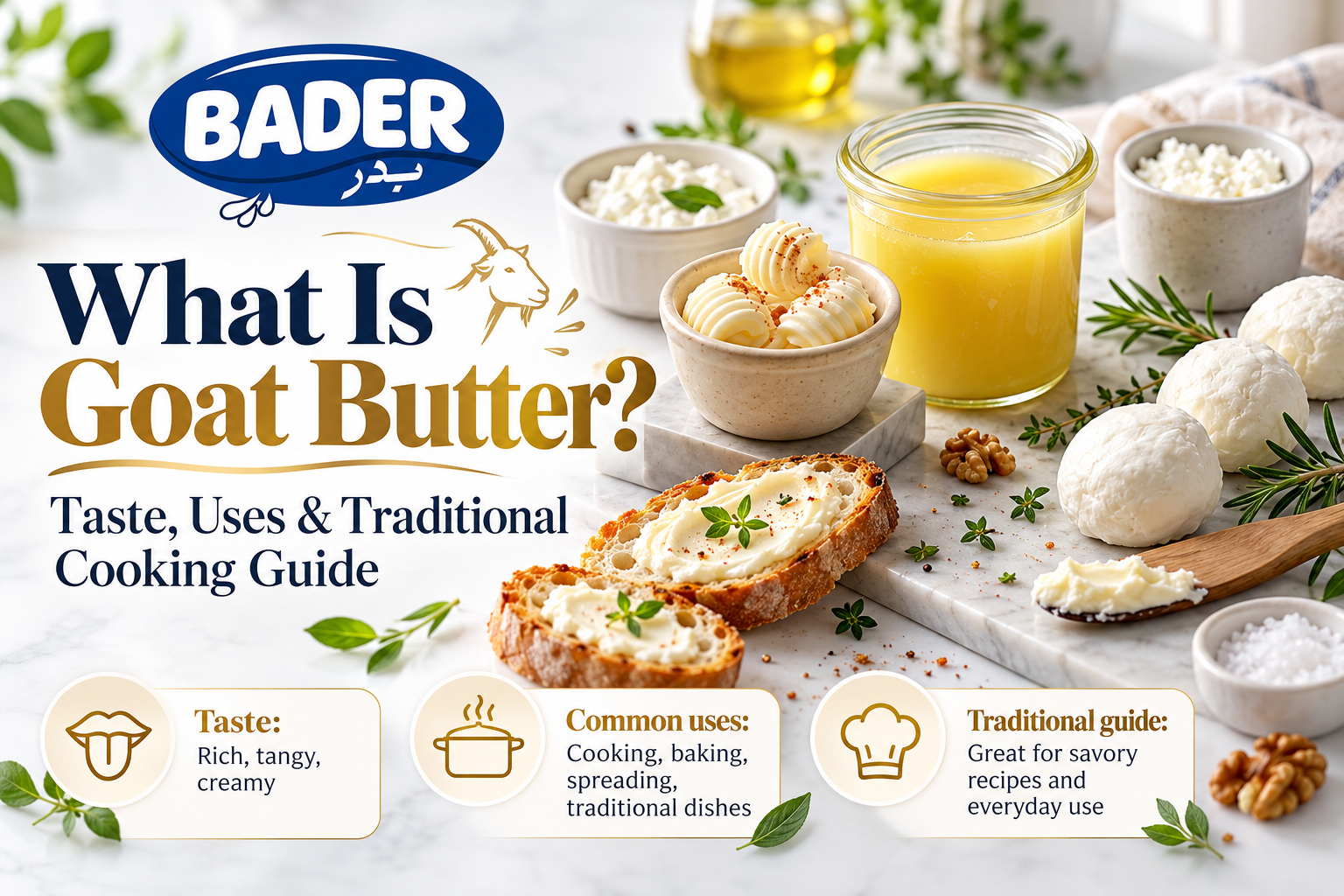
By Bader Dairy | Traditional Jordanian Dairy Producers in Worth, Illinois
Published: October 26, 2026 | Reading time: Approximately 10 minutes
Butter is one of the most familiar ingredients in the kitchen, but not all butter comes from cow milk. Across different food traditions, people have also made butter using milk from goats, sheep, and other dairy animals.
Goat butter is especially interesting because it brings a distinctive dairy flavor to familiar foods. It can be spread over warm bread, used to finish vegetables, incorporated into selected baked goods, or enjoyed in simple traditional meals.
Yet many people have never tried it. Others are unsure whether it tastes like goat cheese, behaves like regular butter, or requires different cooking techniques.
Goat butter is butter made from the fat in goat milk. Like traditional cow butter, it is produced by concentrating milkfat through churning. Its flavor can be creamy, tangy, or slightly distinctive depending on the milk and preparation method. It can be used in many of the same applications as cow butter, although its flavor, texture, and melting behavior may differ.
At Bader Dairy, we produce fresh hand-churned goat butter as part of our traditional Jordanian dairy collection in Worth, Illinois.
This guide explains what goat butter is, how it tastes, how to use it, and what to consider when cooking with this traditional dairy ingredient.
What Exactly Is Goat Butter?
Goat butter is a dairy product made from the fat naturally present in goat milk.
In conventional butter production, cream is churned until the fat globules begin joining together and separating from the surrounding liquid.
The butterfat gathers into solid or semi-solid masses, which are then worked into the finished butter.
The principle is similar whether the starting cream comes from cows or goats.
However, goat milk differs from cow milk in several ways, including its fat composition and physical characteristics.
These differences can influence the flavor and texture of the finished butter.
Is goat butter made from goat cheese?
No.
Goat butter and goat cheese are separate dairy products.
Goat cheese is produced by coagulating or culturing goat milk using particular cheesemaking methods.
Goat butter is made by concentrating the fat from goat dairy through a butter-making process.
They may come from the same type of animal milk, but they have different compositions, textures, and culinary uses.
What is goat butter called in Arabic?
In Arabic, butter is commonly called zibdeh or zubda, with regional variations in spelling and pronunciation.
Goat butter may be described as zibdeh maaz, referring to butter made from goat dairy.
Bader Dairy uses the name Zibdeh Maaz for its Fresh Hand-Churned Goat Butter.
What Does Goat Butter Taste Like?
Goat butter generally has a rich, creamy dairy character with flavor notes that may differ from cow butter.
Some varieties are mild and pleasantly buttery. Others have a more noticeable tang or distinctive goat-dairy aroma.
The exact result depends on several factors:
- The composition of the goat milk
- The animals’ diet
- The freshness and handling of the dairy
- Whether the cream or dairy was cultured
- The churning and processing method
- Storage conditions
It would be inaccurate to assume that every goat butter tastes strongly of goat cheese.
In fact, the flavor of well-prepared goat butter can be considerably more delicate than people expect.
Does goat butter have a strong smell?
Some varieties have a distinctive dairy aroma, but the intensity varies.
Goat milkfat contains fatty acids that can contribute characteristic flavors when released or transformed.
That does not mean every goat butter has a strong aroma.
The milk source, production process, and handling determine how noticeable those flavors become.
Is goat butter supposed to taste sour?
A slightly tangy flavor can be part of certain goat butter preparations.
However, an unexpected sharp, rancid, or otherwise abnormal flavor should not automatically be considered normal.
Follow the product’s storage instructions and do not taste butter that you suspect is spoiled.
Why Is Goat Butter Often Pale or White?
One of the first things people notice about goat butter is that it can look paler than conventional yellow cow butter.
The difference is related partly to pigments in the milkfat.
Cow milkfat can contain carotenoid pigments, including beta-carotene, that contribute to a yellow appearance.
Goats convert much of the dietary beta-carotene into vitamin A, so goat milkfat generally contains less of the pigment responsible for yellow coloration.
As a result, goat butter often looks white, ivory, or very pale cream.
Does pale butter mean it has less flavor?
No.
Butter color is not a reliable measure of flavor strength or product quality.
A pale goat butter can have a rich dairy aroma.
Similarly, yellow cow butter is not automatically better or more nutritious simply because of its color.
Color depends partly on the milk source and other production factors.
Can goat butter change color during storage?
Minor appearance changes can occur depending on temperature and handling.
However, unusual discoloration accompanied by other signs of deterioration should be treated cautiously.
Always follow the package’s storage and date instructions.
How Is Traditional Goat Butter Made?
Goat butter is produced through a churning process that concentrates milkfat.
Traditional methods vary between regions and households.
Some preparations begin with cream, while others involve cultured dairy or traditional butter-making techniques.
The general process can be divided into several stages.
Step 1: Preparing the dairy
The producer begins with goat dairy appropriate for butter production.
The milk or cream must be handled under suitable sanitary and temperature-controlled conditions.
Step 2: Concentrating or preparing the fat
Depending on the process, cream may be separated or a traditional cultured dairy preparation may be used.
Goat milk can present different cream-separation characteristics from cow milk, which can influence the chosen production method.
Step 3: Churning
The dairy is agitated until fat globules gather together.
As the fat joins into larger masses, butter begins separating from the surrounding liquid.
Step 4: Separating the butter
The concentrated butterfat is collected.
Remaining liquid is removed according to the process.
Step 5: Working and shaping
The butter is worked to achieve the desired texture and distribution of moisture.
It can then be shaped or placed into suitable packaging.
Step 6: Packaging and storage
Fresh butter must be handled and packaged appropriately to maintain quality and safety.
These are general butter-making principles. Individual producers use different equipment and processing procedures.
Bader Dairy describes its goat butter as hand-churned and produced at its own facility in Worth, Illinois.
Learn more about our production philosophy through Our Story.
10 Ways to Use Goat Butter in Everyday Cooking
One of the advantages of goat butter is that you do not need a complicated recipe to enjoy it.
In fact, simpler foods often make it easier to appreciate the flavor.
1. Spread it over warm flatbread
Warm pita, shrak, or another flatbread.
Spread a small amount of goat butter onto the warm surface.
Allow it to soften and serve immediately.
This is one of the easiest ways to experience its flavor without strong seasonings masking the dairy.
2. Serve goat butter with honey
Butter and honey are a familiar combination in many food traditions.
Place a small serving of goat butter alongside warm bread and drizzle a little honey over it.
The sweetness contrasts with the butter’s dairy flavor.
This works especially well as part of a simple breakfast.
3. Pair it with date molasses
Date molasses offers a deep, caramel-like sweetness.
Try spreading goat butter onto warm bread and adding a small amount of date molasses.
The combination creates a rich, sweet-and-savory breakfast or snack.
4. Finish a pot of rice
Prepare rice using your preferred recipe.
When the rice is fully cooked, remove it from the heat.
Add a small amount of goat butter and gently fold it through the grains.
The residual warmth melts the butter and distributes its flavor.
For another traditional preparation, explore Bader Dairy’s Cow Ghee and our guide to Ghee vs. Butter vs. Clarified Butter.
5. Melt over steamed vegetables
Steam or boil vegetables such as carrots, potatoes, or green beans.
Drain them thoroughly.
Add goat butter while the vegetables are still warm.
Finish with a little fresh parsley or another mild seasoning.
This allows the butter’s flavor to remain noticeable.
6. Make flavorful mashed potatoes
Prepare mashed potatoes as usual.
Use goat butter for part or all of the butter called for in the recipe.
Add liquid gradually to control the consistency.
Taste before adding additional seasonings.
The finished potatoes may have a slightly different dairy character than those made with cow butter.
7. Cook eggs over moderate heat
Melt a small amount of goat butter in a skillet over moderate heat.
Add eggs and cook according to your preference.
Avoid overheating the butter, because its milk solids can brown and scorch.
Goat butter works particularly well in dishes where you want a gentle dairy flavor.
8. Add it to roasted potatoes
Roast potatoes using an appropriate cooking oil and seasoning.
When they finish cooking, toss them with a little goat butter.
This finishing method allows you to enjoy the butter’s flavor without exposing it to the oven’s highest temperatures for an extended period.
9. Use it in selected baked goods
Goat butter can be used in certain baking recipes.
However, results can vary depending on the butter’s fat and moisture content.
Begin with a straightforward recipe rather than a highly technical pastry.
Cookies or simple butter-based breads can be useful experiments.
For recipes requiring precise structure, follow a tested formulation and compare the product’s characteristics with those of the butter specified.
10. Serve it as part of a traditional breakfast
Create a shared plate with warm bread, goat butter, honey, olives, fresh vegetables, and a dairy spread such as labneh.
This approach reflects the tradition of serving several small foods together.
For more ideas, explore our Traditional Jordanian Dairy Guide, which explains the role of butter, ghee, labneh, cheese, and jameed in traditional meals.
How to Cook With Goat Butter Without Burning It
Because goat butter contains milk solids and moisture, it should not automatically be treated like clarified ghee.
Regular butter can scorch when exposed to excessive heat.
The same general issue applies to goat butter.
Use moderate heat
When sautéing with goat butter, begin with medium-low or moderate heat.
Adjust based on the recipe and how quickly the butter begins browning.
Watch for changes in color
As butter heats, it may foam as moisture evaporates.
Milk solids can gradually brown.
Controlled browning may add flavor, but excessive heating can produce burnt notes.
Use butter as a finishing ingredient
One of the easiest ways to preserve its distinctive flavor is to add it after cooking.
Try finishing rice, vegetables, or potatoes with a small amount.
When should you choose ghee instead?
If your recipe requires higher cooking temperatures, clarified butter or ghee may be more suitable.
Clarification removes much of the material that causes butter to scorch at relatively low temperatures.
Learn more in Ghee vs. Butter vs. Clarified Butter: Key Differences.
Can You Bake With Goat Butter?
Yes, goat butter can be used in baking.
However, several factors influence the result.
Butterfat content
Baking recipes often depend on a particular amount of fat.
If the goat butter has a different composition from the butter used to develop the recipe, the texture may change.
Moisture content
Water contributes to steam formation and other baking processes.
Changes in moisture can influence spreading, rising, and texture.
Flavor
Goat butter may have a distinctive dairy character that becomes more noticeable in lightly flavored baked goods.
For recipes with strong chocolate or spice flavors, the difference may be less apparent.
Temperature and consistency
Butter temperature matters in baking.
Cold butter, softened butter, and melted butter behave differently in doughs and batters.
Follow the recipe’s temperature instructions rather than assuming all butter should be used the same way.
What should you bake first?
A simple butter cookie or straightforward quick bread can be a useful starting point.
Try a small batch before changing a recipe intended for a larger gathering.
Goat Butter and Traditional Jordanian Cooking
Butter and clarified dairy fats have long been part of food traditions across Jordan and the wider Middle East.
Historically, sheep and goats played important roles in rural and pastoral food systems.
Milk could be consumed fresh or processed into cultured dairy, butter, cheese, or longer-keeping preparations.
These products allowed households to use dairy in different ways depending on the season, available ingredients, and cooking needs.
Butter at the breakfast table
Butter can be served with warm bread and sweet accompaniments.
A simple arrangement of bread, butter, honey, or date molasses highlights the dairy flavor.
It can also accompany traditional breakfast spreads with labneh, olives, vegetables, and cheese.
Butter in rice and cooked dishes
A small amount of butter added near the end of cooking can create richness and aroma.
Traditional recipes may also use clarified dairy fats such as samneh baladi.
These ingredients are related, but their different compositions create different cooking characteristics.
Goat dairy as part of a larger tradition
Goat butter belongs to a broader family of products made from goat milk.
Goat dairy may also be used in cheeses and cultured preparations.
Each method changes the original milk in a different way.
The result is a diverse range of foods rather than a single characteristic goat-dairy product.
Is Goat Butter Easier to Digest?
You may encounter claims that goat butter is automatically easier to digest than cow butter.
The scientific picture is more complicated.
Goat and cow milkfat differ in fatty-acid composition, but that does not prove that everyone digests goat butter more easily.
Individual tolerance depends on the person, product, and underlying reason for discomfort.
Does goat butter contain lactose?
Butter generally contains much less lactose than milk because most of its composition is fat.
However, goat butter should not automatically be described as lactose-free.
The amount depends on its manufacturing process and composition.
Anyone requiring verified lactose-free products should check product-specific information.
Is goat butter dairy-free?
No.
Goat butter is made from animal milk and is a dairy product.
Is goat butter safe for people with cow milk allergies?
Do not assume so.
Cow and goat milk contain proteins that can cause allergic reactions, and cross-reactivity is possible.
People with diagnosed milk allergies should not treat goat butter as a safe alternative without appropriate medical guidance.
Is goat butter healthier than cow butter?
Neither product is automatically healthier.
Both are concentrated sources of dairy fat, including saturated fat.
The nutritional differences depend on the products’ actual composition and serving size.
Claims about calories, vitamins, or health benefits should be based on verified Nutrition Facts and supporting evidence rather than broad assumptions.
How Should Goat Butter Be Stored?
Fresh butter is a perishable dairy product.
Keep goat butter refrigerated according to the manufacturer’s instructions.
Bader Dairy’s product-specific storage directions should be confirmed using the actual product label.
General storage practices
- Keep butter in its original packaging or a clean, covered food-safe container.
- Refrigerate promptly.
- Use clean utensils.
- Avoid prolonged exposure to warm temperatures.
- Follow the date printed on the packaging.
- Keep it away from strongly aromatic foods when possible to reduce flavor transfer.
Can goat butter be frozen?
Butter can often be frozen, but storage performance depends on the specific product and packaging.
Freezing can help preserve quality for some butter products, although it does not improve butter that has already deteriorated.
Follow any manufacturer-specific instructions.
How can you tell if goat butter has spoiled?
Potential warning signs include visible mold, abnormal discoloration, or an unpleasant rancid odor.
However, harmful contamination is not always detectable through appearance or smell.
Storage history and package instructions are important.
Do not taste butter if you suspect it is spoiled.
How to Introduce Goat Butter to Someone Who Has Never Tried It
The easiest approach is to begin with a familiar food.
If someone has never tasted goat butter, serving it in a heavily seasoned dish may make its distinctive qualities difficult to recognize.
Instead, try a simple tasting.
A three-step tasting idea
Step 1: Warm a piece of plain bread.
Step 2: Spread a small amount of goat butter onto the bread.
Step 3: Taste it before adding honey, salt, or other ingredients.
Notice the texture, creaminess, and aroma.
Then try another piece with a little honey or date molasses.
This allows the flavor to be experienced in more than one context.
For a broader introduction to traditional dairy foods, read Traditional Jordanian Dairy: A Complete Guide.
What Should You Look for When Buying Goat Butter?
Because goat butter is less familiar to many shoppers, the package information is particularly important.
Check the milk source
Confirm that the product is made from goat-derived dairy.
Review the ingredients
Read the complete ingredient statement, including any added salt or other ingredients.
Check the storage instructions
Fresh butter generally needs refrigeration, but use the directions provided for the specific product.
Look at the package size
Choose a quantity appropriate to how frequently you plan to use it.
Learn about the producer
Some shoppers appreciate understanding where a specialty dairy product is manufactured and how it is prepared.
Bader Dairy describes its butter as hand-churned and produced in its own facility in Worth, Illinois.
We explain our approach to traditional food production on our Our Story page.
Frequently Asked Questions About Goat Butter
What is goat butter made from?
Goat butter is made from fat derived from goat milk, generally through a butter-making process involving churning.
Does goat butter taste like goat cheese?
Not necessarily. Goat butter and goat cheese are different products, and their flavors depend on their production methods.
Why is goat butter white?
Goat milkfat generally contains less beta-carotene pigment than cow milkfat, contributing to its pale appearance.
Can you cook with goat butter?
Yes. Goat butter can be used in a variety of cooking applications, especially at moderate temperatures or as a finishing ingredient.
Is goat butter good on bread?
Yes. Warm bread is one of the simplest ways to enjoy its dairy flavor.
Can goat butter replace cow butter in recipes?
Often, but results depend on composition and the recipe. Baking may require more attention to fat content, moisture, and texture.
Can you fry with goat butter?
Goat butter can be used for moderate-temperature pan cooking, but its milk solids can scorch. For sustained higher heat, a suitable clarified fat may be preferable.
Is goat butter the same as goat ghee?
No. Goat butter generally retains more moisture and milk solids, while goat ghee is a clarified dairy fat.
Does goat butter contain lactose?
It may contain residual lactose. Do not assume it is completely lactose-free without verified product information.
Is goat butter suitable for someone with milk allergies?
No one with a milk allergy should assume goat butter is safe. Goat milk contains allergenic proteins, and cross-reactivity with cow milk proteins is possible.
Can goat butter be used in cookies?
Yes, although the result may differ depending on its composition, flavor, and temperature during mixing.
What is zibdeh maaz?
Zibdeh maaz is a name used for goat butter in Arabic.
Does goat butter need refrigeration?
Fresh goat butter should be stored according to its product label, generally under refrigeration.
Where can I find goat butter in Illinois?
Bader Dairy produces fresh hand-churned goat butter in Worth, Illinois. Customers can inquire about purchasing options through the company’s website.
Discover Fresh Hand-Churned Goat Butter From Bader Dairy
Goat butter offers a different way to enjoy a familiar dairy ingredient.
Its creamy texture, pale appearance, and potentially distinctive dairy flavor make it suitable for simple everyday foods and selected traditional preparations.
Whether you spread it on warm flatbread, finish a pot of rice, or experiment with a butter-based recipe, understanding how goat butter behaves can help you get the best result.
At Bader Dairy, we produce fresh hand-churned goat butter as part of our traditional Jordanian dairy collection.
Our products are made and packed in Worth, Illinois.
Explore our traditional dairy collection:
- Fresh Hand-Churned Goat Butter
- Fresh Hand-Churned Cow Butter
- Cow Ghee — Samneh Baladi
- All Bader Dairy Products
For more information on traditional cooking fats, see our Ghee vs. Butter vs. Clarified Butter Guide and Cow Ghee vs. Sheep Ghee Comparison.
Looking to purchase Bader Dairy products?
Visit Where to Find Bader to inquire about availability.
Own a grocery store or specialty market?
Read our Grocery Store Guide to Stocking Middle Eastern Dairy or contact our team through the Wholesale Inquiry page.
Bader Dairy
6903 W 111th St, Worth, IL 60482
Phone: (708) 827-5174
Email: info@baderdairy.com
Website: baderdairy.com
Traditional Jordanian dairy, made in Illinois.