By Bader Dairy | Traditional Jordanian Dairy Producers in Worth, Illinois | Updated October 21, 2026 | Approximately 9-minute read
Labneh balls in olive oil are one of the simplest ways to bring traditional Middle Eastern flavors to the table. Creamy, pleasantly tangy, and rich with olive oil, these small balls of strained yogurt can turn an ordinary piece of warm bread into a memorable breakfast or become the centerpiece of an appetizer platter.
But if you’ve never tried them before, you might have questions. Do you eat them directly from the jar? Should you cook them? What goes well with them? And does the olive oil mean they can be stored without refrigeration?
This guide explains how to enjoy labneh balls, what to serve alongside them, how to use them in everyday meals, and how to handle them properly after opening.
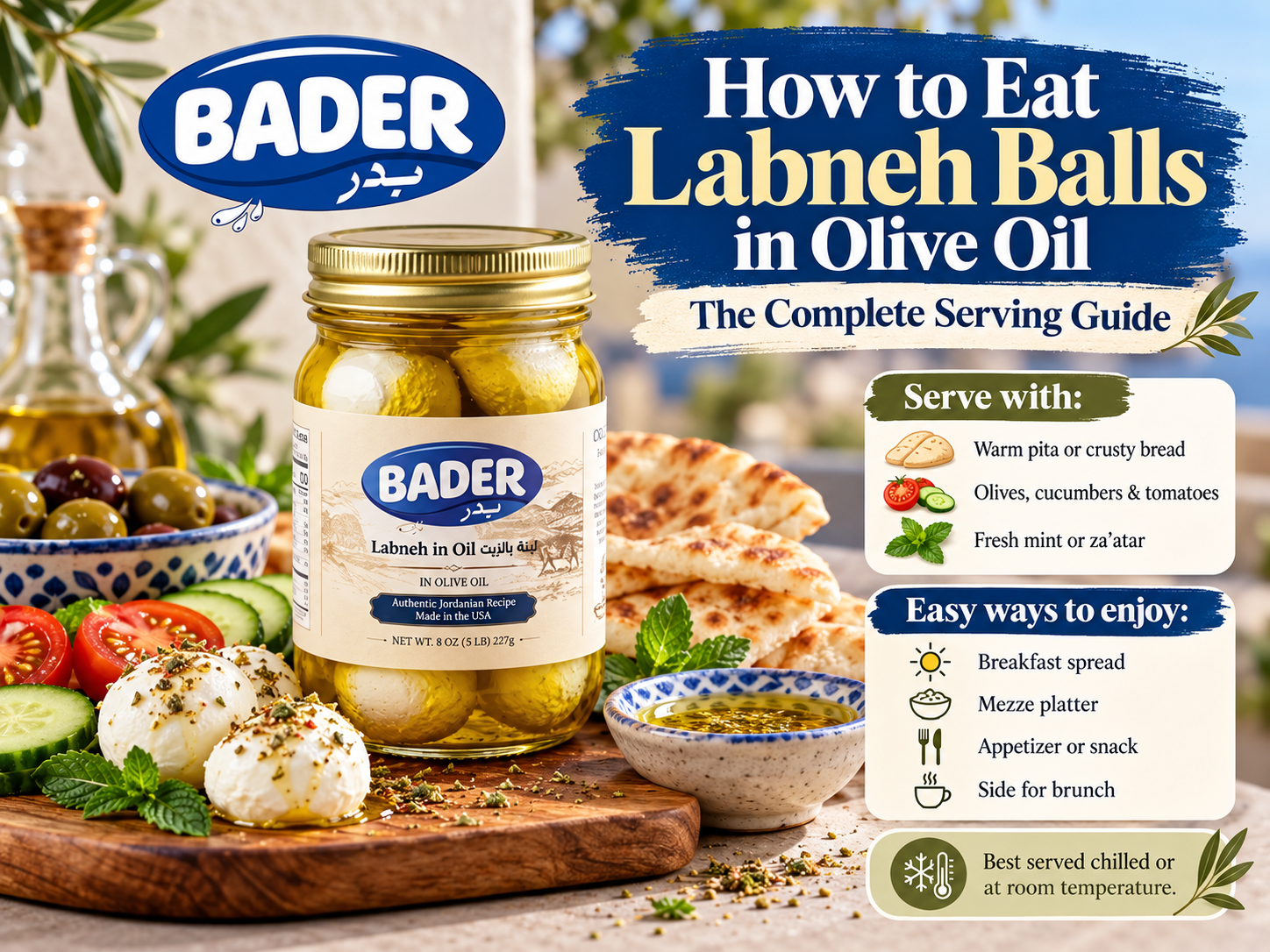
Quick answer: Labneh balls in olive oil are generally ready to eat directly from the jar. Remove a ball with a clean utensil, place it on warm flatbread or a serving plate, and enjoy it with olive oil, za’atar, olives, tomatoes, or fresh vegetables. They can also be spread on toast, crumbled over salads, and served as part of a traditional Middle Eastern mezze platter.
What Are Labneh Balls in Olive Oil?
Labneh balls are made from strained cultured dairy. Labneh begins as yogurt, which is strained to remove part of its whey, producing a thicker, creamier texture.
When labneh is strained sufficiently, it can become firm enough to shape into small balls.
These are sometimes called:
- Labneh balls
- Labneh in oil
- Labneh bil zeit
- Labaneh balls
- Labneh cheese balls
- Strained yogurt balls
- Middle Eastern yogurt balls
The terms can vary across different countries and transliterations.
In traditional Levantine cooking, the shaped labneh may be packed in olive oil and served with bread, vegetables, and seasonings.
The flavor is usually tangy and creamy, with richness from the surrounding oil.
Unlike an aged hard cheese, labneh remains a cultured dairy product with a soft interior. The exact firmness depends on how much moisture has been removed.
What is labneh bil zeit?
Labneh bil zeit is an Arabic expression commonly used for labneh in oil.
The preparation is associated with traditional food cultures across Jordan, Palestine, Lebanon, Syria, and other parts of the Levant.
It combines two important ingredients in regional cooking: strained cultured dairy and olive oil.
The finished product can be served at breakfast, lunch, or dinner, and it is especially convenient for assembling a mezze spread without extensive cooking.
At Bader Dairy, our Labneh in Oil is made into individual balls by hand and packed in olive oil. Each 8 oz glass jar brings this traditional preparation to the American table.
How Do You Eat Labneh Balls From a Jar?
You do not need an elaborate recipe to enjoy labneh balls.
In fact, one of their biggest advantages is how little preparation they require.
Step 1: Open the jar
Make sure the product has been stored according to the package directions.
For refrigerated products like Bader Dairy Labneh in Oil, keep the jar refrigerated until you’re ready to serve.
Step 2: Remove a labneh ball
Use a clean, dry spoon or other clean serving utensil to lift a ball from the jar.
Avoid putting a utensil that has touched bread, vegetables, or other foods directly back into the container.
Step 3: Place it on bread or a plate
Labneh balls can be served whole or gently pressed into a spread.
If you prefer a spreadable texture, press one onto warm pita bread using the back of a spoon.
The labneh softens as it spreads, creating a creamy layer.
Step 4: Add toppings
Depending on your preferences, add:
- Za’atar
- Olive oil
- Fresh mint
- Black pepper
- Chopped parsley
- Sliced tomatoes
- Cucumber
- Olives
You don’t need all of these ingredients.
A labneh ball, a little olive oil, and warm bread are enough to make a satisfying traditional snack.
Step 5: Serve and enjoy
Eat the prepared labneh immediately.
If you’re preparing food for a group, remove only the quantity needed and return the remaining jar to the refrigerator promptly.
15 Delicious Ways to Eat Labneh Balls
Labneh balls aren’t limited to the traditional breakfast table.
Their creamy texture, tangy flavor, and convenient size make them useful in many dishes.
Here are 15 practical serving ideas.
1. Spread labneh balls on warm pita bread
This is the most traditional and straightforward approach.
Warm a piece of pita bread, remove a labneh ball from the jar, and press it gently onto the bread.
Add a little za’atar or fresh mint.
The warm bread contrasts with the cool, creamy labneh.
Best for: Breakfast, light lunches, or a quick snack.
2. Serve with olive oil and za’atar
Place two or three labneh balls on a shallow plate.
Drizzle with a small amount of olive oil and sprinkle with za’atar.
Serve with pita wedges.
Za’atar adds herbal, nutty, and sometimes tangy notes, depending on the blend.
Best for: A traditional Middle Eastern appetizer.
3. Add to a mezze platter
Labneh balls are an excellent addition to a shared appetizer board.
Arrange them alongside hummus, olives, sliced vegetables, fresh herbs, and warm bread.
Their tanginess complements the other ingredients and provides a creamy element.
Best for: Gatherings, holidays, and entertaining guests.
4. Make a Middle Eastern breakfast sandwich
Spread a labneh ball onto fresh flatbread.
Add cucumber, tomato, mint, and olives.
Roll or fold the bread into a sandwich.
This creates an easy breakfast without cooking.
Best for: Busy mornings and packed lunches, provided the sandwich is kept appropriately chilled.
5. Crumble over a Mediterranean salad
Labneh balls can be broken into smaller pieces and placed on top of a salad.
Try them with:
- Cucumbers
- Tomatoes
- Romaine lettuce
- Red onion
- Parsley
- Olive oil
- Lemon juice
Their creamy texture adds richness to fresh vegetables.
Best for: Lunch or a light dinner.
6. Serve with roasted vegetables
Roasted eggplant, zucchini, carrots, and peppers all pair well with tangy dairy.
Place the cooked vegetables on a platter and allow them to cool slightly.
Add pieces of labneh and garnish with herbs.
The combination of warm vegetables and cool labneh creates a satisfying contrast.
Best for: Vegetable side dishes and meat-free meals.
7. Use as a topping for baked potatoes
Instead of sour cream, gently break a labneh ball over a warm baked potato.
Add chives, black pepper, or fresh parsley.
The tanginess balances the potato’s mild flavor.
Best for: Everyday dinners.
8. Create a cucumber and labneh snack
Slice fresh cucumbers into thick rounds.
Top each round with a small piece of labneh.
Finish with mint or za’atar.
This creates a simple, no-cook appetizer.
Best for: Parties or afternoon snacks.
9. Add to a grilled chicken plate
Serve a labneh ball alongside grilled chicken, rice, and vegetables.
The cool, creamy labneh complements the warm, savory meal.
You can spread it onto the chicken or enjoy it with bread between bites.
Best for: Family lunches and dinners.
10. Make labneh toast
Toast a slice of sourdough or another sturdy bread.
Spread a labneh ball over the surface.
Add sliced tomatoes, extra-virgin olive oil, and za’atar.
For a variation, try fresh herbs or a small drizzle of honey.
Best for: Breakfast or brunch.
11. Pair with warm olives and herbs
Arrange labneh balls on a serving plate with a selection of olives.
Add fresh mint or parsley.
Serve with warm flatbread.
This simple combination highlights the contrast between salty olives and creamy labneh.
Best for: Traditional entertaining.
12. Add to a grain bowl
Prepare a bowl using cooked bulgur, quinoa, or rice.
Add roasted vegetables, chopped herbs, and a labneh ball.
Break the labneh into the grains just before eating.
It provides a creamy element without requiring a separate sauce.
Best for: Meal preparation and lunches.
13. Serve with eggs
A labneh ball can accompany scrambled eggs, boiled eggs, or a vegetable omelet.
Spread it on bread or serve it separately with sliced tomatoes.
This is particularly appealing for people who enjoy savory breakfasts.
Best for: Weekend breakfasts.
14. Make a quick labneh dip
Place two labneh balls in a bowl.
Mash them with a spoon and add a small amount of olive oil until the texture becomes spreadable.
Sprinkle with herbs and serve with vegetables or pita chips.
This is an easy way to turn a jarred product into an appetizer.
Best for: Informal gatherings.
15. Finish a traditional Middle Eastern dinner
Serve labneh balls alongside rice, grilled meat, flatbread, and a vegetable salad.
Rather than mixing them into a hot pot, let each person add labneh to their plate.
The cool dairy flavor provides contrast to warm savory dishes.
Best for: Traditional family dinners.
What Goes Well With Labneh Balls?
One of the easiest ways to build a meal around labneh is to think about complementary flavors.
Labneh is creamy and tangy, so it works especially well with foods that are salty, herbal, crisp, roasted, or mildly sweet.
| Food | Why it works with labneh |
|---|---|
| Pita and flatbread | Provides a simple base for spreading |
| Za’atar | Adds herbal and tangy seasoning |
| Olive oil | Complements the creamy texture |
| Tomatoes | Adds freshness and acidity |
| Cucumbers | Provides a cool, crisp contrast |
| Olives | Balances the dairy with salty flavor |
| Mint and parsley | Adds fresh herbal notes |
| Roasted eggplant | Offers soft texture and savory depth |
| Honey | Creates a sweet-and-tangy combination |
| Grilled chicken | Pairs cool dairy with savory protein |
| Roasted peppers | Adds sweetness and a lightly smoky flavor |
| Bulgur and rice | Makes grain-based meals more flavorful |
For a traditional Jordanian table, start with bread, olives, tomatoes, cucumbers, and herbs.
For something more modern, try labneh toast, grain bowls, or roasted vegetable platters.
How to Make a Labneh Mezze Platter
A mezze platter is one of the most attractive ways to serve labneh balls to guests.
Mezze refers to a collection of small dishes commonly served throughout the Middle East and eastern Mediterranean.
You can build a beautiful platter without spending hours preparing food.
Ingredients for a simple platter
For approximately four people as an appetizer:
- 4–6 labneh balls
- 2–3 pieces of pita bread, cut into triangles
- 1 cucumber, sliced
- 2 tomatoes, cut into wedges
- ½ cup olives
- A small bowl of hummus
- Fresh mint or parsley
- 1–2 teaspoons za’atar
- Extra olive oil, if desired
Adjust the quantities according to your guests and other dishes.
Assembly instructions
- Place the labneh balls in a small serving bowl.
- Arrange the pita bread around the platter.
- Add cucumbers and tomatoes in separate groups.
- Fill a small bowl with olives.
- Add hummus.
- Garnish with fresh herbs.
- Sprinkle za’atar over the labneh just before serving.
The result is colorful, inviting, and easy for guests to share.
You can prepare the vegetables ahead of time and refrigerate them until serving. Keep the labneh chilled until you’re ready to assemble the platter.
Should You Eat Labneh Balls Cold or at Room Temperature?
Labneh balls are typically enjoyed cool or slightly tempered, depending on personal preference and the manufacturer’s directions.
For Bader Dairy’s product, refrigeration at 40°F (4°C) or below is required.
You can remove the amount you intend to eat, serve it, and return the remaining jar to refrigeration.
Avoid leaving perishable dairy on a table for an extended period.
General food safety guidance recommends refrigerating perishable foods within two hours, or within one hour when temperatures exceed 90°F (32°C).
Can you heat labneh balls?
You can use labneh in dishes served warm, but heating may change its texture.
Unlike a firm grilling cheese, labneh is a cultured dairy spread.
High heat can cause it to release moisture or separate.
For best results, add labneh to cooked food shortly before serving rather than cooking it aggressively.
For example, spoon a little labneh onto roasted vegetables after they leave the oven.
This preserves the contrast between warm vegetables and cool, creamy dairy.
Can You Use the Olive Oil From the Jar?
The oil surrounding labneh is part of the product’s traditional presentation.
If the oil remains wholesome and has been handled and refrigerated according to the product instructions, it can be used as a finishing ingredient.
For example, you can drizzle a small amount over:
- Warm flatbread
- A plate of labneh
- Tomato and cucumber salad
- Roasted vegetables
The oil may carry some of the flavor of the cultured dairy and any ingredients present in the jar.
However, do not assume oil taken from a dairy product is safe for extended room-temperature storage.
Treat it as part of the refrigerated product, follow the package directions, and discard it if you have concerns about contamination or spoilage.
How Do You Store Labneh Balls in Olive Oil After Opening?
Proper storage is important because labneh is a perishable dairy product.
Although olive oil is traditionally used in this preparation, oil alone does not make labneh shelf-stable.
Follow these storage practices
Keep the jar refrigerated. Bader Dairy instructs customers to store Labneh in Oil at 40°F (4°C) or below.
Keep the container sealed. Close the lid tightly after each use.
Keep the labneh covered with oil. Follow the product’s instructions for keeping the remaining labneh submerged.
Use clean utensils. Avoid introducing crumbs, moisture, or other foods into the jar.
Follow the printed date. Use the manufacturer’s date and any instructions about handling after opening.
Return it to the refrigerator promptly. Do not leave the opened jar on the breakfast table throughout the day.
How long do labneh balls last after opening?
There is no universally safe number of days for every brand.
Shelf life varies according to how the product is manufactured, packaged, refrigerated, and handled.
Use the specific product’s labeling and any after-opening directions provided by the manufacturer.
If that information is unclear, contact the producer rather than assuming the product will remain safe for a particular number of weeks.
Can you freeze labneh balls?
Freezing may change the texture of cultured dairy.
After thawing, labneh can become less smooth or release liquid.
Unless the manufacturer provides freezing instructions, refrigeration according to the package is generally the better way to preserve its intended texture.
Are Labneh Balls the Same as Fresh Labneh?
Both begin with strained cultured dairy, but their textures and presentations are different.
Fresh labneh is usually thick and spreadable.
Labneh balls are typically strained further so they can be shaped and handled individually.
The balls are often packed in olive oil and served as distinct pieces.
Fresh labneh, by comparison, is commonly spooned into a bowl, spread onto bread, or used as a creamy accompaniment.
At Bader Dairy, we offer both varieties:
- Fresh Labneh — a thick, creamy strained yogurt spread.
- Labneh in Oil — hand-rolled labneh balls packed in olive oil.
Each suits a slightly different serving style.
If you enjoy assembling appetizer platters and quick snacks, labneh balls are particularly convenient.
If you want a versatile dairy spread for dips, breakfasts, and sauces, fresh labneh may be more suitable.
Common Mistakes When Serving Labneh Balls
Mistake #1: Treating them like hard cheese
Labneh balls may look like small pieces of cheese, but they have a creamy cultured-dairy texture.
Handle them gently and avoid expecting the same grilling performance as halloumi or other firm cheeses.
Mistake #2: Adding too many strong toppings
Labneh already has a distinctive tang.
Start with a few complementary ingredients rather than covering it with several sauces and seasonings.
Olive oil, za’atar, and fresh vegetables are often enough.
Mistake #3: Leaving the jar unrefrigerated
The olive oil does not remove the need for proper cold storage.
Keep Bader Dairy Labneh in Oil refrigerated according to its label.
Mistake #4: Using contaminated utensils
A spoon that has touched other foods can introduce unwanted microorganisms into the jar.
Always use a clean serving utensil.
Mistake #5: Thinking labneh is only for breakfast
Traditional breakfast is one of its most familiar uses, but labneh also works in lunches, appetizers, side dishes, and evening meals.
Experiment with salads, grain bowls, roasted vegetables, and sandwiches.
The Place of Labneh in Jordanian Food Culture
Labneh has a long history in the culinary traditions of Jordan and the wider Levant.
Straining cultured dairy is a practical technique that changes the texture of yogurt and concentrates its flavor.
Different households have developed their own approaches to preparing, seasoning, and serving labneh.
For many Jordanian families, labneh is part of the breakfast table alongside warm bread, olives, vegetables, cheese, and tea.
Labneh balls in olive oil provide another way to serve this familiar ingredient.
They are convenient for shared meals, mezze platters, and gatherings where several small dishes are placed in the center of the table.
The appeal is not simply the ingredient itself.
It’s the way labneh fits into everyday hospitality, allowing guests and family members to share food without elaborate preparation.
At Bader Dairy, we continue these traditions in Worth, Illinois.
Our dairy products are produced and packaged at our own facility, using traditional Jordanian recipes and milk sourced from Illinois farms.
Our labneh balls are rolled individually by hand and packed in olive oil.
You can learn more about our production philosophy and family heritage on our Our Story page.
Frequently Asked Questions About Labneh Balls
Can you eat labneh balls straight from the jar?
Yes, when they are sold as ready-to-eat products and have been properly stored. Use a clean utensil to remove the portion you want.
What do labneh balls taste like?
They generally have a creamy, tangy cultured-dairy flavor. Olive oil adds richness, while additional seasonings can change the flavor.
What is the best bread to eat with labneh balls?
Pita, shrak, markook, and other flatbreads work particularly well. Toasted sourdough is another option.
Do you need to cook labneh balls?
No. They are commonly served without cooking.
Are labneh balls made from yogurt?
Yes. They are traditionally made from strained cultured yogurt that has become thick enough to shape.
What does labneh bil zeit mean?
It means labneh in oil, typically referring to shaped or packed labneh served in olive oil.
Are labneh balls vegetarian?
Many labneh products are suitable for lacto-vegetarian diets, but ingredients vary. Always verify the specific product’s label and preparation details.
Are labneh balls dairy-free?
No. Labneh is a dairy product made from cultured milk.
Do labneh balls contain probiotics?
Cultured labneh may contain live microorganisms, but the amount and types vary. The presence of live cultures does not automatically establish a clinically proven probiotic benefit.
Is labneh a cheese or yogurt?
Labneh is traditionally made by straining yogurt. Its thick texture makes it similar to a soft cheese, which is why it is sometimes described as yogurt cheese.
Do labneh balls need to be refrigerated?
Follow the product label. Bader Dairy’s Labneh in Oil requires refrigeration at 40°F (4°C) or below.
Can you use labneh balls in salads?
Yes. They can be broken into small pieces and added to vegetable salads, grain bowls, or roasted vegetable dishes.
What can I serve with labneh balls for guests?
Try a mezze platter with warm pita, olives, tomatoes, cucumbers, hummus, za’atar, and fresh herbs.
Where can I find traditional labneh balls in Illinois?
Bader Dairy produces Labneh in Oil at its facility in Worth, Illinois. Contact the company or visit its product inquiry page to ask about availability.
Discover Hand-Rolled Labneh in Olive Oil From Bader Dairy
Labneh balls offer a simple way to enjoy traditional Middle Eastern dairy without complicated preparation.
Whether you’re serving breakfast for your family, assembling a mezze platter, preparing an easy lunch, or introducing guests to Jordanian food traditions, labneh can be a versatile addition to the table.
At Bader Dairy, our Labneh in Oil is hand-rolled and packed in olive oil at our production facility in Worth, Illinois.
Explore Bader Dairy’s labneh products:
Labneh in Oil — Hand-Rolled Labneh Balls
Fresh Labneh — Traditional Strained Yogurt Spread
Looking to purchase Bader Dairy products?
Visit our Where to Find Bader page to inquire about availability.
Interested in wholesale distribution?
Grocery stores, specialty markets, restaurants, and distributors can contact Bader Dairy through our Wholesale Inquiry page.
Bader Dairy
6903 W 111th St, Worth, IL 60482
Phone: (708) 827-5174
Visit Bader Dairy
Traditional Jordanian dairy, made in Illinois.