By Bader Dairy | Traditional Jordanian Dairy Producers in Worth, Illinois
Published: October 26, 2026
Reading Time: Approximately 10 minutes
Category: Our Products
You open a jar of ghee expecting a smooth, golden cooking fat, but instead you notice tiny grains, crystals, or a mixture of solid and liquid layers.
Maybe the ghee was smooth when you first purchased it. A few weeks later, it looks grainy. Or perhaps the jar develops a pale, firm layer underneath a clearer golden liquid.
Does that mean the ghee has spoiled? Was it manufactured incorrectly? Can you still cook with it?
In many cases, these changes are completely normal.
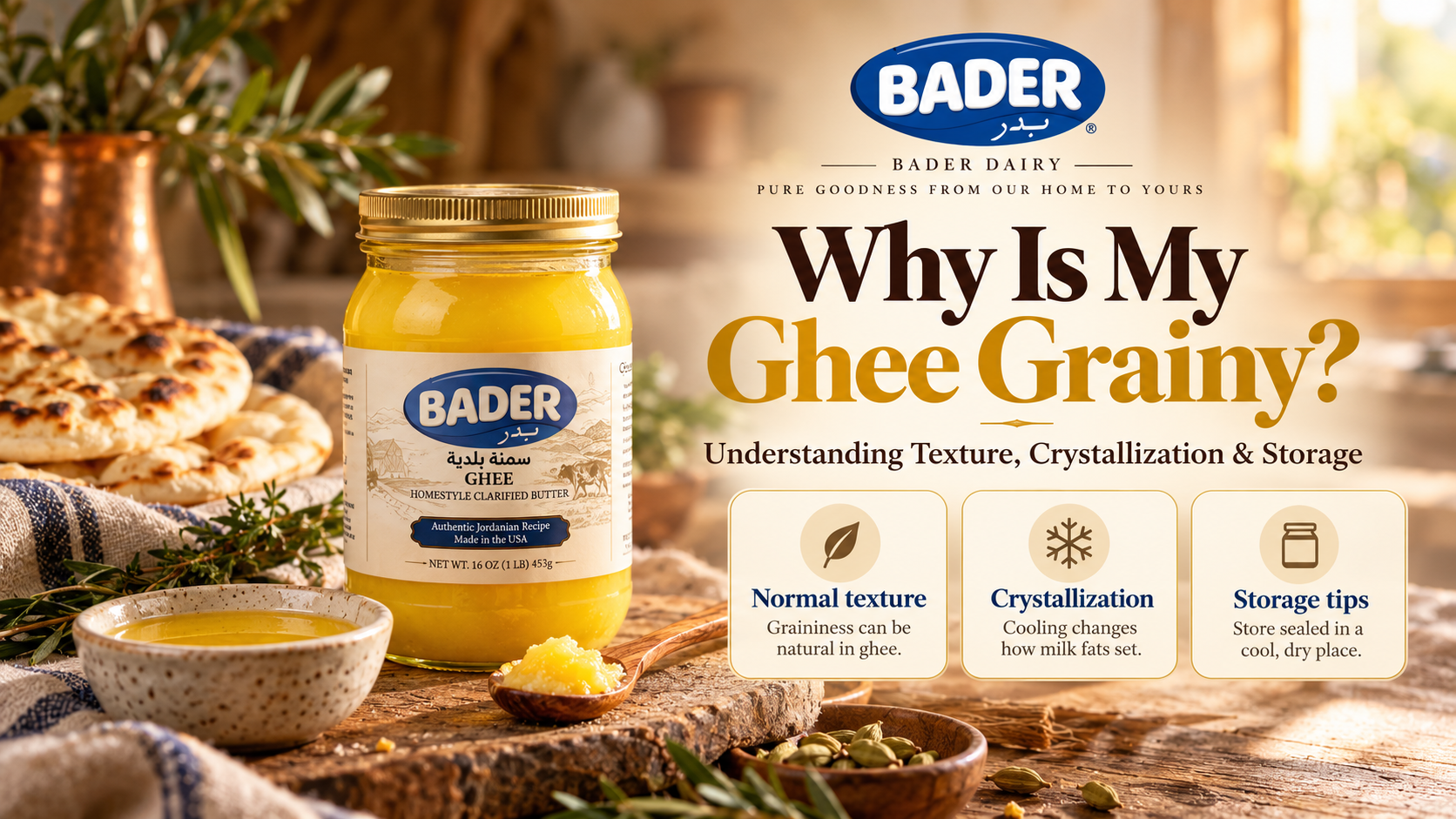
Ghee becomes grainy because different components of milkfat crystallize as the temperature changes. Ghee contains a mixture of fats with different melting points. As it cools, some of those fats solidify into small crystals while others remain liquid. This creates the grainy, granular, or layered appearance you may notice in a jar.
Graininess alone does not mean ghee has spoiled, and it does not automatically indicate poor quality.
However, texture changes should always be considered alongside the product’s storage history, packaging, odor, and condition.
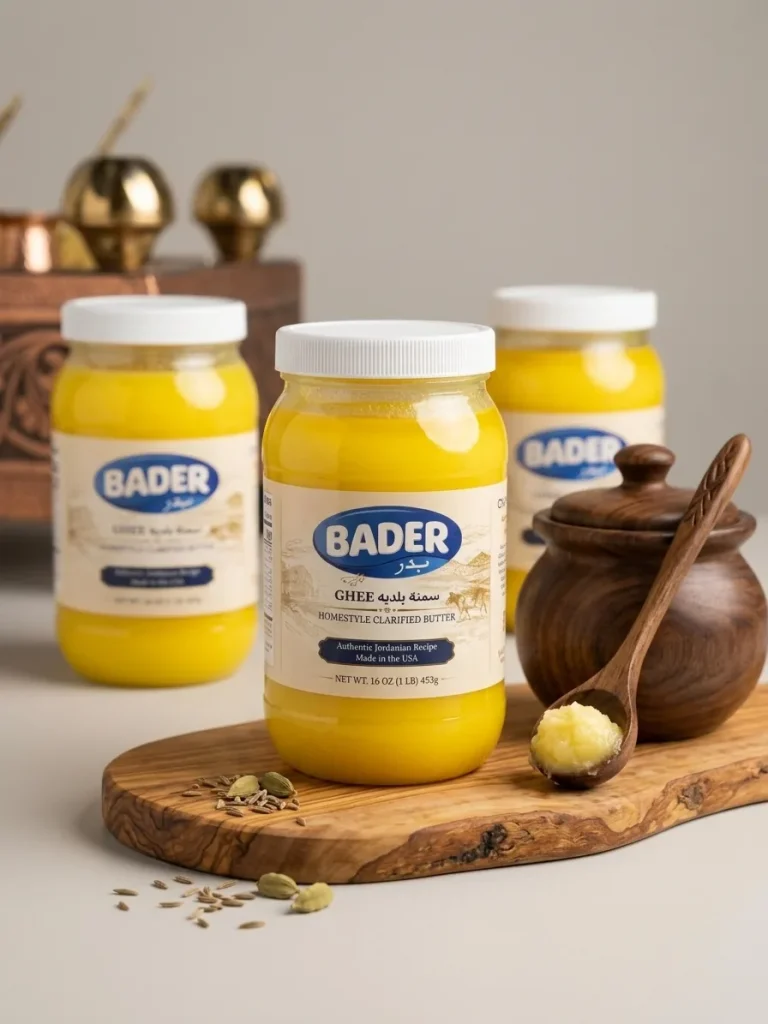
At Bader Dairy, we produce traditional Jordanian cow ghee and sheep ghee, known as samneh baladi. Understanding the science behind ghee’s texture can help you use it confidently and recognize the difference between normal crystallization and potential quality problems.
Is Grainy Ghee Normal?
Yes. A grainy texture can be a completely normal characteristic of ghee.
In fact, granularity is a recognized physical property of traditional ghee and has been studied extensively in dairy science.
Ghee is not a single uniform fat with one melting temperature.
It contains many different triglycerides, which are molecules formed from glycerol and fatty acids.
These triglycerides do not all solidify at the same temperature.
When ghee cools, some begin forming crystals before others.
The crystals can grow, cluster together, and create the small grains visible in the finished product.
What does normal grainy ghee look like?
Normal crystallization may produce:
- Small golden or pale-yellow grains
- A slightly sandy-looking surface
- A soft, granular consistency
- Firmer material near the bottom of the jar
- Clearer liquid above a solid layer
- Different textures at different temperatures
The appearance depends on the milkfat composition and the product’s temperature history.
A jar that looks grainy today may become more liquid when stored in a warmer environment.
This does not necessarily represent a permanent change.
Why Does Ghee Become Grainy? The Science Explained
The main reason is milkfat crystallization.
Milkfat contains a complex mixture of triglycerides, each with different physical characteristics.
Some remain liquid at temperatures where others have already solidified.
This creates a mixture of solid and liquid fat.
1. Different fats have different melting points
Ghee contains triglycerides with a range of melting temperatures.
As the temperature falls, higher-melting components begin crystallizing.
Lower-melting components may remain liquid.
This creates the physical conditions that produce granularity.
2. Fat crystals begin forming
When suitable conditions develop, fat molecules organize into crystalline structures.
This initial process is called nucleation.
Once crystals begin forming, additional fat molecules may join them.
3. Crystals grow into visible grains
Some crystals remain extremely small.
Others grow large enough to create a visibly granular appearance.
The size and distribution of these crystals influence the texture.
4. Temperature changes alter the structure
When ghee warms, some crystals melt.
When it cools, they may form again.
The cooling rate and storage conditions influence the resulting texture.
This explains why two jars of the same ghee may look different after being stored in different kitchens.
Grainy Ghee vs. Spoiled Ghee: How to Tell the Difference
One of the most important things to understand is that graininess is a physical texture characteristic, not proof of freshness or spoilage.
However, this doesn’t mean every grainy jar is safe to consume.
A product’s condition and handling history still matter.
| What you notice | Possible explanation | Recommended action |
|---|---|---|
| Fine, pale grains | Normal fat crystallization | Usually a normal texture change |
| Firm bottom and liquid top | Different milkfat fractions separating | Check label and storage history |
| Ghee becoming solid in cool conditions | Fat crystallization | Generally expected |
| Liquid ghee becoming grainy after cooling | Recrystallization | Generally expected |
| Unusual rancid odor | Possible fat oxidation | Do not consume |
| Visible mold or foreign growth | Possible contamination | Discard |
| Damaged or leaking packaging | Possible product integrity problem | Contact the manufacturer |
| Unexpected severe changes | Possible quality or storage issue | Follow manufacturer guidance |
Important: Neither appearance nor smell can guarantee food safety. Never taste a product merely to determine whether it has spoiled.
If ghee has been stored contrary to its label or shows signs of contamination, do not assume that melting it will make it safe.
Why Does Ghee Separate Into Solid and Liquid Layers?
Sometimes ghee does not become uniformly grainy.
Instead, you may notice a clearer liquid layer sitting above a firmer, more opaque layer.
This happens because milkfat contains different fractions with different melting and crystallization properties.
At certain temperatures, some fats remain liquid while others solidify.
As these fractions organize during storage, visible layers may develop.
Is separated ghee bad?
Not necessarily.
Separation can be a normal physical change.
However, the product should still be within its appropriate storage period and handled according to the package.
Can you mix the layers together?
If the product is otherwise suitable to use, you can generally stir the different fat layers together using a clean, dry utensil.
The texture may remain somewhat uneven depending on temperature.
For cooking, this usually matters less because the ghee melts when heated.
Should you throw away the liquid layer?
No, not simply because it is liquid.
The clearer layer may consist of a lower-melting portion of the same milkfat.
Discarding it would change the composition of the remaining product.
Follow the manufacturer’s guidance if the separation looks unusual.
Why Does Ghee Turn White or Pale Yellow?
Color changes can also occur when ghee solidifies.
Liquid ghee may look transparent and golden.
As fat crystals form, they scatter light.
This can make the ghee appear more opaque, creamy, or pale yellow.
A change from clear golden liquid to pale, semi-solid ghee may therefore be caused by temperature rather than spoilage.
Does white ghee mean it’s fake?
No.
Color alone cannot establish whether ghee is authentic, pure, or adulterated.
Appearance varies depending on the milk source, processing, and physical state.
The more reliable approach is to purchase products from a producer that provides accurate ingredient information and appropriate product documentation.
Does cow ghee have a different color from sheep ghee?
It can.
Milk source influences the composition and appearance of dairy fat.
However, the finished color also depends on processing, temperature, and formulation.
There is no single shade that proves a jar contains cow ghee or sheep ghee.
To learn how the two products differ, explore our article on Cow Ghee vs. Sheep Ghee and the individual product pages for Cow Ghee and Sheep Ghee.
Does Temperature Affect Ghee Texture?
Temperature is one of the most important influences on ghee consistency.
When ghee becomes warmer, more of its fat components melt.
When it cools, some components solidify.
This can create changes even when the product remains in the same sealed container.
In a cool kitchen
Ghee may become firmer and more opaque.
Depending on the milkfat composition, it may develop a fine-grained texture.
In a warm kitchen
Ghee may soften or become mostly liquid.
If it contains different fat fractions, some material may remain solid longer than others.
During temperature fluctuations
Repeated warming and cooling can change crystal size and distribution.
The ghee may look different each time it solidifies.
What temperature should ghee be stored at?
There is no single storage temperature appropriate for every commercially packaged ghee product.
Follow the instructions printed on the actual container.
Bader Dairy’s Cow Ghee product information recommends keeping the container tightly sealed in a cool, dry place away from direct sunlight and excessive heat, with refrigeration optional unless the package states otherwise.
These directions should take priority over general suggestions found online.
How to Make Grainy Ghee Smooth Again
If your ghee has developed normal crystallization and is otherwise safe to use, gentle warming can help melt the crystals.
However, you do not need to make ghee perfectly smooth before cooking with it.
Method 1: Allow normal melting during cooking
This is the simplest option.
- Remove the amount of ghee needed using a clean, dry spoon.
- Place it in a suitable saucepan or skillet.
- Heat gently according to the recipe.
- Allow it to melt.
- Continue preparing the food.
For most cooking applications, graininess disappears naturally as the fat melts.
Best for: Rice, sautéing, and traditional recipes.
Method 2: Gently warm a measured portion
If you want liquid ghee for drizzling, you can warm a small portion separately.
- Transfer the desired amount into a clean, heat-safe container.
- Warm gently over low heat.
- Stir carefully until the fat becomes liquid.
- Use immediately as intended.
Avoid overheating or allowing the ghee to smoke.
Best for: Drizzling over cooked rice or warm bread.
Method 3: Stir normally separated ghee
If the ghee has distinct solid and liquid regions, gentle stirring may redistribute them.
Use a clean, dry utensil.
The mixture may not become completely uniform until the solid fractions melt.
Best for: Minor physical separation in otherwise properly stored ghee.
Should you microwave the entire jar?
Do not automatically microwave the original product container.
Packaging may not be microwave-safe, and uneven heating can create hot spots.
It is generally more controlled to warm only the quantity needed in cookware designed for heating.
Can You Prevent Ghee From Becoming Grainy?
You can influence texture by limiting unnecessary temperature fluctuations, but crystallization is part of the natural physical behavior of milkfat.
A completely smooth appearance at every temperature is not a realistic expectation for all ghee products.
Follow the product’s storage directions
Keep ghee under the conditions specified by its manufacturer.
Do not expose it to unnecessary heat or direct sunlight.
Keep the container sealed
Closing the lid limits exposure to air and contamination.
Use clean, dry utensils
Introducing moisture or food particles can affect the product and create contamination risks.
Avoid repeatedly heating the entire jar
Remove only what you need for cooking.
Repeatedly heating and cooling the complete container can change its physical texture.
Don’t judge quality by appearance alone
A smooth jar is not automatically better than a grainy one.
Some traditional ghee preparations naturally produce granularity.
Does Grainy Ghee Taste Different?
Granularity primarily affects texture, not necessarily the flavor of the melted fat.
When ghee is warmed and its crystals melt, the difference between grainy and smooth portions may become less noticeable.
However, temperature and processing can also influence aroma and flavor development.
Some ghee products are naturally more aromatic than others.
What gives ghee its distinctive flavor?
Ghee flavor depends on:
- Milk source
- Milkfat composition
- Preparation method
- Heating conditions
- Traditional flavoring ingredients
- Storage and freshness
Traditional Jordanian samneh baladi may have a distinctive aroma that reflects its preparation.
For a broader explanation of the ingredient, read Why Jordanian Kitchens Cook With Samneh Baladi.
Cow Ghee and Sheep Ghee: Can Both Become Grainy?
Yes.
Both contain mixtures of milkfat components that can crystallize.
However, their precise fatty-acid and triglyceride compositions differ.
As a result, their melting and crystallization characteristics may not be identical.
Processing conditions also affect the finished texture.
It would be inaccurate to claim that cow ghee must always be smooth or sheep ghee must always be grainy.
What about traditional hand-prepared ghee?
Traditional methods may produce differences in crystal formation and consistency.
Heating, cooling, and storage conditions affect how crystals develop.
This is one reason texture can vary between batches and producers.
At Bader Dairy, our traditional cow and sheep ghee are part of a larger collection of Jordanian dairy products produced and packaged in Worth, Illinois.
Learn about the full collection in our Traditional Jordanian Dairy Guide.
Can You Cook With Grainy Ghee?
Yes, provided the product has been stored appropriately and is otherwise safe.
For most cooked dishes, graininess is not a major concern.
When the ghee is heated, its fat crystals melt.
This allows it to function as a cooking fat.
Cooking rice with grainy ghee
Add a measured spoonful to a pot over moderate heat.
Allow it to melt, then proceed with your rice recipe.
Alternatively, stir melted ghee through finished rice.
Toasting nuts
Ghee can be used to toast almonds or pine nuts.
Use moderate heat and watch the nuts carefully to prevent burning.
Cooking vegetables
Melt ghee in a pan and add vegetables according to the recipe.
The original crystal structure generally does not affect the final cooked dish once the fat has melted.
Finishing warm flatbread
A small quantity of melted ghee can be brushed onto warm bread.
This is an easy way to experience its traditional dairy flavor.
For more ideas, visit our Recipes & Inspiration collection.
Does Graininess Mean Ghee Is Pure?
No.
A grainy appearance cannot reliably establish that ghee is pure, authentic, or free from adulteration.
Crystal formation depends on multiple physical and chemical characteristics.
Food scientists can analyze fat composition using laboratory methods, but visual inspection is not a substitute for product testing.
Similarly, smooth ghee is not automatically fake.
Different products can have different textures without that difference proving anything about authenticity.
Consumers should instead consider reliable manufacturers, accurate labels, appropriate storage, and product documentation.
What Causes Ghee to Become Rancid?
Ghee can deteriorate through oxidation and other chemical changes.
Oxidation affects fats over time, particularly when they are exposed to unfavorable storage conditions.
Heat, light, oxygen exposure, and contamination can contribute to quality loss.
This process is different from ordinary fat crystallization.
Crystallization versus rancidity
Crystallization is a physical change involving the formation of solid fat structures.
Rancidity involves chemical deterioration that can create undesirable odors and flavors.
Melting grainy ghee may change its texture.
Melting rancid ghee does not restore its original quality.
How can you protect ghee’s quality?
- Follow the manufacturer’s storage instructions.
- Keep the container closed.
- Avoid unnecessary exposure to heat.
- Protect it from direct sunlight.
- Use clean, dry utensils.
- Observe the package date and handling instructions.
If the product has an unexpected rancid odor or other clear signs of deterioration, do not consume it.
Is Grainy Ghee Different From Grainy Butter?
Yes, although both are related to milkfat behavior.
Regular butter contains more water and nonfat milk components than ghee.
Its structure therefore depends on more than fat crystallization alone.
Ghee has much less moisture and is predominantly concentrated dairy fat.
This makes its crystal formation especially noticeable.
If you’re interested in how these ingredients behave differently, read our detailed Ghee vs. Butter vs. Clarified Butter Guide.
You can also explore What Is Goat Butter? to learn about another traditional dairy fat and how its cooking characteristics differ from clarified ghee.
Why Texture Matters in Traditional Jordanian Samneh
In Jordanian cooking, samneh baladi is appreciated primarily for its flavor and culinary role.
It may be used in rice, lamb dishes, vegetables, or traditional pastries.
The ghee’s texture inside the jar is only one physical characteristic.
What matters in the finished dish is how it melts, distributes, and contributes flavor.
Traditional dairy products can vary in appearance because of their milk source and production methods.
Understanding these differences helps consumers appreciate the ingredient without mistaking every texture change for a defect.
Bader Dairy continues Jordanian dairy traditions through its production facility in Worth, Illinois, using family recipes and locally sourced milk.
For more about our background, explore Our Story.
Frequently Asked Questions About Grainy Ghee
Why does ghee become grainy?
Ghee becomes grainy when certain milkfat components crystallize as the temperature changes.
Is grainy ghee safe to eat?
Graininess alone does not indicate spoilage. Safety depends on the product’s manufacturing, storage, condition, and handling.
Why is my ghee solid at the bottom and liquid on top?
Different milkfat fractions can solidify at different temperatures, creating visible layers.
Can I melt grainy ghee?
Yes. If the product is otherwise suitable to use, gentle heating will melt the fat crystals.
Is grainy ghee better than smooth ghee?
Not necessarily. Texture depends on milkfat composition, processing, and storage conditions. Neither appearance universally establishes quality.
Does refrigeration make ghee grainy?
Refrigeration changes the way milkfat crystallizes and can make ghee firmer. The exact texture depends on the product.
Why does ghee turn white?
Solid fat crystals scatter light, making ghee look paler and more opaque than when it is liquid.
Can sheep ghee become grainy?
Yes. Sheep ghee can also develop fat crystals and changes in texture.
Is separated ghee spoiled?
Not automatically. Layering can result from normal crystallization, but storage history and signs of deterioration still matter.
Should I stir my ghee?
If the product has normal separation and is otherwise safe, gentle stirring with a clean, dry utensil may redistribute the fat layers.
Can I use grainy ghee for rice?
Yes. Properly stored ghee generally melts during cooking, so its original granularity is usually not a problem.
Why does my ghee change texture in different seasons?
Seasonal temperature changes influence how much milkfat is solid or liquid.
Does grainy ghee contain impurities?
Not necessarily. Normal graininess is caused by fat crystals, not automatically by foreign material.
Can I prevent ghee from separating?
Maintaining appropriate, reasonably stable storage conditions can help limit some changes, but natural crystallization cannot always be prevented.
Where can I find traditional Jordanian ghee in Illinois?
Bader Dairy produces cow and sheep ghee in Worth, Illinois. Customers can inquire about availability through the company’s website.
Explore Traditional Jordanian Ghee From Bader Dairy
If your ghee develops small grains, becomes pale and solid, or separates into layers, the change may simply reflect the natural crystallization of milkfat.
Ghee contains different fat components that respond differently to temperature.
Understanding this process helps explain why the same jar can look liquid one day and grainy another.
For properly stored ghee, these physical changes do not necessarily affect its usefulness in cooking.
At Bader Dairy, we produce traditional Jordanian ghee as part of our specialty dairy collection.
Explore our ghee products:
For additional education, read:
Looking for Bader Dairy products?
Visit Where to Find Bader to ask about product availability.
Interested in carrying our ghee products?
Grocery stores, Middle Eastern markets, specialty retailers, restaurants, and distributors can contact us through our Wholesale Inquiry page.
Bader Dairy
6903 W 111th St, Worth, IL 60482
Phone: (708) 827-5174
Email: info@baderdairy.com
Website: baderdairy.com
Traditional Jordanian dairy, made in Illinois.