By Bader Dairy | Traditional Jordanian Dairy Producers in Worth, Illinois
Published: November 3, 2026
Reading Time: Approximately 12 minutes
Traditional Middle Eastern dairy products can do much more than complete a breakfast plate. In professional kitchens, ingredients such as labneh, Nabulsi cheese, ghee, and jameed can become the foundation for appetizers, signature entrées, side dishes, and desserts.
For restaurants serving Jordanian, Palestinian, Lebanese, Syrian, or broader Mediterranean cuisine, these ingredients may already be familiar. For other chefs, they provide opportunities to introduce distinctive flavors and cooking techniques without completely redesigning an existing menu.
But selecting ingredients for a restaurant involves more than taste.
Chefs need products that perform consistently during preparation. Purchasing managers need accurate specifications, dependable ordering arrangements, and predictable costs. Kitchen teams need to understand storage, allergens, food safety, and how each product behaves during service.
The most practical Middle Eastern dairy ingredients for restaurants include labneh for spreads and appetizers, Nabulsi cheese for frying and desserts, cow or sheep ghee for cooking and finishing, and jameed for traditional mansaf. Each has a different culinary function, and understanding those differences helps restaurants develop consistent dishes.
This guide explores how professional kitchens can use traditional Jordanian dairy products, choose the right ingredients for their menus, and evaluate sourcing options.
Which Middle Eastern Dairy Products Work Best in Restaurants?
Different dairy products serve different functions in a professional kitchen.
Some are ready-to-serve ingredients, while others require preparation before they can be incorporated into a dish.
| Product | Professional kitchen applications | Important consideration |
|---|---|---|
| Fresh Labneh | Mezze, dips, sandwiches, sauces, plated appetizers | Refrigerated handling and consistency |
| Labneh in Oil | Mezze platters, catering, appetizers | Refrigeration and portion control |
| Nabulsi Cheese | Fried cheese, breakfast, knafeh, savory pastries | Saltiness and heating behavior |
| Cow Ghee | Rice, vegetables, pastry preparation, finishing | Flavor and portion cost |
| Sheep Ghee | Mansaf, lamb, traditional rice | Distinctive aromatic profile |
| Jameed | Traditional mansaf sauce | Rehydration and sauce preparation |
| Cow Butter | Bread service, finishing, selected baked foods | Temperature and baking performance |
| Goat Butter | Specialty bread service, finishing, selected recipes | Flavor consistency and cost |
These are culinary applications rather than claims that every product is available in commercial-size packaging. Restaurant buyers should confirm current package sizes and wholesale arrangements directly with the supplier.
1. Fresh Labneh: A Versatile Ingredient for Restaurant Menus
Labneh is a thick cultured dairy product traditionally made by straining yogurt.
Its creamy texture and tangy flavor make it useful in both traditional and contemporary restaurant cooking.
Unlike a thin yogurt sauce, labneh can hold its shape on a plate, making it especially suitable for spreads, dips, and composed appetizers.
Traditional labneh appetizers
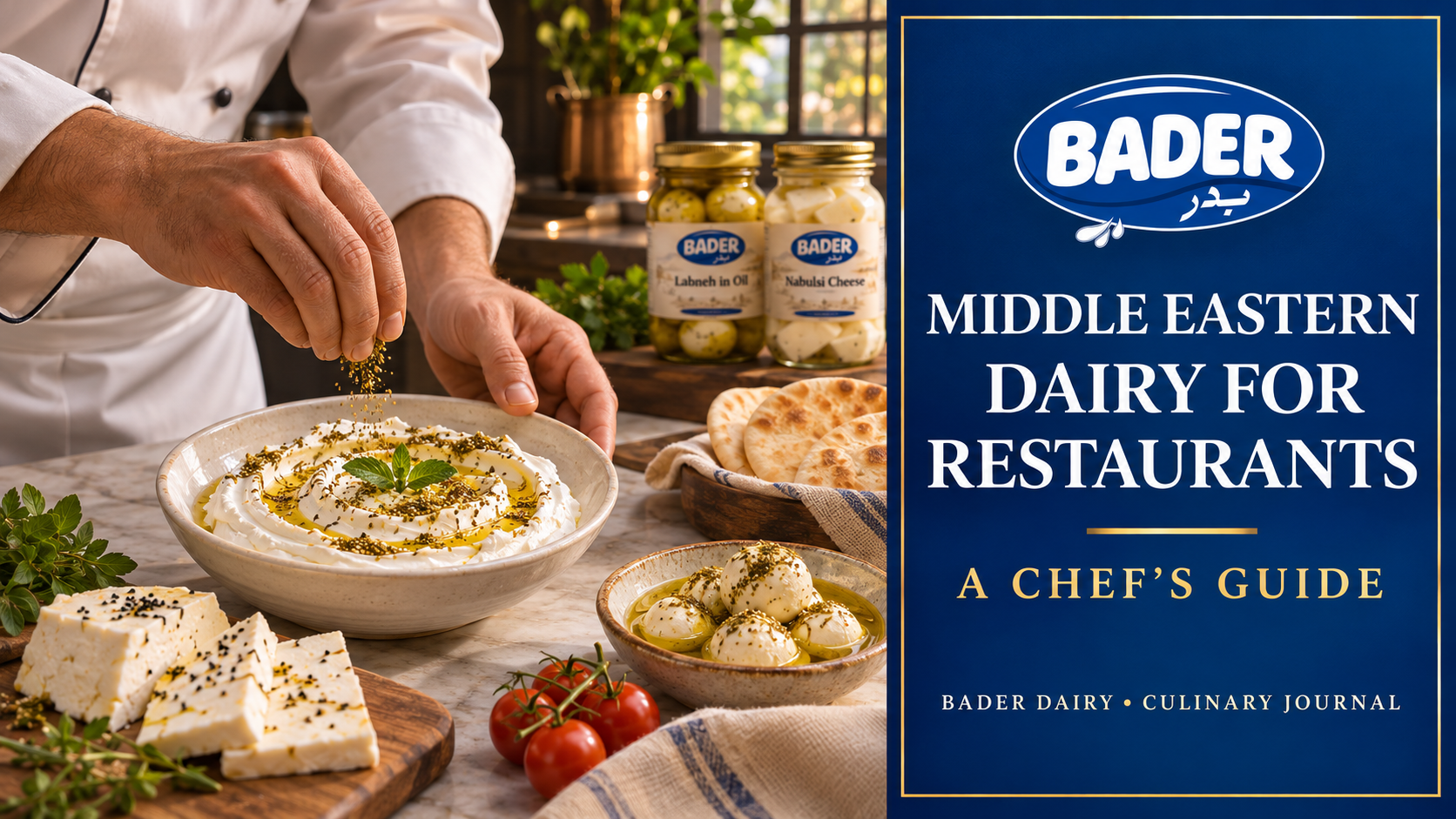
One of the simplest restaurant applications is a shallow plate of labneh finished with olive oil and za’atar.
The preparation requires relatively little cooking, but presentation matters.
A chef can spread labneh across a chilled plate, create a shallow well in the center, and finish with olive oil, herbs, or other appropriate seasonings.
Serve with warm pita or flatbread.
This works as an individual appetizer or a larger shared dish.
Labneh as a sandwich spread
Labneh can also be used in wraps and sandwiches.
Its tanginess complements grilled chicken, vegetables, fresh herbs, and flatbread.
For restaurant consistency, chefs should establish a standard portion and ensure the spread does not make bread excessively wet.
Labneh with roasted vegetables
Roasted eggplant, carrots, zucchini, and peppers can be served over or alongside chilled labneh.
The contrast between warm vegetables and cool dairy creates a simple plated dish with multiple textures.
Using labneh in sauces
Labneh can provide acidity and creaminess in certain sauces.
However, high heat may cause cultured dairy to separate.
For many dishes, adding labneh as a finishing ingredient is more predictable than boiling it directly in a pan.
What should chefs evaluate?
Before introducing labneh, test its thickness, flavor, portion consistency, and performance during service.
A product suitable for spreading may not behave identically when mixed into a dressing.
Bader Dairy produces Fresh Labneh using traditional Jordanian dairy preparation methods.
For more information about the ingredient and its production, read our Traditional Jordanian Dairy Guide.
2. Labneh in Oil: A Convenient Option for Mezze and Catering
Labneh balls in olive oil offer a different texture and presentation from ordinary fresh labneh.
The cultured dairy is concentrated until firm enough to shape into individual balls, which are then packed in oil.
For restaurants, this format can create attractive appetizer presentations.
Mezze platters
Labneh balls can be served alongside olives, fresh vegetables, hummus, and warm flatbread.
For a shared appetizer, arrange the components so diners can sample different flavors and textures.
The labneh adds a tangy, creamy element to the platter.
Catering and banquet service
For catering menus, labneh balls can be incorporated into individually portioned appetizer plates or chilled mezze displays.
However, caterers must maintain appropriate refrigeration and time-temperature controls during transportation, preparation, and service.
The surrounding olive oil does not automatically make the product shelf-stable.
Salad applications
Labneh balls may be broken into smaller pieces and added to salads.
They can provide a creamy dairy component without requiring a separate dressing.
Try them with cucumber, tomatoes, parsley, and other suitable ingredients.
Foodservice considerations
Chefs should evaluate the number of usable servings per jar, portion size, oil handling, refrigerated storage requirements, and how the labneh performs once removed from its packaging.
Bader Dairy offers Labneh in Oil as hand-rolled labneh balls packed in olive oil.
3. Nabulsi Cheese: A Specialty Cheese for Savory and Sweet Menus
Nabulsi cheese is a traditional white-brined cheese originating in Nablus, Palestine.
It is widely used throughout Jordan and the Levant.
For restaurants, its value comes from its ability to serve several different culinary roles.
Depending on the preparation, it can be served as breakfast cheese, fried, incorporated into savory pastries, or used in traditional knafeh.
Fried Nabulsi cheese appetizers
Fried Nabulsi cheese can be a distinctive appetizer.
The cheese is sliced, drained, and cooked until the surface becomes lightly golden.
Its interior softens while retaining some structure.
Serve it with warm flatbread, tomatoes, cucumbers, or other appropriate accompaniments.
Traditional breakfast plates
Restaurants offering Jordanian or Levantine breakfast can include Nabulsi cheese alongside labneh, olives, eggs, vegetables, and bread.
This allows the same ingredient to support more than one menu item.
Nabulsi cheese in knafeh
Nabulsi cheese is strongly associated with traditional knafeh.
For dessert preparation, excess salt is commonly reduced before the cheese is added to the pastry.
The soaking process requires planning.
A commercial kitchen should establish a tested procedure for its specific cheese, including refrigeration, water changes, draining, and portion control.
Bader Dairy’s Knafeh with Nabulsi Cheese recipe provides a starting point for understanding the preparation.
Standardizing Nabulsi cheese preparation
Restaurants should test how the cheese behaves under their actual cooking conditions.
Useful variables include slice thickness, salt level, cooking time, pan temperature, and draining.
For knafeh, chefs should also evaluate moisture, final texture, and performance after baking.
Read our Nabulsi Cheese product information to learn about Bader Dairy’s traditional cheese.
4. Cow Ghee: An Ingredient for Cooking and Finishing
Cow ghee, often associated with samneh baladi in Jordanian cooking, is a concentrated dairy fat.
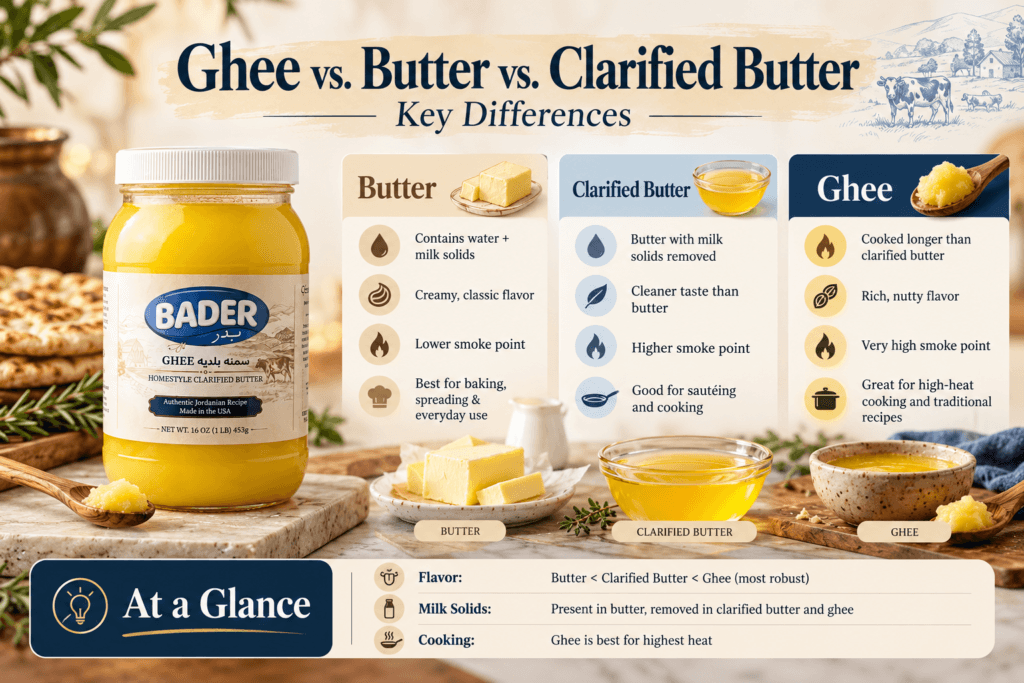
Unlike ordinary butter, properly clarified ghee contains relatively little water and fewer nonfat milk solids.
This makes it useful in many cooking applications where chefs want dairy richness and a higher typical smoke point than regular butter.
Restaurant applications for cow ghee
Cow ghee may be used to:
- Finish rice and grain dishes
- Toast nuts
- Cook vegetables
- Prepare selected traditional pastries
- Add buttery flavor to savory dishes
- Finish warm flatbread
- Complement certain meat preparations
Using ghee in rice service
Rice is one of the most practical applications.
A chef can prepare the rice using a standardized recipe and add a measured quantity of ghee near the end of cooking.
This helps distribute its flavor.
For portion consistency, the amount should be measured rather than added differently by each cook.
Ghee for finishing
Ghee can also be used after cooking.
For example, a measured amount may be brushed onto warm flatbread or stirred into finished vegetables.
Finishing applications can make its flavor more noticeable without requiring large quantities.
Cost control
Because specialty dairy fats can cost more than common neutral oils, restaurants should consider where ghee contributes the most noticeable value.
Using it selectively as a finishing ingredient may provide a distinctive flavor while keeping recipe costs manageable.
Bader Dairy offers Cow Ghee as part of its traditional dairy range.
For a broader explanation of how ghee behaves, see Why Jordanian Kitchens Cook With Samneh Baladi.
5. Sheep Ghee: A Traditional Ingredient for Mansaf and Lamb Dishes
Sheep ghee is another type of clarified dairy fat.
It can have a more distinctive aroma than many cow-ghee varieties.
This makes it especially relevant to restaurants focused on traditional Jordanian cuisine.
Sheep ghee in mansaf
Mansaf commonly combines lamb, rice, shrak bread, and a sauce made from jameed.
Traditional sheep ghee may be used in preparing or finishing the rice and other components.
Its aroma contributes to the character of the dish.
Sheep ghee with lamb
A small quantity of sheep ghee can complement certain lamb preparations.
Its stronger flavor may be particularly noticeable in dishes with relatively simple seasoning.
Standardizing flavor
When a restaurant introduces sheep ghee, the kitchen should establish an intended flavor profile and portion quantity.
A strong traditional ingredient can become overpowering if added without measurement.
For some dishes, cow ghee may offer a milder result.
Bader Dairy’s Sheep Ghee is part of the company’s traditional Jordanian product collection.
6. Jameed: Essential for Restaurants Serving Traditional Mansaf
Jameed is one of the most distinctive dairy ingredients in Jordanian cooking.
It is a dried fermented dairy product traditionally used to make mansaf sauce.
Unlike ready-to-serve labneh or cheese, traditional dried jameed requires preparation.
The product is generally soaked, broken down, blended or whisked, and incorporated into the sauce.
Why jameed matters for menu authenticity
Mansaf’s characteristic tangy dairy sauce comes from jameed.
Ordinary yogurt may be used in alternative preparations, but it does not necessarily reproduce the same concentrated traditional flavor.
For restaurants that specifically advertise traditional Jordanian mansaf, the jameed is a defining ingredient.
Preparing jameed for restaurant service
A kitchen should develop a tested preparation procedure covering rehydration, blending, straining, sauce consistency, cooking temperature, and safe refrigerated handling.
The exact water-to-jameed ratio depends on the product and desired result.
Do not assume that every dried jameed cone has identical concentration or preparation requirements.
Preventing grainy jameed sauce
Inadequate rehydration may leave undissolved particles.
Blending and straining can help produce a smoother mixture.
Aggressive heating may also contribute to separation.
A commercial kitchen should standardize the process and test it before introducing the dish to customers.
Planning ahead
Very hard dried jameed may require several hours or overnight refrigerated soaking.
That preparation time should be included in the kitchen’s production schedule.
Bader Dairy’s Mansaf with Jameed recipe explains the traditional meal and its ingredients.
Explore the Jameed product page for information about Bader Dairy’s version.
7. Traditional Butter in Professional Kitchens
Traditional butter can also contribute to restaurant dishes.
Bader Dairy produces hand-churned cow butter and goat butter.
These products are different from clarified ghee because regular butter retains more moisture and nonfat milk components.
Cow butter
Cow butter can be used for bread service, moderate-temperature cooking, finishing, and selected baking applications.
Its creamy dairy character makes it familiar to many customers.
Goat butter
Goat butter offers a different flavor profile.
It may be appropriate for specialty bread service, selected pastries, or dishes where the chef wants to highlight the butter itself.
Butter and ghee are not universally interchangeable
Baking formulas may depend on butter’s water content and physical structure.
A direct substitution with ghee can change the finished texture.
For professional production, any substitution should be tested and documented.
Explore Bader Dairy Cow Butter and Goat Butter for product information.
8. Five Menu Ideas Using Traditional Jordanian Dairy
Restaurants do not necessarily need to overhaul their menus to introduce these ingredients.
A few well-designed dishes can help test customer interest.
Menu Idea 1: Traditional Jordanian breakfast platter
Key ingredients: Fresh labneh, Nabulsi cheese, olive oil, vegetables, warm flatbread.
Menu description example:
“A traditional Levantine breakfast with creamy labneh, Nabulsi cheese, olives, fresh vegetables, and warm bread.”
This can work as a weekend brunch special or breakfast-sharing platter.
Menu Idea 2: Fried Nabulsi cheese appetizer
Key ingredients: Nabulsi cheese, fresh herbs, tomatoes, flatbread.
Menu description example:
“Golden pan-fried Nabulsi cheese served warm with fresh vegetables and traditional bread.”
The kitchen should test saltiness and cooking performance before service.
Menu Idea 3: Labneh mezze plate
Key ingredients: Fresh labneh or labneh balls, olive oil, za’atar, vegetables, bread.
Menu description example:
“Thick traditional labneh finished with olive oil and za’atar, served with warm pita.”
This can be designed for individual or shared service.
Menu Idea 4: Mansaf with traditional jameed
Key ingredients: Jameed, lamb, rice, shrak bread, sheep ghee, toasted nuts.
Menu description example:
“Traditional Jordanian mansaf featuring tender lamb, rice, and a tangy jameed sauce, served over shrak bread.”
This is a more preparation-intensive dish suited to kitchens with the required equipment and expertise.
Menu Idea 5: Knafeh with Nabulsi cheese
Key ingredients: Nabulsi cheese, knafeh pastry, ghee, syrup, pistachios.
Menu description example:
“Warm knafeh with traditional Nabulsi cheese, golden pastry, sweet syrup, and pistachios.”
The cheese preparation should be standardized to control saltiness and moisture.
For additional ideas, explore Bader Dairy’s Recipes & Inspiration.
9. How Chefs Can Introduce Unfamiliar Ingredients to Customers
One challenge for restaurants using specialty dairy is that customers may not recognize traditional ingredient names.
A dish may sound unfamiliar even when its flavor and presentation are approachable.
Explain the ingredient in plain language
A menu can use the traditional name alongside a concise description.
For example:
Labneh: Thick, tangy strained yogurt.
Nabulsi Cheese: Traditional brined white cheese.
Samneh Baladi: Aromatic clarified dairy fat.
Jameed: Dried fermented dairy used in Jordanian mansaf.
This approach respects traditional terminology while helping new customers understand what they’re ordering.
Introduce products through familiar dishes
A labneh dip may be easier for first-time customers to understand than a complex traditional recipe.
Similarly, a fried Nabulsi cheese appetizer can introduce the product before a customer orders a full traditional breakfast.
Use accurate descriptions
Avoid unsupported claims such as “healthier than butter,” “lactose-free,” or “safe for milk allergies.”
Menu descriptions should accurately reflect the actual ingredients and preparation.
Train front-of-house staff
Servers should understand what each product is, how it tastes, and whether the dish contains common allergens.
Accurate staff knowledge supports customer confidence and helps reduce misunderstandings.
10. Recipe Costing and Portion Control
Restaurants need consistent recipes not only for food quality but also for purchasing and menu profitability.
Traditional dairy products should be incorporated into standardized recipes.
Calculate ingredient cost per serving
Consider a hypothetical labneh appetizer.
| Ingredient | Example cost |
|---|---|
| Labneh portion | $1.40 |
| Olive oil | $0.25 |
| Za’atar and herbs | $0.20 |
| Pita bread | $0.60 |
| Other ingredients | $0.15 |
| Total ingredient cost | $2.60 |
If the dish sells for $10, its ingredient food-cost percentage would be 26%.
These figures are illustrative, not Bader Dairy’s wholesale prices or a recommendation for actual menu pricing.
Labor, packaging, waste, overhead, and other operating expenses must also be considered.
Measure ghee portions
Using measured quantities of ghee helps maintain a consistent flavor and predictable food costs.
Account for preparation losses
For ingredients requiring preparation, determine usable yield.
With Nabulsi cheese, consider draining and any recipe-specific soaking.
With jameed, measure the yield of prepared sauce.
Evaluate waste
Track how much product is discarded because of expiry, poor handling, overproduction, or other causes.
These records can guide purchasing decisions and recipe adjustments.
11. How Restaurants Should Store and Handle Specialty Dairy
Food safety requirements are especially important in commercial kitchens.
Traditional dairy products do not all have the same handling requirements.
Refrigerated products
Fresh labneh, labneh in oil, Nabulsi cheese, and butter should be handled according to their product-specific refrigeration instructions.
Ghee
Storage requirements depend on the finished product, packaging, and manufacturer instructions.
Do not assume all varieties have identical shelf stability.
Dried jameed
Dried jameed and reconstituted jameed have different handling requirements.
Once water has been added, the mixture must be treated as a perishable dairy preparation and handled under appropriate refrigeration and cooking procedures.
Allergy considerations
All of these traditional dairy products are milk-derived.
Restaurants should identify milk allergens accurately in recipes and staff guidance.
Goat or sheep dairy should not automatically be considered suitable for customers with cow-milk allergies.
Kitchen procedures
Restaurants should maintain appropriate systems for receiving, labeling, stock rotation, refrigeration, sanitation, and cross-contact prevention.
Follow applicable food regulations and the manufacturer’s instructions.
12. Questions Restaurants Should Ask a Wholesale Dairy Supplier
Before adding a new specialty dairy ingredient to a professional kitchen, purchasing managers should request information relevant to the intended operation.
Product specifications
Ask for the current ingredient information, product sizes, storage requirements, and applicable allergen documentation.
Available formats
Confirm which retail or foodservice packaging options are available.
Do not assume bulk containers exist simply because a product is offered wholesale.
Wholesale pricing
Request current pricing and ask how case quantities or order volumes affect the cost.
Delivery arrangements
Confirm the areas served, delivery schedules, minimum orders, and shipping requirements.
Shelf life
Ask how much shelf life typically remains upon delivery and what after-opening handling instructions apply.
Samples
Product samples can help a chef test recipes before placing larger orders.
Supply consistency
Discuss lead times and how the supplier communicates changes in availability.
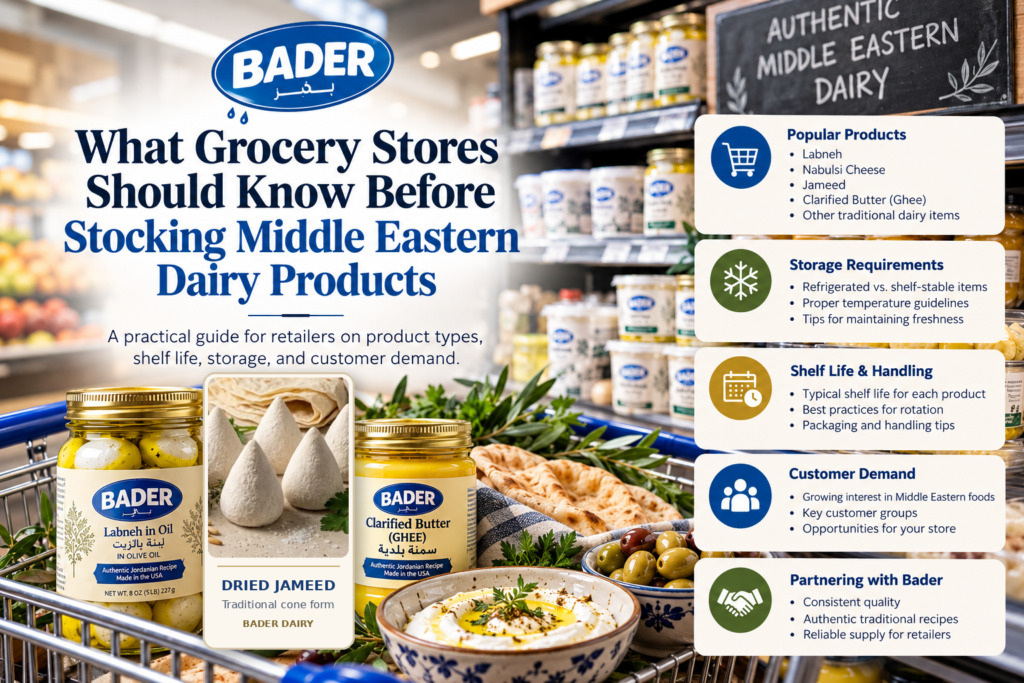
Supporting documentation
Request product information and any relevant food-safety or certification documentation needed by the business.
For a more complete supplier evaluation framework, read our Grocery Store Guide to Stocking Middle Eastern Dairy Products. The retail purchasing principles are also useful for foodservice operators.
13. Building a Restaurant Menu Around Multiple Dairy Products
One advantage of understanding traditional dairy is that several ingredients can work together within a cohesive menu.
A restaurant might use fresh labneh as an appetizer, Nabulsi cheese for breakfast, sheep ghee to finish rice, and jameed for a signature mansaf dish.
This creates opportunities for shared ingredients, related menu storytelling, and complementary dishes.
However, menu planning should remain practical.
Start with a manageable assortment
Choose products that fit existing equipment and staff skills.
Test every recipe
Record portion sizes, preparation steps, food-safety controls, cooking temperatures, and desired results.
Train the team
Make sure kitchen and service staff understand unfamiliar ingredients.
Track customer response
Evaluate sales, feedback, preparation difficulty, and waste.
Expand deliberately
Introduce additional products when the kitchen has the capacity and evidence of demand.
This approach can help restaurants build a distinctive menu without introducing unnecessary operational complexity.
14. Traditional Jordanian Dairy Made in Illinois
For restaurant buyers in Illinois and surrounding markets, working with a regional specialty dairy producer may offer an opportunity to learn directly about the product range and its traditional culinary uses.
Bader Dairy produces and packages traditional Jordanian dairy at its facility in Worth, Illinois.
The company uses family recipes and milk sourced from Illinois farms.
Its collection includes eight products:
Cow ghee, sheep ghee, Nabulsi cheese, labneh, labneh in oil, jameed, cow butter, and goat butter.
These products reflect different techniques used in traditional dairy preparation, including clarification, straining, brining, drying, and churning.
Bader Dairy’s Our Story explains the connection between the company’s Jordanian heritage and its Illinois production facility.
For a broader educational introduction, explore our Complete Guide to Traditional Jordanian Dairy.
Frequently Asked Questions About Middle Eastern Dairy for Restaurants
What Middle Eastern dairy products do restaurants commonly use?
Traditional products include labneh, Nabulsi cheese, ghee, jameed, and butter. Their uses range from appetizers and breakfast to cooking fats, main dishes, and desserts.
Can restaurants purchase labneh wholesale?
Yes. Specialty dairy suppliers may offer labneh through wholesale arrangements. Buyers should confirm available packaging, pricing, storage, and ordering terms.
What is Nabulsi cheese used for in restaurants?
Nabulsi cheese can be used for breakfast platters, fried cheese appetizers, savory preparations, and traditional knafeh.
What dairy is needed for authentic Jordanian mansaf?
Traditional mansaf relies on jameed to produce its characteristic tangy dairy sauce. Sheep ghee may also be used in the dish.
Can chefs use ghee instead of butter?
In many savory cooking applications, yes. However, baking and other recipes that depend on butter’s moisture and structure may require adjustments.
Can labneh be used in restaurant sauces?
Yes. Labneh can provide a creamy, tangy element, but overheating may affect its texture. It often works well as a cold sauce or finishing ingredient.
Is labneh in olive oil shelf-stable?
Not automatically. Bader Dairy’s Labneh in Oil requires refrigeration. Follow the packaging instructions.
Does Bader Dairy offer restaurant wholesale inquiries?
Yes. Bader Dairy’s wholesale page accepts inquiries from restaurants and foodservice businesses interested in its traditional dairy products.
Can catering companies use traditional Jordanian dairy?
Yes. Labneh, Nabulsi cheese, ghee, and other products can be incorporated into catering menus when appropriate preparation, refrigeration, and food-safety controls are maintained.
How can a restaurant calculate specialty dairy food costs?
Use the actual purchase price, usable yield, serving size, freight, and other acquisition expenses to calculate the cost of each recipe.
Do all Middle Eastern dairy products require refrigeration?
Storage requirements differ by product. Fresh cultured dairy and many cheeses require refrigeration, while some clarified or dried products have different instructions. Always verify the specific product.
How should a chef evaluate a new specialty dairy supplier?
Request specifications, samples, current pricing, packaging information, storage instructions, lead times, and applicable documentation.
Where is Bader Dairy located?
Bader Dairy produces traditional Jordanian dairy products in Worth, Illinois.
Bring Traditional Jordanian Dairy to Your Restaurant
Traditional dairy ingredients can help chefs develop distinctive dishes while preserving the flavors associated with Jordanian and Levantine cooking.
Fresh labneh creates creamy appetizers and spreads.
Nabulsi cheese works in savory breakfasts, fried dishes, and knafeh.
Cow and sheep ghee contribute different flavor profiles to rice and other preparations.
Jameed gives traditional mansaf its defining tangy sauce.
The right products, combined with tested recipes and dependable purchasing arrangements, can help restaurants deliver consistent meals to their customers.
Bader Dairy welcomes inquiries from restaurants, catering businesses, foodservice operators, grocery stores, and distributors interested in carrying its traditional Jordanian dairy products.
Explore the Bader Dairy Product Collection to learn about the available range.
Then visit our Wholesale Inquiry page to discuss current product information, purchasing options, and next steps.
Bader Dairy
6903 W 111th St, Worth, IL 60482
Phone: (708) 827-5174
Email: info@baderdairy.com
Website: baderdairy.com
Traditional Jordanian dairy, made in Illinois.