By Bader Dairy | Traditional Jordanian Dairy Producers in Worth, Illinois | Updated October 21, 2026 | Approximately 12-minute read
If you’ve ever held a piece of dried jameed in your hand, you know it doesn’t look like an ordinary dairy ingredient. It is extremely firm, sometimes nearly as hard as stone, and it gives very little indication of the rich, tangy sauce it can become.
Yet this traditional dried yogurt is one of the most important ingredients in Jordanian cooking. It gives mansaf, Jordan’s national dish, the distinctive flavor that separates it from ordinary lamb and rice.
For anyone preparing mansaf for the first time, working with dried jameed can seem intimidating. How long should you soak it? Do you need a blender? Why does the sauce sometimes turn grainy? And how do you keep it smooth while cooking?
Fortunately, the method becomes much easier once you understand how the ingredient behaves.
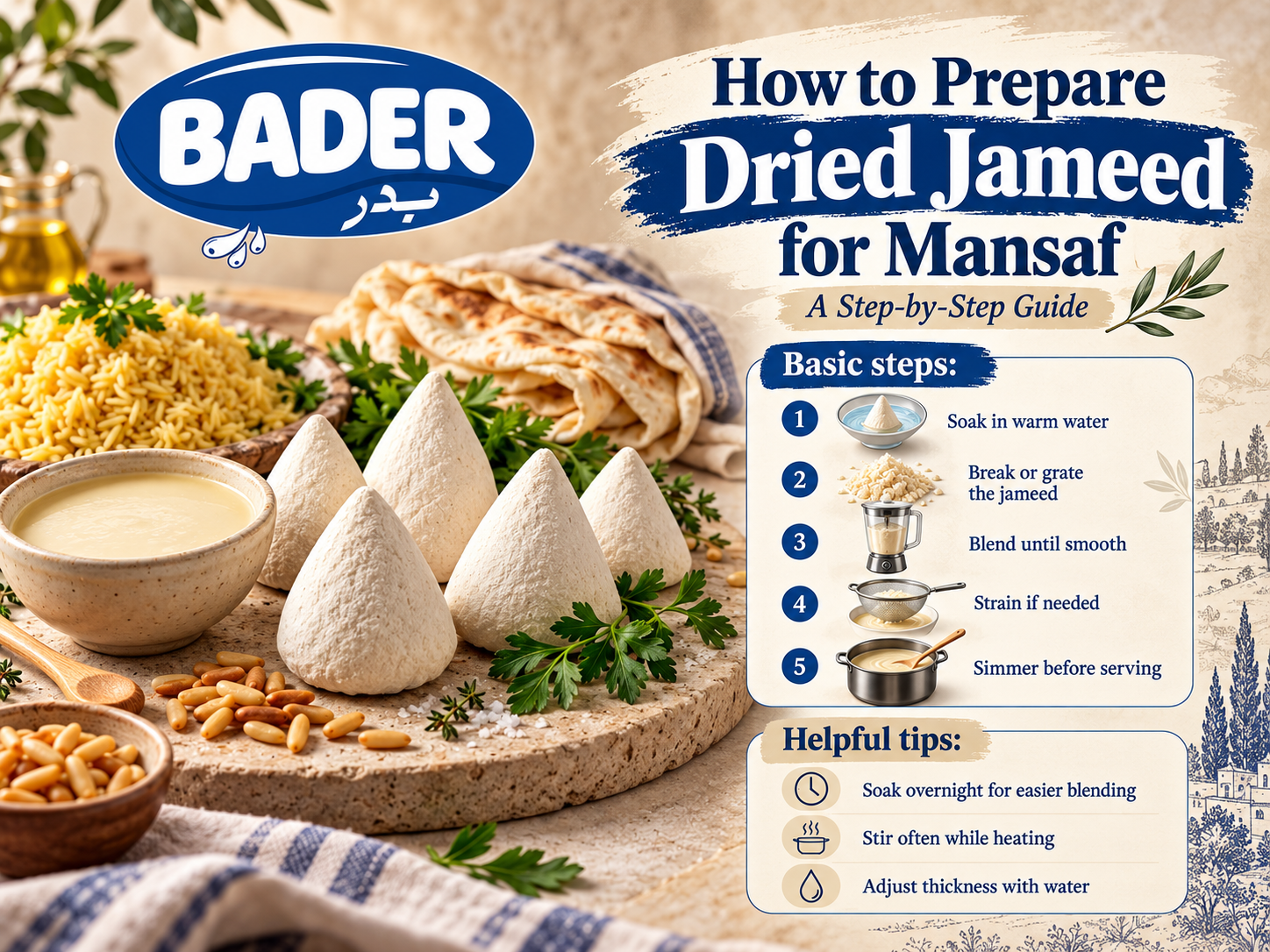
Quick answer: To prepare dried jameed for mansaf, break it into smaller pieces, soak it in water until thoroughly softened, blend it with the soaking liquid, and strain the mixture to remove any remaining hard particles. The reconstituted jameed can then be combined with lamb broth and gently heated while stirring to make the traditional sauce.
The key is allowing enough time for rehydration, creating a smooth mixture, and controlling the heat.
This guide walks through the process from beginning to end.
What Is Dried Jameed?
Jameed is a traditional dried fermented dairy product widely associated with Jordanian cuisine.
It is made by concentrating cultured dairy, adding salt, and removing moisture until the product becomes extremely firm.
Traditionally, jameed has been shaped into balls or cones and dried for preservation.
The result is a concentrated dairy ingredient with a distinctive salty, tangy flavor.
Unlike ordinary fresh yogurt, dried jameed must generally be rehydrated before it can be incorporated into a sauce.
Its most famous use is in mansaf, where it provides the characteristic dairy broth served with lamb, rice, and thin flatbread.
Why is jameed so hard?
The firm texture comes primarily from moisture removal.
As the cultured dairy is strained and dried, it becomes increasingly concentrated.
With less water remaining, the structure becomes compact and difficult to break apart.
That firmness is an important part of the traditional preparation, but it also explains why dried jameed cannot simply be dropped into a cooking pot and expected to dissolve immediately.
The ingredient needs time to absorb water again.
Is jameed the same as yogurt?
Jameed begins with fermented dairy, but it is not the same as ordinary yogurt sold in a refrigerated container.
Fresh yogurt contains substantial moisture and is generally ready to eat.
Dried jameed is concentrated, salted, and dehydrated.
Rehydrating it creates the base for a sauce, but it does not turn it back into exactly the same product as fresh yogurt.
The concentrated flavor is one reason jameed is so important in traditional cooking.
For more information about its background, explore Bader Dairy’s Jameed product page.
How to Prepare Dried Jameed: Quick Reference
| Step | What to do | Why it matters |
|---|---|---|
| 1. Break | Divide dried jameed into smaller pieces | Helps water penetrate |
| 2. Soak | Cover with drinking water and refrigerate until softened | Rehydrates the dried dairy |
| 3. Mash | Break up the softened pieces | Reduces large lumps |
| 4. Blend | Blend jameed with soaking liquid | Creates a smoother consistency |
| 5. Strain | Pass through a fine-mesh strainer | Removes remaining hard particles |
| 6. Dilute | Add broth gradually | Controls thickness and flavor |
| 7. Heat | Heat gently while stirring | Helps maintain a smooth sauce |
| 8. Adjust | Taste and adjust consistency | Balances saltiness and richness |
Important: Preparation times and liquid quantities vary depending on the size, hardness, and concentration of the jameed. Follow the product label when it provides specific directions.
What You Need Before Preparing Jameed
You don’t need specialized commercial equipment to prepare dried jameed at home.
Most kitchens already have the necessary tools.
Equipment
- A sturdy cutting board or protected work surface
- A clean kitchen towel
- A suitable tool for safely breaking hard dried jameed
- A large food-safe bowl
- A refrigerator
- A blender
- A fine-mesh strainer
- A saucepan or cooking pot
- A whisk or wooden spoon
Ingredients
For the jameed sauce base, you’ll need:
- Dried jameed
- Clean drinking water
- Lamb broth, if preparing mansaf
Optional recipe ingredients may include traditional mansaf spices.
The exact quantity of jameed depends on its concentration and the amount of sauce you want to make.
Start with the manufacturer’s recommended quantity if available.
For the full meal, you’ll also need lamb, rice, shrak bread or another suitable flatbread, and garnishes such as almonds or pine nuts.
Step 1: Break the Dried Jameed Into Smaller Pieces
Traditional dried jameed can be extremely hard.
Breaking it into smaller pieces before soaking allows water to reach more of its surface.
This can shorten the time required for rehydration and make the later blending process easier.
How to break hard jameed safely
- Place the dried jameed in a sturdy, clean food-safe bag.
- Wrap the bag in a clean kitchen towel.
- Position it on a solid, stable surface.
- Carefully use a suitable blunt kitchen tool to break it into smaller pieces.
- Transfer the pieces into a clean bowl.
Avoid holding the jameed in your hand while trying to cut it with a sharp knife.
Its irregular, hard surface can cause a blade to slip.
You do not need to grind the jameed into fine powder.
Pieces small enough to soak evenly are sufficient.
Can you soak a whole jameed cone?
Yes, but a large, completely dried cone may take substantially longer to soften.
The outside can become hydrated while the center remains firm.
For more predictable results, breaking it into pieces is usually preferable.
Step 2: Soak the Jameed in Water
Soaking is one of the most important stages.
The goal is to allow water to penetrate the dried material until it softens enough to blend.
Place the broken pieces in a large bowl and add enough clean water to cover them.
Keep the soaking mixture refrigerated at 40°F (4°C) or below.
How long should dried jameed soak?
Very hard traditional jameed may need approximately 8–12 hours or an overnight soak.
Some softer or more finely broken products may rehydrate more quickly.
The correct endpoint is not simply the number of hours.
The jameed should be soft enough to break apart and blend without leaving a hard center.
Check its texture before moving to the next stage.
If substantial hard pieces remain, continue soaking under refrigeration.
Should you use warm or cold water?
Room-temperature or lukewarm water may help begin hydration, but the mixture should be placed promptly in the refrigerator for extended soaking.
Avoid leaving rehydrating dairy at room temperature overnight.
Cold drinking water is a straightforward choice when planning an overnight soak.
Can you soak jameed overnight?
Yes. Overnight soaking is a common preparation method for very hard dried jameed.
Keep the container covered and refrigerated throughout the soaking period.
This also makes meal preparation easier because the jameed can be prepared the evening before you cook mansaf.
Step 3: Mash the Softened Jameed
Once the pieces have absorbed water, they should become easier to break apart.
Use a clean spoon or another suitable kitchen utensil to mash any remaining softened lumps.
The goal is to create a mixture that can be blended evenly.
If the center of a piece still feels hard, allow additional soaking time rather than forcing it into a blender.
Should you discard the soaking water?
Usually, no.
Traditional preparation commonly uses the soaking liquid as part of the sauce base.
The water contains material released from the jameed during rehydration.
However, if the manufacturer’s directions specify a different method, follow those instructions.
The liquid can be adjusted later when preparing the sauce.
Step 4: Blend the Jameed Until Smooth
Transfer the softened jameed and an appropriate amount of its soaking liquid into a blender.
Do not fill the blender beyond its recommended capacity.
Blend until the mixture becomes as smooth as possible.
The result should resemble a pourable cultured-dairy mixture rather than a bowl of separate particles.
If it is too thick to blend properly, gradually add a small amount of clean water.
What consistency should blended jameed have?
Aim for a consistency similar to a smooth, pourable yogurt sauce.
It should flow from a spoon but still have enough body to coat the back of it.
There is no universal thickness at this stage.
The concentration can be adjusted after the jameed is combined with broth.
Can you make jameed sauce without a blender?
Yes, although it may require more work.
Traditionally, softened jameed can be broken down by hand or with kitchen utensils until it becomes a liquid mixture.
You can then pass it through a fine strainer.
However, a blender is convenient because it reduces the amount of manual work and can improve consistency.
Step 5: Strain the Jameed Mixture
Even after blending, small hard particles may remain.
This is especially common when working with very firm traditionally dried jameed.
Place a fine-mesh strainer over a clean bowl or saucepan.
Pour the blended mixture through the strainer.
Use a spoon to gently help the liquid pass through if necessary.
Discard any stubborn hard particles that do not break down.
Why is straining important?
Straining helps produce a smoother sauce.
Without it, undissolved pieces can create a gritty texture or settle at the bottom of the pot.
A smooth jameed base is easier to incorporate into broth and distribute evenly over rice.
What if the mixture is still grainy?
Small differences in texture are normal with traditional dairy preparations.
However, noticeable hard granules often suggest that some jameed was not fully hydrated.
Try the following:
- Check whether the remaining particles are soft or hard.
- If hard pieces remain, give them additional time to hydrate.
- Blend again if appropriate.
- Strain through a finer mesh.
Avoid assuming that extended boiling will solve a poorly hydrated mixture.
High heat can introduce additional texture problems.
Step 6: Prepare the Lamb Broth
For traditional mansaf, jameed is commonly combined with lamb broth.
The broth contributes savory depth and helps create the sauce used to cook or finish the meat.
You can prepare the lamb according to your preferred mansaf recipe.
Traditional preparations often include ingredients such as onions, cardamom, bay leaves, and other aromatic spices.
After the lamb has cooked, strain the broth if needed.
Why use lamb broth instead of plain water?
Lamb broth adds flavor and richness.
It also connects the sauce to the meat being served.
Using only water may produce a lighter sauce, but it will not have the same savory depth.
Should you add salt to the broth?
Be cautious.
Traditional jameed is often already quite salty.
If you heavily salt the lamb broth before combining it with jameed, the final sauce may become too salty.
It’s generally easier to adjust seasoning near the end of preparation.
Taste the jameed mixture before adding extra salt.
Step 7: Combine Jameed With the Broth
Transfer the strained jameed mixture into a suitable pot.
Gradually add warm lamb broth, stirring as you go.
Start with a moderate amount rather than adding all the broth immediately.
This allows you to control the consistency.
What should the sauce look like?
The finished sauce should be smooth and pourable.
It should be thin enough to flow over rice but substantial enough to provide a creamy coating.
Some households prefer a thinner sauce, while others serve mansaf with a richer consistency.
Both approaches reflect personal and family preferences.
How do you know if you’ve added too much broth?
If the sauce becomes very watery, its flavor may also become less concentrated.
The best approach is to add broth gradually.
If the mixture is already too thin, avoid trying to correct it through aggressive boiling.
Instead, consider adding more properly prepared concentrated jameed, if available.
Step 8: Heat the Jameed Sauce Gently
Now the reconstituted sauce is ready for cooking.
Heat it over medium-low heat while stirring regularly.
As it warms, continue monitoring its consistency.
Avoid allowing the sauce to reach a prolonged, vigorous rolling boil.
Cultured dairy mixtures can become grainy or separate when subjected to excessive heat.
Why does jameed sauce sometimes curdle?
Jameed contains dairy proteins.
Its acidity, salt concentration, and protein structure influence how it responds to heating.
Aggressive boiling or uneven heating can encourage visible separation or graininess.
The risk depends on the composition of the product and the recipe.
How to reduce the risk of separation
- Begin with thoroughly hydrated jameed.
- Blend and strain before cooking.
- Use moderate heat.
- Stir regularly.
- Add broth gradually.
- Avoid sudden temperature changes.
- Follow a tested mansaf recipe.
Gentle heating helps maintain a more uniform texture.
It is also important to heat the sauce thoroughly according to the recipe and applicable food-safety directions, not merely warm it slightly.
Step 9: Add the Lamb and Finish the Sauce
Once your sauce is properly prepared and heated, add the cooked lamb according to your mansaf recipe.
Allow the flavors to combine under gentle heat.
This is one of the defining stages of mansaf preparation.
The lamb contributes savory flavor to the tangy dairy sauce, while the jameed gives the dish its characteristic taste.
The sauce should remain pourable because it will also be served over rice and bread.
Taste before making final seasoning adjustments.
Remember that the jameed itself can supply substantial saltiness.
How to Tell if Jameed Sauce Is Ready
A properly prepared jameed sauce should have several recognizable characteristics.
| Characteristic | What to look for |
|---|---|
| Texture | Smooth or mostly smooth |
| Consistency | Creamy and pourable |
| Flavor | Tangy, savory, noticeably dairy-based |
| Saltiness | Balanced with the other ingredients |
| Appearance | Generally pale and relatively uniform |
| Undissolved pieces | Minimal after blending and straining |
The exact flavor and appearance depend on the specific jameed.
Traditional products can vary considerably, so a slightly different color or aroma does not necessarily mean the recipe is incorrect.
However, obvious signs of spoilage should never be ignored.
Common Jameed Problems and How to Fix Them
One of the most useful skills in traditional cooking is understanding why a recipe didn’t behave as expected.
Here are some common preparation problems.
Problem #1: The jameed will not dissolve
Possible cause: It has not absorbed enough water.
What to do: Continue soaking under refrigeration until the pieces soften throughout. Break very large pieces into smaller portions when safe to do so, and blend once properly hydrated.
Problem #2: The sauce is gritty
Possible cause: Small hard particles remain after soaking.
What to do: Blend more thoroughly and pass the mixture through a fine-mesh strainer.
If the particles remain hard, additional hydration may be necessary before blending.
Problem #3: The sauce is too salty
Possible cause: The jameed is highly concentrated, or the broth was salted before the jameed was added.
What to do: Gradually dilute with suitable unsalted broth or water while checking the consistency and flavor.
For future batches, season the broth conservatively.
Problem #4: The sauce is too thin
Possible cause: Too much liquid was added during blending or cooking.
What to do: If available, add more properly hydrated and blended jameed in small amounts.
Avoid relying on prolonged hard boiling to reduce the sauce.
Problem #5: The sauce separates while heating
Possible cause: Excessive heat, abrupt heating, or instability in the dairy mixture.
What to do: Lower the heat and whisk gently.
Minor separation may sometimes improve with careful mixing, but severely separated sauce may not return to its original texture.
Prevention is more reliable than correction.
Problem #6: The sauce tastes too sour
Possible cause: The jameed’s natural acidity is stronger than expected.
What to do: Balance the sauce with the appropriate amount of broth and other recipe ingredients.
Avoid trying to eliminate the traditional tang entirely, as it is an important characteristic of jameed.
Problem #7: The finished mansaf tastes bland
Possible cause: The sauce is overly diluted, the broth lacks flavor, or the overall seasoning is insufficient.
What to do: Check the concentration of the jameed sauce and taste the lamb broth.
Make gradual adjustments instead of adding a large amount of salt at once.
How Much Jameed Do You Need for Mansaf?
The exact quantity depends on several factors:
- The weight of the dried jameed
- How concentrated it is
- Its moisture content
- The quantity of lamb broth
- The number of servings
- Your preferred sauce consistency
- Your family’s preferred intensity of flavor
A very concentrated traditional jameed may require more dilution than a softer commercial variety.
For that reason, a universal ratio would be misleading.
For Bader Dairy Jameed, use the directions and quantities on the product packaging when available. If specific preparation instructions are not provided, begin with a tested mansaf recipe appropriate to the amount of dried jameed you have.
Once you become familiar with the product, you can adjust the sauce to your preferred thickness and flavor.
Can You Prepare Jameed the Day Before Cooking Mansaf?
Yes.
In fact, preparing jameed ahead of time can make the day of cooking easier.
For very hard dried jameed, an overnight refrigerated soak is often useful.
You can break the pieces, place them in a covered bowl with water, and refrigerate them.
The next day, finish blending and straining before preparing the sauce.
Can you make the sauce ahead of time?
Reconstituted jameed is no longer the same as the original dry product.
Once water has been added, it must be handled as a perishable dairy preparation.
Bader Dairy advises refrigerating reconstituted jameed and using it promptly.
If you’re preparing ahead, keep the mixture refrigerated until cooking.
Do not leave prepared sauce at room temperature overnight.
How to Store Dried and Reconstituted Jameed
The handling requirements change significantly once jameed has been mixed with water.
Before rehydration
For Bader Dairy’s dried jameed:
- Keep it in a cool, dry place.
- Store it in a tightly sealed container.
- Protect it from moisture.
- Avoid direct heat.
- Follow the package instructions.
After rehydration
Once jameed has been soaked or blended:
- Refrigerate promptly.
- Keep the container covered.
- Use clean utensils.
- Use the mixture promptly.
- Follow applicable food-safety guidance for cooked leftovers.
Do not assume the traditional keeping qualities of dried jameed continue after it has been rehydrated.
Can you freeze prepared jameed sauce?
Freezing can change the texture of cultured dairy mixtures, potentially creating separation after thawing.
If you choose to freeze a cooked sauce, use suitable food-safe containers, chill it promptly, and follow standard handling and reheating practices.
The sauce may need gentle stirring after thawing.
For the best traditional texture, freshly prepared sauce is generally preferable.
Why Jameed Matters So Much in Traditional Mansaf
Mansaf is more than lamb served over rice.
Its characteristic flavor comes largely from the jameed sauce.
Traditional jameed adds a tangy, salty, concentrated dairy flavor that is difficult to reproduce with ordinary plain yogurt.
The preparation also reflects a long history of food preservation.
Before modern refrigeration, drying cultured dairy helped families preserve ingredients for later use.
What began as a practical preservation technique became part of the culinary identity of Jordan.
Today, mansaf is strongly associated with celebrations, hospitality, family gatherings, and important occasions.
The flavor of jameed is one of the reasons the dish remains so recognizable.
What Should You Serve With Jameed Sauce?
Although jameed is most closely associated with mansaf, its tangy dairy flavor can complement several traditional ingredients.
Lamb
Lamb is central to many mansaf preparations.
The savory meat and acidic dairy sauce provide a distinctive flavor combination.
Rice
Rice absorbs the sauce and helps balance its intensity.
Some traditional preparations finish the rice with samneh baladi, a type of ghee.
Bader Dairy offers Sheep Ghee, which is often associated with traditional Jordanian meals.
Shrak bread
Shrak is a thin flatbread traditionally placed beneath the rice and meat.
As the sauce is poured over the dish, the bread absorbs some of the liquid.
Toasted nuts
Almonds and pine nuts are common garnishes.
They provide a pleasant crunch against the soft rice and tender lamb.
Fresh parsley
Parsley adds color and freshness.
It is often used as a finishing garnish.
For the complete meal, visit Bader Dairy’s Recipes & Inspiration section and explore the Mansaf with Jameed recipe.
Frequently Asked Questions About Preparing Jameed
How do you dissolve dried jameed?
Break the dried jameed into smaller pieces, soak it until softened, blend it with soaking liquid, and strain out any remaining hard particles.
How long should jameed soak?
Very hard dried jameed may need approximately 8–12 hours or overnight. Softer products may require less time. Use the texture and package instructions to determine when it is ready.
Can you soak jameed overnight?
Yes. Overnight soaking in the refrigerator is a practical method for very hard dried jameed.
Should you use hot water to dissolve jameed?
Some recipes begin with lukewarm water, but prolonged soaking should occur under refrigeration. Follow the product’s instructions and avoid leaving rehydrated dairy at room temperature for extended periods.
Do you have to blend jameed?
Blending is convenient but not mandatory. Traditionally, softened jameed can be broken down manually. A blender often helps create a smoother mixture.
Why is my jameed sauce grainy?
The jameed may not have fully rehydrated, or small undissolved particles may remain. Additional soaking, blending, and straining can help.
Why did my jameed sauce curdle?
High heat or uneven heating can cause dairy proteins to separate. Gentle heating and regular stirring help reduce the risk.
Can you use jameed without lamb?
Jameed can be prepared as a sauce without lamb, although the resulting dish will differ from traditional lamb mansaf.
Is jameed the same as Greek yogurt?
No. Jameed is a dried, salted fermented dairy product. Greek yogurt is a refrigerated strained yogurt with a much higher moisture content.
Does jameed contain dairy?
Yes. Jameed is made from cultured dairy and is not suitable for people who need to avoid milk allergens.
Is jameed supposed to be salty?
Yes. Traditional jameed has a concentrated salty and tangy flavor. The intensity varies by product.
Can jameed sauce be prepared in advance?
You can prepare components ahead of time, but once rehydrated, jameed must be refrigerated and used promptly. Follow food-safety instructions and the product label.
Is jameed only used for mansaf?
Mansaf is its best-known use, but jameed may also be incorporated into other traditional dishes where its concentrated tangy flavor is desired.
Where can I find dried jameed in Illinois?
Bader Dairy produces traditional Jordanian jameed in Worth, Illinois. Contact the company through its website to inquire about product availability.
Discover Traditional Jordanian Jameed From Bader Dairy
Preparing dried jameed is a skill that becomes more familiar with experience.
The essential steps are straightforward: break, soak, blend, strain, and gently cook.
Taking the time to hydrate the dairy thoroughly and maintain a smooth sauce can make a significant difference in the finished dish.
At Bader Dairy, we continue traditional Jordanian dairy preparation in our own facility in Worth, Illinois.
Our product range includes jameed, cow and sheep ghee, Nabulsi cheese, labneh, and traditional butter.
Explore our products:
- Jameed — Traditional Dried Yogurt for Mansaf
- Sheep Ghee — Samneh Baladi Ghanam
- All Bader Dairy Products
Looking to purchase Bader Dairy products?
Visit Where to Find Bader to inquire about product availability.
Interested in carrying Bader Dairy in your store or restaurant?
Visit our Wholesale Inquiry page to connect with our team.
Bader Dairy
6903 W 111th St, Worth, IL 60482
Phone: (708) 827-5174
Website: baderdairy.com
Traditional Jordanian dairy, made in Illinois.