By Bader Dairy | Traditional Jordanian Dairy Producers in Worth, Illinois | Published October 21, 2026 | Approximately 12-minute read
Jordanian food is often associated with mansaf, warm flatbread, fragrant rice, olive oil, and generous family gatherings. But behind many of these familiar dishes is another important part of Jordan’s culinary heritage: traditional dairy.
From the tangy jameed that gives mansaf its characteristic flavor to the salty Nabulsi cheese served at breakfast, Jordanian dairy products are central to how families prepare, preserve, and share food.
Some are eaten fresh. Others are strained, clarified, salted, brined, or dried. Each preparation changes the dairy’s flavor, texture, and role in cooking.
For anyone discovering Middle Eastern dairy for the first time, the variety can be confusing. What is samneh baladi? Why is labneh different from yogurt? What makes jameed so important to mansaf? And which traditional cheese is used in knafeh?
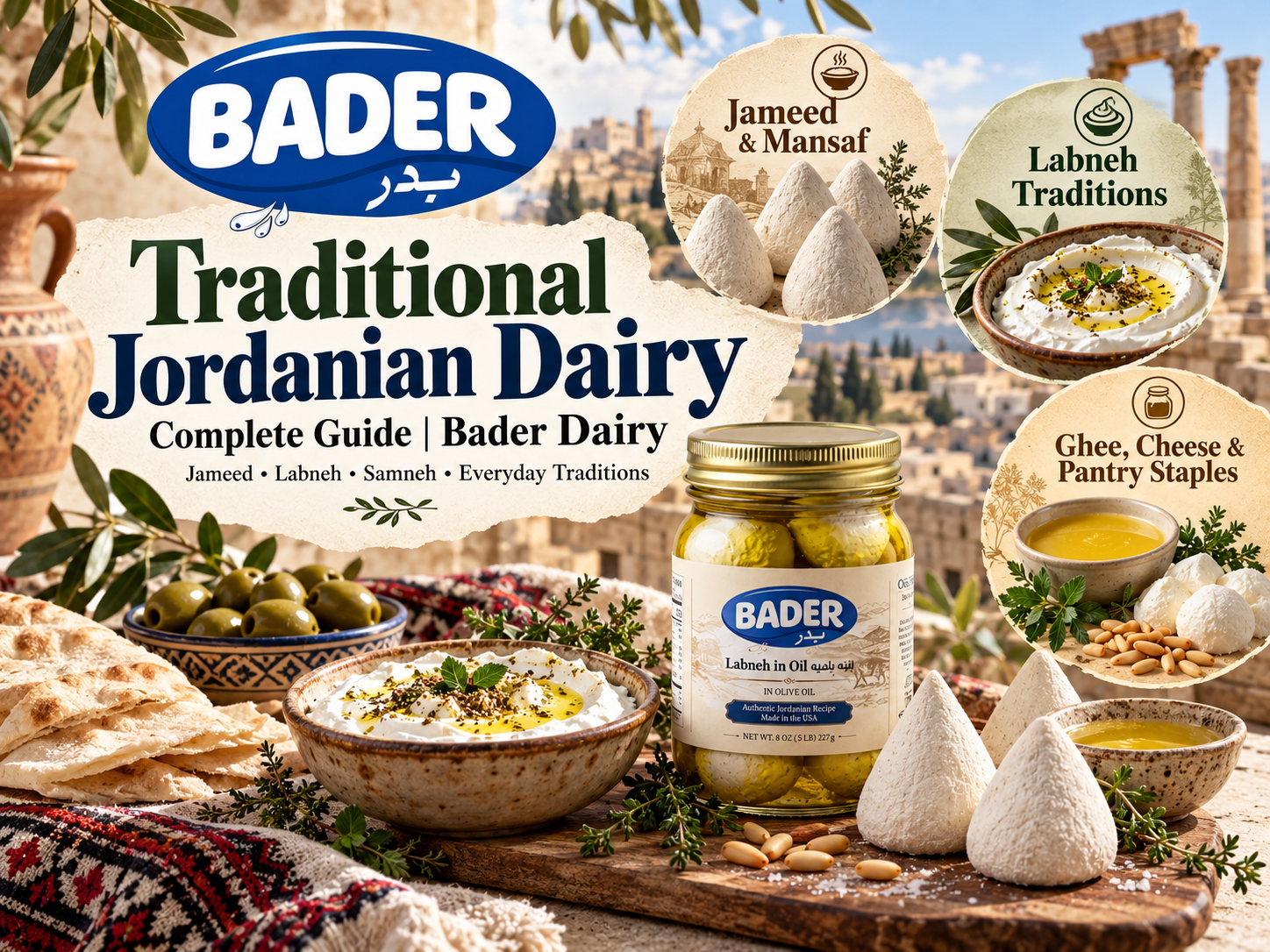
Traditional Jordanian dairy includes cultured and strained products such as labneh, brined cheeses such as Nabulsi, clarified dairy fats known as samneh, dried fermented dairy such as jameed, and fresh butter. Each has a distinct place in Jordanian cuisine.
This guide explains the major types, how they are traditionally prepared, what they taste like, and how to use them in everyday cooking.
What Are Traditional Jordanian Dairy Products?
Traditional Jordanian dairy products are foods made from animal milk using techniques developed and passed down through generations.
These preparations reflect the country’s agricultural history, regional food traditions, and practical ways of preserving milk before refrigeration became widespread.
Historically, milk from sheep and goats played an important role in pastoral communities. Cow dairy is also used in contemporary Jordanian food production.
Different methods developed for different purposes.
- Fermentation transformed fresh milk into cultured dairy.
- Straining removed liquid and created thicker products such as labneh.
- Drying helped preserve fermented dairy in the form of jameed.
- Clarification separated butterfat from much of the water and milk solids.
- Brining helped preserve cheese and develop its characteristic texture and flavor.
- Churning separated butterfat from cream or cultured dairy preparations.
These methods created ingredients with distinctive cooking properties.
Today, many of those products remain essential to traditional Jordanian meals, even though modern refrigeration and manufacturing have changed how they are produced and distributed.
Quick Guide to the Main Types of Jordanian Dairy
| Dairy product | Traditional name | What it is | Common uses |
|---|---|---|---|
| Cow ghee | Samneh Baladi | Clarified dairy fat | Rice, cooking, pastries |
| Sheep ghee | Samneh Ghanam | Clarified sheep dairy fat | Mansaf, lamb, rice |
| Nabulsi cheese | Jibneh Nabulsieh | Traditional brined white cheese | Breakfast, frying, knafeh |
| Fresh labneh | Labneh | Thick strained cultured yogurt | Breakfast, dips, sandwiches |
| Labneh in oil | Labneh bil Zeit | Firm labneh balls packed in oil | Mezze, bread, appetizers |
| Jameed | Jameed | Dried, salted fermented dairy | Mansaf sauce |
| Traditional cow butter | Zibdeh Baladi | Butter produced from cow dairy | Bread, rice, cooking |
| Traditional goat butter | Zibdeh Maaz | Butter produced from goat dairy | Bread, cooking, traditional dishes |
Although these products share a dairy origin, their production methods give them very different textures, flavors, and culinary functions.
1. Samneh Baladi: Traditional Jordanian Ghee
Samneh baladi is one of the most recognizable ingredients in Jordanian cooking.
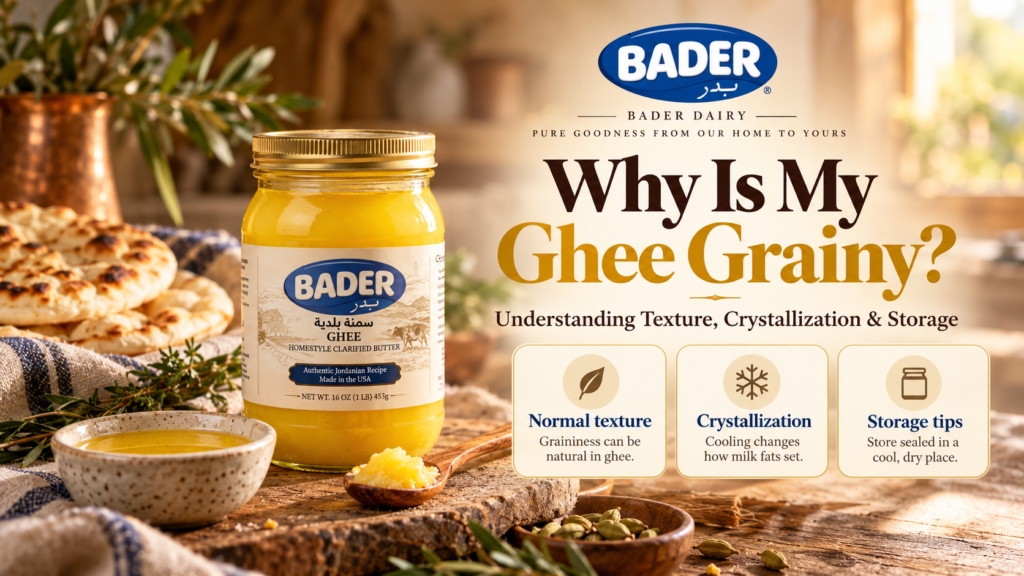
It is a traditional form of clarified dairy fat, commonly described in English as ghee.
Unlike regular butter, which contains water and milk solids, clarified butter is made by separating most of those components from the butterfat.
The resulting fat generally tolerates higher cooking temperatures and contributes a concentrated dairy flavor.
What does samneh baladi taste like?
The flavor depends on the milk source and preparation method.
Some varieties have a relatively mild buttery character, while others develop stronger toasted or traditional dairy aromas.
Cow ghee often tastes familiar to people accustomed to regular butter.
Sheep ghee may have a more pronounced dairy aroma that is especially valued in certain Jordanian preparations.
Traditional recipes also vary in their use of flavoring ingredients.
How is samneh used in Jordanian cooking?
Samneh may be used to:
- Finish rice before serving.
- Toast almonds and pine nuts.
- Cook vegetables and aromatics.
- Prepare certain pastries.
- Add richness to lamb dishes.
- Flavor warm flatbread.
- Complement festive meals.
One simple way to experience samneh is to stir a small amount into freshly cooked rice.
Because rice has a relatively mild flavor, the aroma of the ghee becomes easy to recognize.
Cow ghee and sheep ghee are not identical
Both products belong to the family of clarified dairy fats, but they can have different flavor profiles.
For everyday cooking, some people prefer cow ghee’s familiar buttery taste.
For traditional lamb dishes and mansaf, sheep ghee may be preferred because of its distinctive aroma.
The choice depends on the recipe and personal taste.
Explore Bader Dairy’s Cow Ghee and Sheep Ghee to learn more about these traditional ingredients.
2. Nabulsi Cheese: The White Cheese of the Levant
Nabulsi cheese is a traditional white-brined cheese originating in Nablus, Palestine.
Over generations, it became deeply associated with Palestinian, Jordanian, and wider Levantine cooking.
It is especially recognizable for its firm texture, salty taste, and ability to withstand certain cooking methods without immediately collapsing.
What makes Nabulsi cheese distinctive?
Traditional Nabulsi cheese is prepared using a combination of cheesemaking techniques and brining.
Its characteristics can include:
- A firm or semi-hard texture.
- A pronounced salty flavor.
- A pale white appearance.
- The ability to soften when heated while retaining some structure.
- Traditional aromatic ingredients in certain recipes.
Depending on the producer, Nabulsi may contain ingredients such as mahlab, mastic, or black seed.
Bader Dairy’s Nabulsi cheese uses a traditional preparation that includes black seed and aromatic ingredients.
How do Jordanian families eat Nabulsi cheese?
A common serving method is to slice the cheese and place it on the breakfast table with bread, tomatoes, cucumbers, and olives.
It can also be pan-fried until the exterior becomes golden.
Unlike many softer cheeses, Nabulsi can retain enough structure to be served as a warm slice.
Why is Nabulsi cheese used in knafeh?
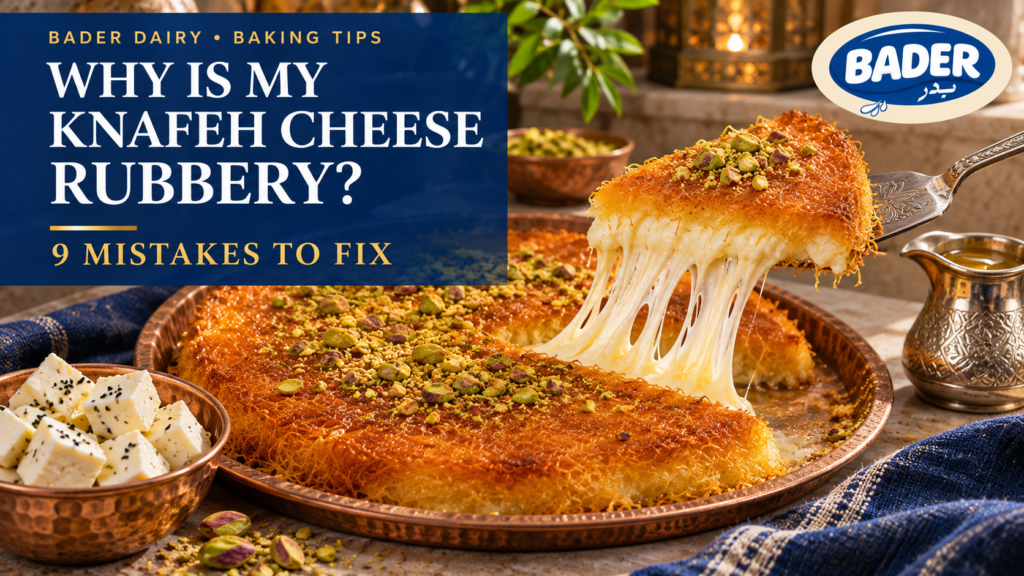
Knafeh is a traditional Middle Eastern dessert that combines cheese, pastry, and sweet syrup.
Nabulsi cheese is associated with the famous Nabulsi style of knafeh.
Because it is stored in brine, it may need soaking to reduce its salt content before being used in desserts.
When properly prepared and heated, it can develop a soft, elastic texture suitable for the cheese layer.
The exact result depends on the cheese’s moisture, salt content, and production method.
For cooking and product information, explore Bader Dairy Nabulsi Cheese.
3. Fresh Labneh: The Creamy Center of the Breakfast Table
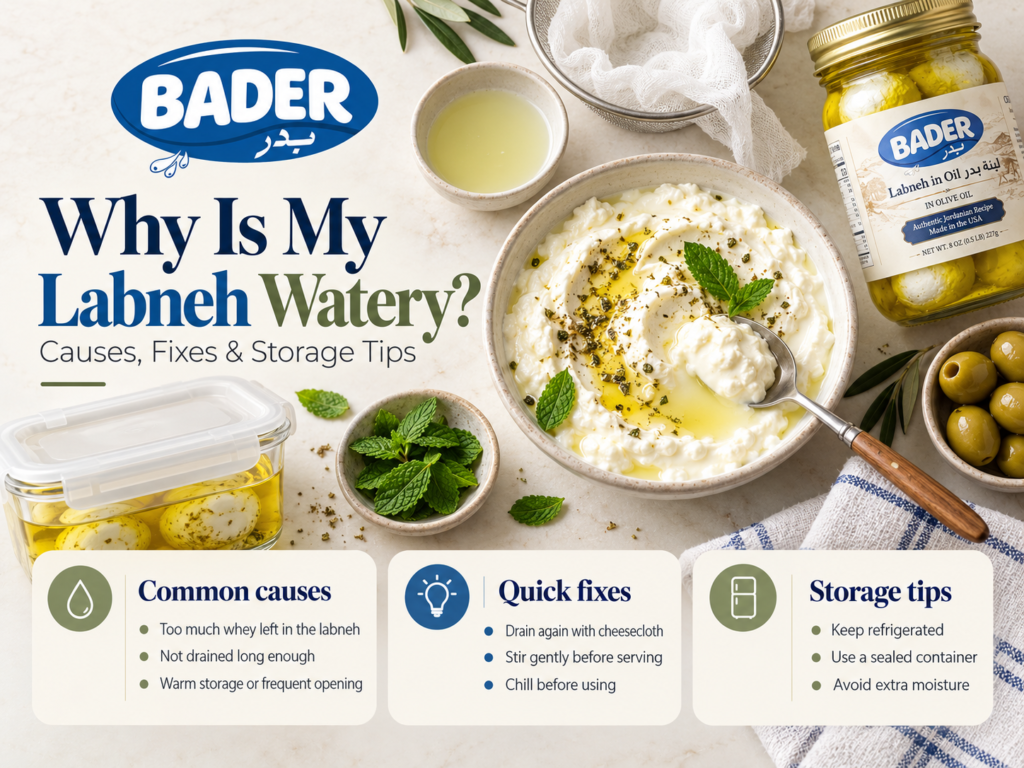
Labneh is a thick cultured dairy product commonly made by straining yogurt to remove some of its whey.
Straining creates a denser texture and concentrates the yogurt’s flavor.
Depending on the degree of straining, labneh may be softly spreadable or firm enough to shape.
What does fresh labneh taste like?
Fresh labneh typically has a pleasantly tangy flavor with a creamy mouthfeel.
It can be compared with thick yogurt or a soft spreadable cheese, although its flavor and production differ from conventional cream cheese.
The acidity comes from cultured dairy fermentation.
How is labneh traditionally served?
One of the simplest presentations involves spreading labneh across a shallow plate, creating a small well in the center, and adding olive oil.
Za’atar may be sprinkled over the top.
The plate is usually served with warm flatbread and other breakfast foods.
Common accompaniments include:
- Tomatoes
- Cucumbers
- Olives
- Fresh mint
- Eggs
- Flatbread
- Olive oil
- Za’atar
This style of serving allows everyone at the table to share the dish.
Can you cook with labneh?
Yes, although its cultured-dairy composition requires some care.
Labneh can be used as a finishing ingredient, spread, dip, or accompaniment.
It may also be added to cooked dishes, but intense heat can affect its consistency.
For everyday use, try spreading labneh on warm bread or serving it with roasted vegetables.
See Bader Dairy Fresh Labneh for more information.
4. Labneh in Olive Oil: Traditional Labneh Balls
Labneh in oil, also called labneh bil zeit, is a traditional way of presenting firmer strained labneh.
The cultured dairy is strained until it becomes thick enough to shape into individual balls.
These balls are then packed in oil, commonly olive oil.
How are labneh balls different from fresh labneh?
The primary difference is their moisture content and presentation.
Fresh labneh is usually spreadable.
Labneh balls are typically firmer and can be lifted individually from their container.
Both share the tangy flavor of cultured dairy.
How are labneh balls served?
They may be placed on a breakfast table or mezze platter alongside:
- Warm pita bread
- Olives
- Tomatoes
- Cucumbers
- Za’atar
- Fresh herbs
You can also spread a labneh ball onto toast or crumble it over a salad.
Does olive oil make labneh shelf-stable?
Not automatically.
Labneh remains a perishable dairy product, and storing it in oil does not eliminate food-safety requirements.
Follow the manufacturer’s instructions for storage and refrigeration.
Bader Dairy’s Labneh in Oil should be kept refrigerated.
Our Labneh in Oil features individually rolled balls packed in olive oil.
5. Jameed: The Dried Dairy Behind Jordanian Mansaf
Few dairy products are as closely associated with Jordanian national food culture as jameed.
Jameed is a traditional dried fermented dairy product.
It is often shaped into firm balls or cones after straining, salting, and drying.
Once dried, traditional jameed can become extremely hard.
Before cooking, it must generally be rehydrated.
Why was jameed traditionally dried?
Drying reduced moisture and made it easier to preserve and transport cultured dairy.
This was particularly valuable in communities where milk production varied by season and refrigeration was unavailable.
Traditional preservation methods allowed dairy to remain part of the diet beyond the period when fresh milk was readily available.
Modern commercially produced jameed must still be stored and handled according to its specific packaging instructions.
What does jameed taste like?
Jameed has a concentrated, tangy, salty dairy flavor.
When rehydrated and used in a sauce, it creates a distinctive savory profile.
This flavor is central to traditional mansaf.
How is jameed used in mansaf?
Mansaf commonly combines lamb, rice, flatbread, and a sauce made from jameed.
Traditional dried jameed is soaked until softened, blended or whisked into liquid, and strained if necessary.
The mixture is then prepared with broth to form the sauce.
The finished sauce complements the lamb and is poured over the assembled dish.
The flavor cannot be replicated exactly by using ordinary fresh yogurt.
Is jameed difficult to prepare?
It requires planning, but the basic process is manageable.
Allow sufficient time for soaking, use the proper amount of liquid, and avoid overheating the dairy sauce.
For the complete meal, see Bader Dairy’s Mansaf with Jameed Recipe.
Learn more about the ingredient on the Jameed product page.
6. Traditional Jordanian Butter
Traditional butter is another important part of Jordanian dairy culture.
Unlike ghee, butter retains more of the original water and nonfat milk components.
This gives it different cooking behavior and a familiar creamy flavor.
What is zibdeh baladi?
Zibdeh baladi is a name commonly associated with traditional or homestyle butter.
Preparation methods differ between households and producers.
Some traditional butters are churned from cream, while others may be associated with cultured dairy methods.
The milk source and processing techniques influence their flavor and texture.
How is traditional butter eaten?
Butter can be served with:
- Warm bread
- Honey
- Date molasses
- Rice
- Cooked vegetables
- Breakfast dishes
It may also be used as an ingredient in certain sweets and pastries.
Why do people use butter instead of ghee?
Butter and ghee are related but have different culinary roles.
Butter contains water and milk solids, making it especially useful for particular baking and sauce applications.
Ghee is more concentrated in fat and generally more suitable for higher-temperature cooking.
Both can be valuable ingredients in the same kitchen.
Bader Dairy makes Fresh Hand-Churned Cow Butter and Fresh Hand-Churned Goat Butter using traditional dairy preparation methods.
How Traditional Jordanian Dairy Products Are Made
Although individual recipes vary, several methods are especially important.
Understanding them helps explain why products made from milk can look and taste so different.
Fermentation
Fermentation uses beneficial microorganisms to transform milk.
These cultures convert some milk sugar into lactic acid, changing the flavor, acidity, and texture.
Cultured dairy products such as yogurt provide the starting point for labneh and certain traditional dried dairy preparations.
Straining
Straining separates part of the liquid whey from cultured dairy.
The longer or more thoroughly a product is strained, the thicker its texture can become.
Labneh is a familiar example.
Clarification
Clarification involves heating butter or dairy fat and separating much of the moisture and milk solids.
This creates concentrated cooking fats such as ghee.
Brining
Brining involves holding cheese in a salted solution.
Salt influences taste, moisture, texture, and microbial activity.
Nabulsi cheese is a well-known example of a traditional brined cheese.
Drying
Drying reduces moisture and concentrates flavor.
Jameed demonstrates how traditional dairy can be transformed into a firm product intended for later rehydration.
These processes helped families use milk in different ways rather than depending entirely on fresh dairy.
Why Sheep, Goat, and Cow Milk All Matter
Traditional Jordanian dairy cannot be understood without considering the animals that supplied milk.
Sheep and goats have long been important to pastoral and agricultural communities in the region.
Cow milk is also used in modern dairy production.
Each milk source has a different composition, which can influence the finished food.
Sheep milk
Sheep milk generally contains relatively high concentrations of fat and protein compared with many standard cow-milk varieties.
It has been used in traditional dairy foods, including preparations associated with jameed and ghee.
Goat milk
Goat milk has its own characteristic composition and flavor.
It is used in various traditional cheeses and other dairy products.
Cow milk
Cow milk is widely used in modern commercial dairy production.
It can be used for butter, ghee, cheese, and cultured dairy products.
At Bader Dairy, different products use different dairy sources and recipes.
When choosing a product, check the actual ingredient label rather than assuming every traditional Jordanian food comes from the same type of milk.
Which Jordanian Dairy Products Are Used for Different Meals?
A useful way to understand these products is to organize them by how they’re eaten.
| Meal or dish | Common dairy choice | Why it’s used |
|---|---|---|
| Traditional breakfast | Labneh | Creamy spread with bread |
| Breakfast cheese plate | Nabulsi | Salty, firm white cheese |
| Mezze platter | Labneh in Oil | Easy-to-serve cultured dairy |
| Mansaf | Jameed | Traditional tangy sauce |
| Mansaf rice | Sheep ghee | Rich dairy aroma |
| Everyday rice | Cow ghee | Buttery flavor |
| Knafeh | Prepared Nabulsi cheese | Soft cheese filling |
| Bread with honey | Traditional butter | Creamy dairy richness |
| Roasted vegetables | Ghee | Concentrated buttery flavor |
| Toasted nuts | Ghee | Adds aroma and richness |
These are traditional or suggested uses, not rigid rules.
Families develop their own preferences, and many ingredients appear in a wide variety of dishes.
How to Build a Traditional Jordanian Breakfast
A traditional Jordanian breakfast is often a shared spread rather than a single plated meal.
The table may include several small dishes arranged so everyone can choose what they enjoy.
A simple version might include:
- A shallow bowl of labneh with olive oil and za’atar.
- Sliced Nabulsi cheese.
- Warm flatbread.
- Olives, tomatoes, and cucumbers.
- Fresh mint.
- Eggs or another savory dish.
- Tea.
Labneh balls in olive oil may also be included.
For a larger gathering, fried Nabulsi cheese and additional small dishes can make the table more substantial.
The appeal comes from the variety and the experience of sharing food.
See our Recipes & Inspiration section for traditional meal ideas.
What Makes Jordanian Dairy Different From Other Middle Eastern Dairy Traditions?
Jordanian dairy shares much of its history with neighboring Levantine cuisines.
Products such as labneh, brined white cheese, and clarified butter are not exclusive to one country.
Similar ingredients and methods appear across Palestine, Lebanon, Syria, and other parts of the region.
Jordanian identity is reflected in how these foods are prepared, combined, and served within local traditions.
Mansaf is a particularly important example.
Its combination of lamb, jameed sauce, rice, and bread is strongly associated with Jordanian hospitality and national food culture.
Likewise, samneh, labneh, and Nabulsi cheese contribute to familiar breakfasts and family meals.
Recognizing their shared regional history does not diminish their importance to Jordanian cuisine.
Instead, it helps explain the connected food traditions of the Levant.
Can You Find Traditional Jordanian Dairy in the United States?
Yes.
Jordanian and Middle Eastern specialty foods are available through some grocery stores, specialty markets, and regional producers in the United States.
However, availability varies depending on the product and location.
Fresh dairy products and certain traditional specialties may be harder to find than shelf-stable packaged foods.
Customers may also encounter different spellings of the same traditional products.
For example:
- Samneh, samna, or ghee
- Labneh or labaneh
- Jameed or jamid
- Nabulsi or Nabulsieh
Knowing these different names can make it easier to recognize products on grocery shelves.
Jordanian dairy made in Illinois
Bader Dairy is a Jordanian dairy brand based in Worth, Illinois.
Our company produces traditional dairy products using family recipes and milk sourced from Illinois farms.
The collection includes ghee, Nabulsi cheese, labneh, labneh in olive oil, jameed, and traditional butter.
Rather than selling through an online checkout, we help customers locate products and connect grocery stores, specialty markets, restaurants, and distributors with our team.
Learn more about our background on the Bader Dairy Our Story page.
What Should You Try First If You’re New to Jordanian Dairy?
You do not need to prepare an elaborate meal to begin exploring these foods.
Start with the ingredient that matches your usual cooking habits.
If you enjoy yogurt and creamy spreads: Begin with fresh labneh and serve it with olive oil and warm bread.
If you like salty cheeses: Try Nabulsi cheese with breakfast or prepare a few fried slices.
If you enjoy cooking rice: Use a small amount of cow ghee to finish a pot of rice.
If you want a traditional appetizer: Serve labneh balls in olive oil with pita and fresh vegetables.
If you’re preparing a special Jordanian meal: Learn how jameed is used in mansaf.
If you enjoy rich traditional flavors: Explore sheep ghee and its role in lamb and rice dishes.
Starting with familiar foods allows you to appreciate each new ingredient without needing to learn an entirely new style of cooking at once.
How to Store Traditional Jordanian Dairy Safely
Different dairy products have different storage requirements.
Do not assume that because a product is salted, clarified, dried, or stored in oil it is automatically safe at room temperature.
Use the manufacturer’s directions.
Fresh labneh and labneh balls
These are perishable cultured dairy products.
Keep them refrigerated according to the packaging.
Nabulsi cheese
Store according to the product’s refrigeration and brine-handling instructions.
Use clean utensils and avoid contamination.
Butter
Keep refrigerated unless the manufacturer specifically provides different storage instructions.
Ghee
Storage requirements depend on the product’s processing and packaging.
Follow the label.
Jameed
Traditional dried jameed can have very different storage requirements from reconstituted jameed.
Once soaked or mixed with water, treat it as a perishable dairy preparation and follow appropriate refrigeration directions.
For all products, observe expiration or best-by information and avoid consuming products with signs of spoilage.
Frequently Asked Questions About Jordanian Dairy
What is the most famous traditional Jordanian dairy product?
Jameed is especially well known because of its central role in mansaf, Jordan’s national dish. Labneh, Nabulsi cheese, and samneh baladi are also important traditional foods.
What is Jordanian cheese called?
Jordanian and Levantine cuisine includes several cheese varieties. Nabulsi cheese, or jibneh Nabulsieh, is one of the most recognizable traditional white cheeses.
What is samneh baladi?
Samneh baladi is a traditional clarified dairy fat used for cooking, especially rice, meat dishes, and certain pastries.
What is the difference between labneh and jameed?
Labneh is a thick strained cultured dairy product commonly served fresh. Jameed is a salted, dried fermented dairy product usually rehydrated for cooking.
Is Nabulsi cheese the same as feta?
No. Both can be salty white cheeses, but they generally have different textures, traditional preparations, and cooking behaviors.
What dairy is used in mansaf?
Traditional mansaf uses jameed to prepare its characteristic sauce. Some preparations also use traditional ghee.
Can you eat labneh for breakfast?
Yes. Labneh is a common breakfast food served with olive oil, za’atar, warm bread, vegetables, and olives.
Are all Jordanian dairy products made from sheep milk?
No. Depending on the recipe and producer, Jordanian dairy products may use sheep, goat, cow, or blended dairy sources.
Is ghee dairy-free?
No. Ghee is made from dairy fat and should not be assumed safe for people with milk allergies.
Is jameed the same as dried yogurt?
Jameed is commonly described as dried fermented yogurt or dried cultured dairy, although traditional preparation methods vary.
Can you make knafeh with Nabulsi cheese?
Yes. Nabulsi cheese is traditionally associated with Nabulsi-style knafeh. Excess salt is generally reduced before using it in the dessert.
Where can you buy Jordanian dairy products in Illinois?
Bader Dairy makes traditional Jordanian dairy products in Worth, Illinois. Customers can contact the company to ask about the shop, product availability, and retailers carrying its products.
Preserving Jordanian Dairy Traditions at Bader Dairy
Traditional Jordanian dairy is about more than individual ingredients.
It reflects generations of knowledge about preserving milk, developing flavor, and creating foods that bring people together.
Labneh transforms cultured yogurt into a creamy spread.
Jameed concentrates dairy into an ingredient essential to mansaf.
Nabulsi cheese brings the flavor of the Levant to breakfasts and desserts.
Samneh baladi adds distinctive richness to rice and other traditional dishes.
And fresh butter remains part of everyday home cooking.
At Bader Dairy, our goal is to continue these traditions while producing our dairy products in the United States.
We make and package our products in Worth, Illinois, using family recipes and locally sourced milk.
Explore the complete Bader Dairy product collection to discover the foods discussed in this guide.
For more cooking ideas, visit our Recipes & Inspiration section.
Looking for Bader Dairy products?
Visit Where to Find Bader to inquire about purchasing our products.
Interested in wholesale distribution?
Grocery stores, specialty markets, restaurants, and distributors can contact us through our Wholesale Inquiry page.
Bader Dairy
6903 W 111th St, Worth, IL 60482
Phone: (708) 827-5174
Website: baderdairy.com
Traditional Jordanian dairy, made in Illinois.