By Bader Dairy | Traditional Jordanian Dairy Producers in Worth, Illinois
Published: October 21, 2026 | Reading time: Approximately 10 minutes | Category: Our Products
You open a container of labneh expecting a thick, creamy spread, but instead you notice a layer of pale liquid on top. Maybe the labneh seems thinner than it did when you first opened it, or perhaps homemade labneh never became thick enough to spread on bread.
Does this mean something is wrong? Has the labneh spoiled? Should you pour the liquid away or mix it back in?
In many cases, the answer is simpler than you might expect.
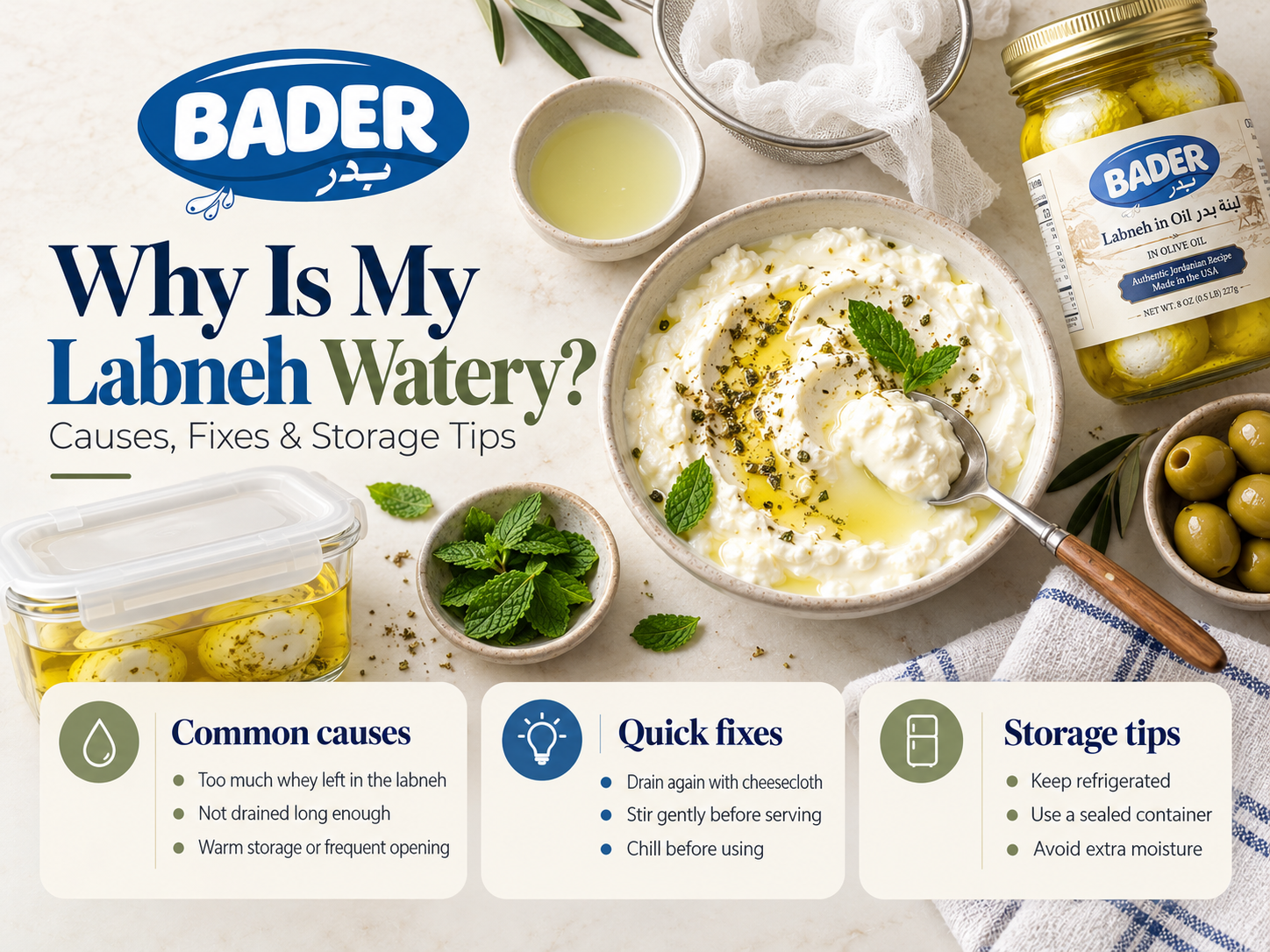
Labneh becomes watery when liquid whey separates from its cultured dairy structure. This natural process is called syneresis. A small amount of whey on top of properly refrigerated labneh does not automatically mean it has spoiled. Depending on the amount of liquid and the desired texture, you can gently stir it back in or drain some away.
However, significant separation combined with unusual odors, visible mold, damaged packaging, or improper storage deserves a different response. Food safety comes before texture.
At Bader Dairy, we produce traditional Jordanian labneh in Worth, Illinois. Understanding how strained dairy behaves can help you serve it properly, maintain its texture, and recognize when an apparent texture problem may be something more serious.
Why Does Labneh Separate and Become Watery?
Labneh is made by straining cultured dairy, traditionally yogurt, to remove part of its whey.
During fermentation, bacterial cultures convert some of the milk’s lactose into lactic acid. This changes the acidity of the milk and causes its proteins to form a gel-like structure.
The structure holds moisture, fat, and other components together.
When yogurt is strained, a portion of the liquid whey drains away, leaving a thicker cultured dairy product.
But even after straining, labneh retains moisture.
Over time, some of that moisture can separate from the protein structure and collect on the surface.
This is why a container of labneh may develop a thin layer of liquid even when it has been properly made and stored.
What is the liquid on top of labneh?
The liquid is usually whey.
Whey is the watery portion of cultured dairy and contains water along with dissolved components such as lactose, minerals, and some proteins.
It may appear:
- Pale yellow
- Slightly cloudy
- Almost transparent
- Thin and watery
A small amount of whey is not unusual in strained dairy.
The important distinction is between ordinary separation in an otherwise properly stored product and changes that could indicate deterioration.
Is Watery Labneh Safe to Eat?
Sometimes, yes.
If labneh has remained properly refrigerated, is within its labeled date and after-opening guidance, and has developed only a small amount of normal whey separation, the liquid alone is not necessarily a sign of spoilage.
However, appearance and smell cannot reliably establish food safety.
Do not taste food that you suspect may be spoiled.
Discard labneh if you notice visible mold, damaged or swollen packaging, or other clear signs of deterioration. Also discard it when its storage history makes it unsafe, even if it looks normal.
If a perishable dairy product has been left at room temperature for more than two hours, or more than one hour above 90°F (32°C), it should generally be discarded.
Normal separation or possible spoilage?
| Observation | What it may mean | What to do |
|---|---|---|
| Thin layer of pale liquid | Normal whey separation | Follow storage guidance; stir or drain if otherwise suitable |
| Slightly thinner texture | Moisture movement or mixing | Adjust texture if safe |
| Very watery throughout | Insufficient straining or structural changes | Evaluate storage history and product condition |
| Visible mold | Potential spoilage | Discard the product |
| Swollen or leaking package | Possible packaging or microbiological problem | Do not consume |
| Unusual odor or discoloration | Possible deterioration | Discard |
| Left unrefrigerated too long | Potential food-safety risk | Discard according to food-safety guidance |
Do not rely on stirring or restraining to make questionable dairy safe.
7 Reasons Your Labneh May Be Watery
1. Natural whey separation
Even thick labneh contains moisture.
As the dairy sits, some of its whey can separate and rise to the top.
This can occur in both homemade and commercially produced products.
A small amount of separated whey is not necessarily a manufacturing defect.
2. Insufficient straining
Labneh gets its characteristic thickness through moisture removal.
If the cultured yogurt is not strained sufficiently, the finished product may retain more water than desired.
Homemade labneh that resembles ordinary yogurt rather than a thick spread may simply require additional straining.
3. Differences in the milk
Milk composition influences the texture of cultured dairy.
Factors include:
- Protein concentration
- Fat content
- Total milk solids
- Milk source
- Processing conditions
Products made from different milk blends may behave differently.
Cow, goat, and sheep dairy are not chemically identical, and variations in the raw ingredients can affect the finished product.
4. Disturbance of the protein structure
The texture of labneh depends partly on its protein network.
Stirring, mixing, transferring, and other mechanical actions can change how the product holds moisture.
Aggressive handling may make certain cultured dairy products appear less structured.
The effect depends on the formulation and processing method.
5. Storage temperature
Temperature affects the quality and stability of cultured dairy.
Labneh stored at higher temperatures may undergo faster chemical and microbiological changes than properly refrigerated labneh.
Research on concentrated yogurt has documented changes in acidity, whey separation, and overall quality during storage.
Keep refrigerated products at the temperature specified on their packaging.
6. Extended storage
Even under refrigeration, labneh is perishable.
Over time, texture and flavor can change.
A product that looks different near the end of its intended storage period may have undergone natural or undesirable changes.
Do not assume that draining the whey resets the product’s shelf life.
7. Changes in acidity
Acidity influences the way dairy proteins interact.
As cultured dairy changes during storage, its protein structure and ability to retain moisture may change too.
This can affect thickness and separation.
A tangy flavor is normal for labneh, but an unexpectedly sharp or otherwise abnormal change should not automatically be treated as harmless.
How to Fix Watery Labneh: Step by Step
Before attempting to improve the consistency, make sure the labneh has been stored properly and shows no signs of deterioration.
These methods address texture only. They cannot correct unsafe storage or spoilage.
Method 1: Gently stir the whey back in
This is useful when there is only a small amount of normal liquid on top.
Instructions:
- Remove the labneh from the refrigerator.
- Open the container using clean hands and utensils.
- Inspect the product for obvious signs of deterioration.
- Use a clean spoon to gently fold the separated whey into the labneh.
- Stop when the consistency becomes reasonably uniform.
- Serve the amount needed.
- Cover and refrigerate the remainder promptly.
This method retains the separated liquid.
The result may be slightly softer than before.
Best for: Labneh with minor whey separation when a creamy, spreadable consistency is desired.
Method 2: Drain away a small amount of whey
If you prefer a thicker spread, you can remove some of the separated liquid.
Instructions:
- Open the refrigerated labneh.
- Use a clean spoon to hold back the thicker portion.
- Carefully pour off a small amount of the liquid.
- Stir the remaining labneh gently.
- Evaluate the consistency.
- Serve or refrigerate promptly.
Avoid removing excessive liquid at once.
A small adjustment may be enough.
Best for: Spreading labneh onto bread or serving it as a thick dip.
Method 3: Strain homemade labneh longer
If your homemade labneh is consistently runny, it may not have been strained sufficiently.
You can allow additional whey to drain under refrigeration.
Instructions:
- Line a clean food-safe strainer with suitable cheesecloth.
- Place the strainer over a bowl.
- Transfer the properly refrigerated labneh into the cloth.
- Cover it.
- Place the entire setup in the refrigerator.
- Allow excess liquid to drain, checking periodically.
- Transfer the thickened labneh into a clean covered container.
Use refrigerated straining rather than leaving cultured dairy at room temperature for an extended period.
Best for: Homemade labneh that is thinner than intended.
This method is not a way to extend the shelf life of an opened commercial product.
Should You Pour Off the Liquid or Mix It Back In?
There is no single answer for every situation.
It depends on the amount of separated liquid and the consistency you want.
If only a teaspoon or two of whey has collected on top, gently mixing it back into otherwise wholesome labneh may be convenient.
If you want a particularly thick spread for bread, removing some liquid may produce a better result.
For dips or dressings, the additional moisture may even be useful.
When to keep the whey
Consider mixing it back in when:
- The amount is small.
- You prefer a softer texture.
- You’re making a dip.
- You’re spreading labneh onto a plate.
- The product has been stored and handled correctly.
When to drain it
Consider draining some whey when:
- You’re making a thick sandwich spread.
- You want labneh that holds its shape on a serving plate.
- You’re preparing a topping for toast.
- The product is otherwise safe but slightly thinner than preferred.
Neither method should be used to conceal spoilage or compensate for improper refrigeration.
How to Make Homemade Labneh Thicker
For people making labneh at home, achieving the desired thickness starts before storage.
Several factors influence the result.
Start with suitable plain yogurt
Traditional labneh begins with cultured dairy.
Using yogurt with an appropriate consistency and composition helps produce a thicker finished spread.
The amount of liquid that drains depends on the yogurt and the preparation method.
Use the right straining material
A fine cheesecloth or suitable food-safe filtering material allows whey to drain while retaining the thicker dairy.
A cloth with large openings may allow too much of the yogurt to pass through.
A very restrictive material may slow drainage.
Keep it refrigerated while straining
Place the straining setup in the refrigerator.
This helps maintain a safe temperature while the dairy drains.
Do not use extended room-temperature straining as a shortcut.
Allow sufficient drainage
The longer whey drains, the thicker the labneh may become.
However, the result depends on the starting yogurt and the conditions.
Rather than relying entirely on a fixed number of hours, evaluate the texture periodically.
Avoid adding unnecessary liquid
Ingredients such as lemon juice, water, or other liquids can change the consistency.
If you are preparing a very thick labneh, add liquids only after the desired base texture has been achieved.
What Is the Ideal Texture of Labneh?
There is no single ideal thickness for every use.
The appropriate consistency depends on how the labneh will be served.
| Intended use | Preferred consistency |
|---|---|
| Traditional breakfast plate | Thick and spreadable |
| Pita sandwich | Firm enough to stay inside bread |
| Vegetable dip | Creamy and scoopable |
| Salad dressing | Softer and more pourable |
| Toast topping | Thick enough to hold toppings |
| Labneh balls | Much firmer, suitable for shaping |
| Sauce accompaniment | Smooth and easily spooned |
For a traditional Jordanian breakfast, labneh should generally be thick enough to spread across a shallow plate while still feeling creamy.
At Bader Dairy, our Fresh Labneh is described as thick without being stiff, with a pleasantly tart character.
Why Does Labneh Become Watery in a Sandwich?
Sometimes labneh appears perfectly thick when first spread onto bread but becomes wetter later.
This may be caused by several things.
Moisture from vegetables
Tomatoes, cucumbers, and other vegetables contain substantial amounts of water.
When sliced and combined with salt or other ingredients, they may release liquid.
That moisture can soak into the bread and create the impression that the labneh itself has become watery.
Preparing sandwiches too early
A sandwich assembled hours before eating has more time for moisture to move between ingredients.
This can soften the bread and change the overall texture.
Too much olive oil
Olive oil is a traditional and delicious accompaniment to labneh.
However, adding a large quantity directly to a sandwich may make the bread feel overly saturated.
How to prevent a soggy labneh sandwich
- Use thick labneh.
- Drain especially juicy vegetables.
- Add tomatoes shortly before serving.
- Use sturdy bread.
- Keep the sandwich appropriately refrigerated if preparing ahead.
- Pack wet toppings separately when practical.
For more traditional serving ideas, explore Bader Dairy’s Recipes & Inspiration.
Why Is Labneh Watery After Refrigeration?
Refrigeration helps preserve perishable dairy, but it does not completely prevent whey separation.
The protein network may continue to release some liquid during storage.
A thin layer of whey can therefore appear even when the labneh has remained cold.
However, excessive separation can also be associated with changes in processing, composition, or quality.
This is why proper storage and evaluation of the entire product matter.
What temperature should labneh be stored at?
Keep refrigerated labneh at 40°F (4°C) or below, or at the more restrictive temperature specified by the manufacturer.
Bader Dairy lists this refrigeration temperature for its Fresh Labneh product.
Keep the container tightly covered when not in use.
Can temperature fluctuations affect labneh?
Yes.
Repeatedly allowing refrigerated dairy to warm and then cooling it again can affect quality and may introduce food-safety risks.
Take out only the portion you plan to use.
Return the main container to the refrigerator promptly.
Avoid leaving the full jar on a breakfast table throughout a long meal.
Is Watery Labneh the Same as Spoiled Labneh?
No.
Whey separation and spoilage are different processes.
Whey separation is a physical change involving liquid leaving the dairy structure.
Spoilage involves undesirable microbiological or chemical deterioration.
However, separation can also accompany changes during storage, and the two processes are not always independent.
The presence of whey alone cannot tell you whether labneh is safe.
Signs that require caution
Discard the product if you notice:
- Visible mold.
- Swelling or damage to the packaging.
- Unusual discoloration.
- A clearly abnormal odor.
- Other unmistakable signs of deterioration.
Also discard dairy that has exceeded safe temperature limits or storage instructions, regardless of appearance.
Can you remove mold and eat the rest?
No.
For soft, high-moisture dairy products such as labneh, do not scrape off visible mold and consume the remainder.
Contamination may extend beyond the visible area.
Discard the product.
Why Does Labneh Sometimes Become Grainy?
Watery labneh and grainy labneh are not identical problems.
Graininess can result from changes in the dairy protein structure, processing conditions, or handling.
In some cases, texture changes occur alongside whey separation.
Can stirring fix grainy labneh?
Gentle stirring may improve the appearance of some products, but it cannot reverse every structural change.
If graininess is associated with overheating or significant protein changes, the original smooth texture may not return.
Avoid adding water simply to conceal the problem.
If the product has an abnormal odor, visible contamination, or unsafe storage history, discard it.
What Is the Difference Between Fresh Labneh and Labneh Balls?
Both products begin with strained cultured dairy, but they are typically prepared to different consistencies.
Fresh labneh is thick and spreadable.
Labneh balls are strained further until the dairy is firm enough to shape.
The balls are often packed in olive oil and served with bread, herbs, and other traditional foods.
Why do labneh balls hold their shape?
Additional moisture removal generally contributes to a firmer structure.
This allows portions to be rolled into individual balls.
The degree of firmness depends on the recipe and process.
Are labneh balls supposed to be watery?
They should have a texture appropriate for their preparation, but the exact firmness varies.
If a packaged labneh ball product shows unexpected changes, follow the manufacturer’s guidance rather than assuming it needs to be strained again.
Bader Dairy makes Labneh in Oil with hand-rolled labneh balls packed in olive oil.
For serving suggestions, our guide to How to Eat Labneh Balls in Olive Oil explores breakfast, sandwiches, mezze platters, and other easy preparations.
Can You Freeze Labneh to Make It Thicker?
Freezing is not a dependable method for improving labneh’s texture.
Ice crystals can form within the dairy.
During thawing, changes in the protein structure and moisture distribution may lead to additional separation.
A previously smooth product may become grainy or watery.
If your objective is to make fresh labneh thicker, refrigerated straining is generally more appropriate than freezing.
Follow any product-specific freezing instructions provided by the manufacturer.
How Long Does Fresh Labneh Last?
There is no single shelf life that applies to all fresh labneh products.
Storage life depends on:
- Manufacturing process
- Packaging
- Acidity
- Ingredient formulation
- Refrigeration
- Handling
- Whether the container has been opened
For commercially produced labneh, follow the printed date and any after-opening instructions.
Never use a general internet estimate to override the manufacturer’s directions.
Does whey separation mean labneh has expired?
Not by itself.
A small amount of whey can separate during normal storage.
However, it is not proof that the product remains safe either.
Use the labeled date, storage instructions, and handling history when deciding whether to consume it.
Can you keep labneh outside the refrigerator?
Fresh labneh is a perishable dairy product.
It should not be treated as shelf-stable unless a manufacturer has specifically established that the particular product is safe for such storage.
Bader Dairy Fresh Labneh requires refrigeration.
How to Serve Labneh After Fixing Its Texture
Once you’ve adjusted the consistency of properly stored labneh, you can serve it in several simple ways.
Traditional labneh with olive oil and za’atar
This preparation highlights the dairy itself.
Ingredients:
- ½ cup fresh labneh
- 1–2 teaspoons olive oil
- ½ teaspoon za’atar, or to taste
- Warm flatbread
- Optional fresh mint
Instructions:
- Spoon the labneh into a shallow serving bowl.
- Spread it outward using the back of a spoon.
- Create a small well in the center.
- Drizzle with olive oil.
- Sprinkle with za’atar.
- Add fresh mint if desired.
- Serve with warm bread.
The labneh should be thick enough to hold the shallow well while remaining soft and creamy.
Labneh with roasted vegetables
Place roasted eggplant, zucchini, or carrots on a serving platter.
Add spoonfuls of chilled labneh shortly before serving.
Finish with herbs or olive oil.
Labneh breakfast toast
Spread thick labneh onto toasted bread.
Add sliced cucumber, tomatoes, and a little za’atar.
If preparing ahead, keep wet toppings separate until serving.
Labneh dip
If your labneh is too thick for dipping but otherwise suitable to eat, stir in a small amount of olive oil or another appropriate recipe ingredient.
Adjust gradually until it reaches your preferred consistency.
The Role of Texture in Traditional Jordanian Labneh
In Jordanian and wider Levantine cooking, labneh is more than a yogurt substitute.
Its thickness is an important part of how it is served.
Traditionally, it is spread onto a plate rather than poured into a bowl like ordinary drinkable yogurt.
The consistency allows olive oil to collect in a small well at the center.
Warm bread can then be used to scoop up the labneh, oil, and seasonings together.
The contrast between the tangy dairy and rich olive oil is one of the most recognizable features of the dish.
Texture also distinguishes fresh labneh from more concentrated forms prepared as balls.
These differences come from traditional techniques for managing moisture in cultured dairy.
At Bader Dairy, we continue producing Jordanian dairy products at our facility in Worth, Illinois, bringing traditional flavors and preparation methods to customers in the United States.
Learn more about our company through Our Story.
Frequently Asked Questions About Watery Labneh
Why is there water on top of my labneh?
The liquid is usually whey that has separated from the cultured dairy. This process is called syneresis.
Is it normal for labneh to release water?
A small amount of whey separation can be normal. Large or unexpected changes should be assessed alongside storage conditions and overall product quality.
Should I drain the liquid from labneh?
You can gently drain a small amount if you want a thicker consistency, provided the product has been stored safely. Mixing it back in is another option.
Can you stir watery labneh?
Yes. Gentle stirring may restore a more uniform consistency when only a small amount of whey has separated.
How do you thicken homemade labneh?
Place it in a clean cheesecloth-lined strainer over a bowl and allow additional whey to drain under refrigeration.
Why is my homemade labneh runny?
It may have retained too much liquid during straining. The original yogurt composition and preparation method also affect thickness.
Why is my labneh grainy?
Changes in dairy proteins, processing, or handling can affect texture. Stirring may help some products but will not reverse every structural change.
Does watery labneh mean it has gone bad?
Not necessarily. However, watery appearance alone cannot establish that it is safe. Evaluate storage history, the labeled date, and any warning signs of spoilage.
Can I eat the whey from labneh?
Whey is a natural dairy component. In a properly stored, otherwise wholesome product, normal separated whey can generally be mixed back into the labneh.
Does freezing labneh make it thicker?
Not reliably. Freezing and thawing can cause additional separation and graininess.
Should fresh labneh be refrigerated?
Yes. Bader Dairy Fresh Labneh requires refrigeration at 40°F (4°C) or below.
How can I stop labneh from making bread soggy?
Use thick labneh, drain wet vegetables, and assemble sandwiches close to serving time.
Why is store-bought labneh sometimes thicker than homemade?
Commercial and homemade products may use different milk compositions, manufacturing methods, and moisture-removal techniques.
Are labneh balls thicker than regular labneh?
Generally, yes. Labneh balls are typically strained to a firmer consistency so they can be shaped.
Discover Traditional Fresh Labneh From Bader Dairy
A small amount of liquid on labneh doesn’t automatically mean something has gone wrong.
Whey separation is part of the science of cultured dairy, and understanding it can help you make better decisions about texture, preparation, and storage.
For properly stored labneh, gentle mixing or removing a small amount of whey may be enough to achieve the consistency you prefer.
For homemade labneh that is too thin, additional refrigerated straining may help.
At Bader Dairy, we make traditional Jordanian labneh and other dairy products in Worth, Illinois.
Our Fresh Labneh is made using cow and goat milk, salt, and live active cultures, and is available in an 8 oz glass jar.
Explore Bader Dairy’s labneh products:
For additional cooking and serving ideas, explore our Recipes & Inspiration collection.
Looking for Bader Dairy products?
Visit Where to Find Bader to inquire about availability.
Own a grocery store, specialty market, or restaurant?
Learn about carrying our products through the Bader Dairy Wholesale Inquiry page.
Bader Dairy
6903 W 111th St, Worth, IL 60482
Phone: (708) 827-5174
Website: baderdairy.com
Traditional Jordanian dairy, made in Illinois.