By Bader Dairy | Traditional Jordanian Dairy Producers in Worth, Illinois
Published: November 3, 2026
Reading Time: Approximately 12 minutes
Finding the right dairy supplier can make a significant difference to a grocery store’s operations. Products need to arrive in good condition, meet customer expectations, and remain available when shoppers return to purchase them again.
For retailers interested in traditional Middle Eastern dairy products, choosing a supplier may require additional research. Products such as Nabulsi cheese, labneh, samneh baladi, and jameed have specific characteristics that buyers should understand before placing an order.
Some are refrigerated cultured dairy products. Others are traditional brined cheeses, concentrated dairy fats, or dried fermented ingredients. Their packaging, handling requirements, and culinary uses can differ considerably.
A reliable Middle Eastern dairy supplier should be able to provide accurate product specifications, clear wholesale terms, appropriate storage and delivery information, and a dependable process for ordering and resolving problems. Buyers should evaluate those factors alongside product flavor, packaging, and customer demand.
This guide explains how grocery store owners and purchasing managers can evaluate prospective dairy partners, compare offers, request samples, and prepare for a successful first wholesale order.
What Should You Look for in a Middle Eastern Dairy Supplier?
The strongest supplier relationship is not necessarily the one offering the lowest price.
A low purchase price may become less attractive if products arrive damaged, have insufficient remaining shelf life, or cannot be replenished consistently.
Before committing to a supplier, examine several areas.
| Evaluation area | What to verify | Why it matters |
|---|---|---|
| Product authenticity | Ingredients, characteristics, intended uses | Meets customer expectations |
| Manufacturing | Producer identity and facility information | Establishes accountability |
| Food safety | Applicable documentation and controls | Supports responsible purchasing |
| Packaging | Unit sizes, labels, case configuration | Affects retail handling |
| Shelf life | Product dates and remaining life at delivery | Helps control waste |
| Distribution | Shipping area, lead times, temperature requirements | Supports reliable inventory |
| Pricing | Unit costs, freight, minimum orders | Determines landed cost |
| Communication | Response times and issue resolution | Helps avoid operational problems |
| Samples | Product and packaging evaluation | Reduces first-order uncertainty |
These factors give retailers a practical framework for comparing manufacturers and distributors.
1. Understand Whether You’re Working With a Manufacturer or Distributor
One of the first questions to ask is whether the company actually makes the dairy products or distributes products manufactured elsewhere.
Both business models can work well, but they offer different advantages.
Working directly with a manufacturer
A manufacturer produces the food itself.
Depending on its operations, a manufacturer may be able to provide direct information about product specifications, ingredients, production methods, packaging, and quality controls.
However, manufacturing a product does not automatically mean a company offers direct delivery to every geographic area.
Distribution capabilities still need to be confirmed.
Working with a distributor
A distributor purchases products from manufacturers or other suppliers and makes them available to retailers.
Some distributors carry many brands and product categories.
This can simplify purchasing for stores that prefer to consolidate orders.
However, retailers may need to verify whether the distributor has access to current manufacturer information and appropriate product documentation.
Questions worth asking
- Who manufactures the products?
- Where is the production facility?
- Are products made in-house or by a co-packer?
- Who is responsible for quality complaints?
- Who handles product recalls or withdrawals?
- Can the supplier provide current specifications?
- Who will deliver and invoice the order?
For retailers interested in a producer with a distinct origin story, direct manufacturing may also help communicate the brand’s identity to shoppers.
A Jordanian dairy manufacturer in Illinois
Bader Dairy makes and packages traditional Jordanian dairy products at its facility in Worth, Illinois.
Its product range includes ghee, Nabulsi cheese, labneh, labneh in oil, jameed, and traditional butter.
The company describes its approach as small-batch production using family recipes and Illinois milk.
Learn more in Small Batch, Made in Worth and the Bader Dairy Our Story.
2. Evaluate Product Quality Before Discussing Volume
A good wholesale relationship begins with products that meet the needs of your customers.
For specialty dairy, quality is not determined only by whether the food tastes pleasant.
Traditional products may have specific characteristics that experienced customers recognize immediately.
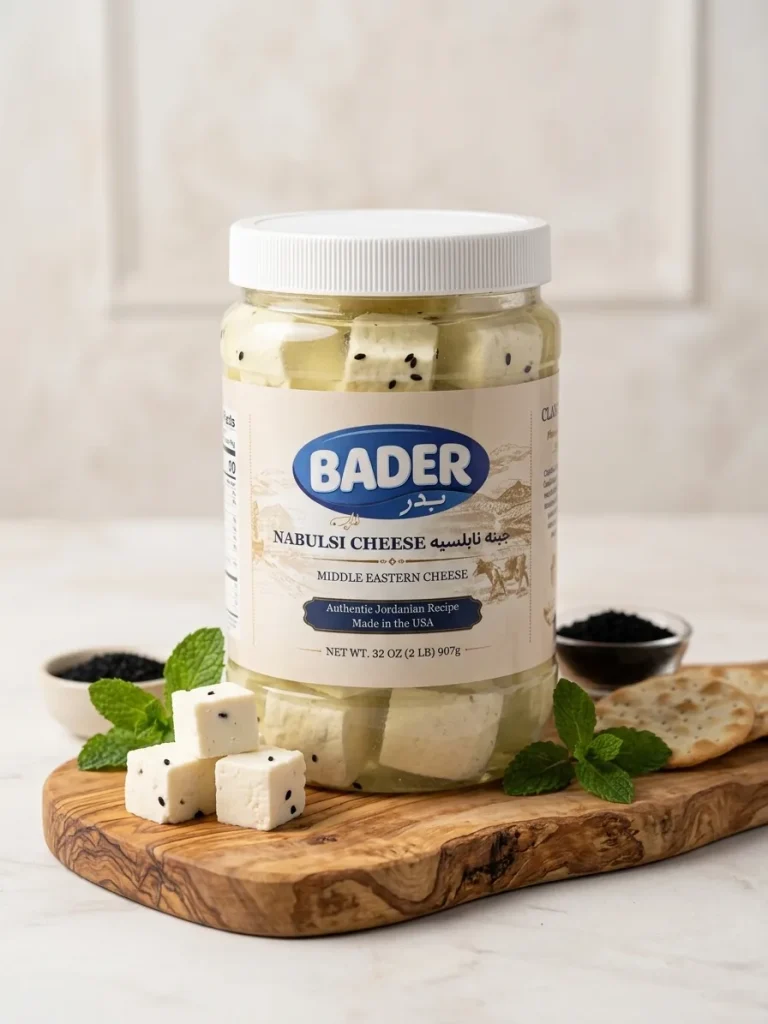
Nabulsi cheese
Retailers should evaluate the cheese’s saltiness, texture, aroma, packaging, and intended cooking applications.
Some traditional Nabulsi cheeses contain aromatic ingredients such as black seed, mahlab, or mastic.
These ingredients may be important to customers familiar with regional recipes.
Bader Dairy’s Nabulsi Cheese includes these traditional ingredients.
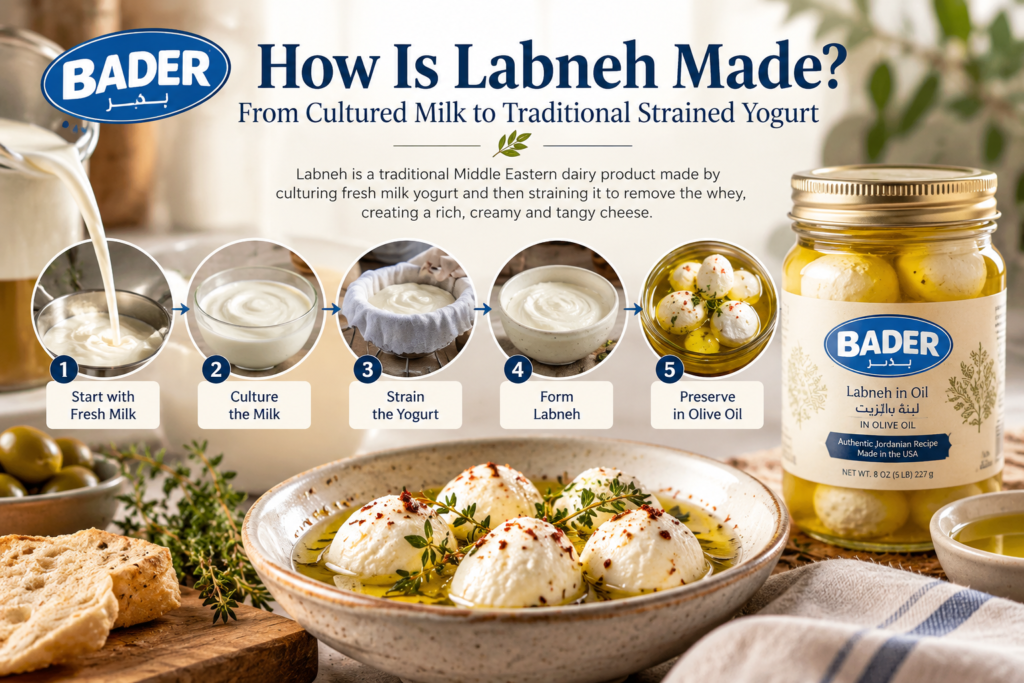
Labneh
Labneh is generally expected to have a thick, creamy texture and cultured dairy flavor.
Retailers should evaluate whether the consistency is appropriate for spreading and serving.
They should also review the product’s refrigeration and after-opening instructions.
Ghee
Ghee quality involves flavor, aroma, product consistency, ingredient composition, and appropriate packaging.
Cow ghee and sheep ghee may have different flavor profiles.
A supplier should be able to explain which product is appropriate for different cooking applications without making unsupported nutritional or health claims.
Jameed
Jameed is a specialized dried fermented dairy ingredient commonly used for mansaf.
Its preparation requirements differ from those of ready-to-eat dairy foods.
Retailers should understand how customers rehydrate and use it before adding it to their assortment.
For an overview of these different foods, explore our Traditional Jordanian Dairy Guide.
3. Request a Complete Product Specification Sheet
A product specification sheet gives buyers practical information needed to evaluate an item.
It should go beyond the marketing description on a website.
Useful information can include:
- Product name and identification code
- Net weight and unit configuration
- Complete ingredients and allergen information
- Nutrition labeling
- Required storage conditions
- Shelf life and date coding
- Packaging details
- Case dimensions and weights
- Lot identification and traceability information
- Relevant manufacturing or certification documentation
Not every product will require identical documentation, and applicable regulatory requirements vary.
However, a supplier should be able to address reasonable questions about the food being purchased.
Why specifications matter
Imagine that a grocery store agrees to carry a new refrigerated cheese.
Before the first delivery, the retailer needs to know how much refrigerated space the product will occupy, how many units arrive in each case, and how long those units can reasonably remain on sale.
Without accurate specifications, even a high-quality product may create preventable operational problems.
Check the actual product label
Marketing content should match the physical package.
Buyers should verify ingredients, allergens, storage instructions, and declared package sizes against current labels.
A website description is helpful, but it should not replace official product documentation.
4. Verify Food Safety and Storage Requirements
Dairy products require careful attention to food safety.
Different products have different risks and storage needs.
For example, fresh labneh and brined cheese are not handled in exactly the same way as some commercially packaged ghee products.
Likewise, dried jameed has different handling requirements before and after rehydration.
Ask about storage temperatures
The supplier should identify the required storage conditions for each product.
Some specialty dairy products require refrigeration throughout shipping, receiving, storage, and display.
Never assume that a product is shelf-stable simply because it is packed in oil, stored in brine, or traditionally associated with preservation.
Ask how refrigerated products are delivered
For products requiring cold-chain control, understand how temperature is maintained during transportation.
Depending on the arrangement, refrigerated trucks, insulated shipping systems, monitoring procedures, or other validated methods may be appropriate.
The correct method depends on the specific food, shipping duration, and applicable requirements.
Check receiving procedures
A retailer should have a process for checking incoming dairy deliveries.
That process may include verifying temperature, package condition, labeling, product dates, and quantities.
Damaged or improperly handled products should be addressed before acceptance.
Request appropriate documentation
Depending on the business relationship, buyers may need information about applicable licenses, inspections, food-safety procedures, traceability, and certifications.
An important rule: Do not assume certification simply because a supplier uses words such as organic, halal, natural, or premium. Request appropriate supporting documentation for claims that matter to your business.
5. Understand Shelf Life Before Placing an Order
Shelf life affects purchasing, storage, display, and waste.
It is particularly important for retailers with limited refrigerated space or products that sell at a slower rate.
Total shelf life versus remaining shelf life
A product may have a defined total shelf life from its manufacturing date.
But the retailer is concerned with how much time remains when the shipment arrives.
Those are not the same number.
For example, a store should know whether it will receive products with sufficient remaining life to sell them through its normal inventory cycle.
Questions to ask the supplier
How is the product date determined? What minimum remaining shelf life is expected upon delivery? What happens if a shipment arrives with less remaining life than agreed? How should the product be stored after opening?
These questions should be answered before a large order, not after the product reaches the store.
Why different products require different planning
Fresh labneh, Nabulsi cheese, butter, ghee, and dried jameed may all have different storage and shelf-life characteristics.
Retailers should evaluate each product separately.
Do not apply a universal expiration assumption to the entire specialty dairy collection.
6. Calculate the True Cost of a Wholesale Dairy Order
Wholesale unit price is only one component of purchasing cost.
Retailers should calculate the total cost of bringing products into the store.
This is often called landed cost.
What goes into landed cost?
Landed cost may include the supplier’s product price, freight charges, handling fees, applicable taxes or duties, and other acquisition expenses.
Refrigerated shipping can create additional costs compared with products that do not require temperature-controlled transport.
Example of landed cost
Suppose a retailer orders 48 jars of specialty dairy.
The purchase and delivery costs are hypothetical:
| Item | Amount |
|---|---|
| Product cost: 48 jars at $6 | $288 |
| Freight and handling | $48 |
| Total acquisition cost | $336 |
| Landed cost per jar | $7 |
The true cost per jar is $7, not $6.
If the store sells each jar for $10, its gross margin before other store expenses would be 30%.
This example is for educational purposes and does not represent Bader Dairy pricing.
Consider spoilage and shrink
A product with a seemingly attractive wholesale price may become less profitable if a large portion expires before being sold.
Retailers should consider expected sales velocity and potential waste.
Ask about payment terms
Clarify when payment is due, how invoices are issued, whether credit terms are available, and whether pricing changes based on order volume.
Do not assume every manufacturer or distributor offers the same terms.
7. Confirm Minimum Orders, Case Sizes, and Lead Times
Retailers should know exactly how the ordering process works.
This becomes particularly important when purchasing from a small-batch producer.
Minimum order quantity
Some suppliers require a minimum number of units, cases, or total order value.
Others structure minimums around delivery areas or product categories.
Ask for the actual requirements rather than relying on assumptions.
Case configuration
Find out how many individual retail units are included in each case.
Also ask whether different products can be combined within one order.
Production and delivery lead times
Lead time is the period between placing an order and receiving the products.
It may include manufacturing, order preparation, and transportation.
Retailers should understand normal lead times and what might cause delays.
Reorder planning
A useful reorder process considers how quickly products sell and how long replacement inventory takes to arrive.
For slower-moving specialty items, ordering smaller quantities more frequently may be appropriate if the supplier’s terms support it.
For popular products, stores may need larger safety stocks.
These decisions should be based on actual sales data and supplier capabilities.
8. Request Samples Before a Larger Purchase
Samples can help buyers evaluate a product before committing significant shelf space.
For specialty dairy, this is particularly useful because traditional flavor and texture expectations can vary between customers.
What should a sample evaluation include?
Evaluate the sample under conditions appropriate to the product.
Consider the flavor, texture, packaging, labeling, net quantity, appearance, and intended use.
For Nabulsi cheese, a buyer might assess how it performs when sliced and fried.
For labneh, the evaluation may focus on texture and spreadability.
For ghee, aroma and cooking performance may be important.
For jameed, preparation instructions and how it performs in a tested recipe may matter.
Use consistent criteria
Rather than simply asking whether staff members like a product, create a short evaluation form.
| Evaluation factor | Suggested score |
|---|---|
| Flavor and aroma | 1–5 |
| Texture and consistency | 1–5 |
| Packaging presentation | 1–5 |
| Label clarity | 1–5 |
| Fit with customer demand | 1–5 |
A scoring system helps document preferences, although it does not replace required safety or regulatory checks.
Ask about sampling arrangements
Some suppliers may provide samples or arrange product demonstrations.
Availability, shipping, and sample charges should be confirmed directly.
Bader Dairy’s Wholesale Inquiry page provides a way to discuss samples and an initial order.
9. Test the Supplier With a Small Initial Order
A well-planned trial order can reveal operational issues that aren’t apparent during a sales conversation.
For example, a supplier may offer excellent products but use packaging that does not work well with a retailer’s existing shelves.
Or a product may appeal strongly to a small customer segment while taking longer to sell than expected.
Establish a trial period
Choose a reasonable evaluation period based on product shelf life, delivery arrangements, and expected demand.
Measure the right things
Useful indicators include product sell-through, packaging damage, temperature compliance, customer feedback, order accuracy, and delivery reliability.
Record the outcome
After the trial, ask whether the products met expectations, which items sold, whether any were wasted, and how effectively the supplier handled questions.
Expand based on evidence
Successful initial products can justify a broader assortment.
If demand for fresh labneh is strong, a retailer may explore labneh in oil.
If traditional cooking fats perform well, cow and sheep ghee may deserve additional shelf space.
For a detailed discussion of assortment planning, see our Grocery Store Owner’s Guide to Stocking Middle Eastern Dairy Products.
10. Evaluate Communication and Long-Term Reliability
A good supplier relationship continues after the first order arrives.
Questions and problems can arise even when both businesses operate carefully.
What matters is whether there is a clear process for addressing them.
Look for responsive communication
Buyers should know whom to contact about orders, invoices, damaged products, missing items, or documentation requests.
Ask about product availability
Find out how the supplier communicates temporary shortages or production delays.
Understand complaint handling
Ask how quality complaints are recorded and evaluated.
Who should the retailer contact? What information should be provided? What happens if a product needs to be withdrawn or recalled?
Consider growth capacity
A store may begin with a small trial and later expand to multiple locations.
Retailers should discuss whether the supplier can support the planned growth, without assuming any particular capacity.
For a manufacturer focused on traditional small-batch products, realistic expectations are especially important.
Supplier Evaluation Scorecard for Grocery Buyers
You can use the following framework to compare potential suppliers.
Give each category a score from 1 to 5 after verifying the relevant information.
| Factor | Weight |
|---|---|
| Product quality and customer fit | 25% |
| Food safety and documentation | 25% |
| Delivery and reliability | 20% |
| Pricing and wholesale terms | 15% |
| Communication and support | 10% |
| Brand and product education | 5% |
Multiply each score by its weight and compare the totals.
However, this scorecard has one important limitation: food-safety and legal requirements are mandatory checks, not deficiencies that can be offset by a low price or excellent customer service.
Only use weighted scoring after the supplier has satisfied the essential requirements.
Common Mistakes When Selecting a Specialty Dairy Supplier
Choosing solely on price
A cheaper product may not deliver the quality, reliability, or remaining shelf life a store needs.
Consider total operating cost.
Ignoring storage requirements
Not all traditional dairy products can be displayed in the same section.
Verify the instructions for every item.
Ordering too much initially
A large first order can create avoidable waste if demand has not been tested.
Start with quantities that fit a realistic sales forecast.
Failing to review labels
Ingredient, allergen, and storage information should be accurate and suitable for the intended retail market.
Assuming manufacturing capacity
A supplier may have a growing product catalog but limited production or delivery capacity.
Confirm what is available and how frequently it can be replenished.
Not establishing a reorder procedure
Even popular products can become unavailable to customers if the retailer does not know when or how to reorder.
Why the Manufacturer’s Story Can Matter to Grocery Shoppers
Customers shopping for traditional foods may care about more than price.
They may want to know where a product comes from, who makes it, and whether its preparation reflects familiar culinary traditions.
For specialty dairy, this information can be particularly useful.
Origin and authenticity
Traditional Jordanian products can have recognizable flavors, ingredients, and preparation methods.
A manufacturer’s ability to explain those characteristics may help retailers educate shoppers.
Local manufacturing
Regional production can provide a distinct origin story.
Bader Dairy’s dairy products are made and packaged in Worth, Illinois, using traditional Jordanian recipes.
Ingredient knowledge
A supplier familiar with its products can help explain how Nabulsi cheese is used in cooking, why jameed needs rehydration, or how different kinds of ghee contribute to traditional dishes.
This information can become useful educational material for stores and their customers.
Bader Dairy’s Journal and Recipes & Inspiration provide additional information about the ingredients and their culinary uses.
Considering Bader Dairy as a Wholesale Partner
Bader Dairy is a traditional Jordanian dairy producer located in Worth, Illinois.
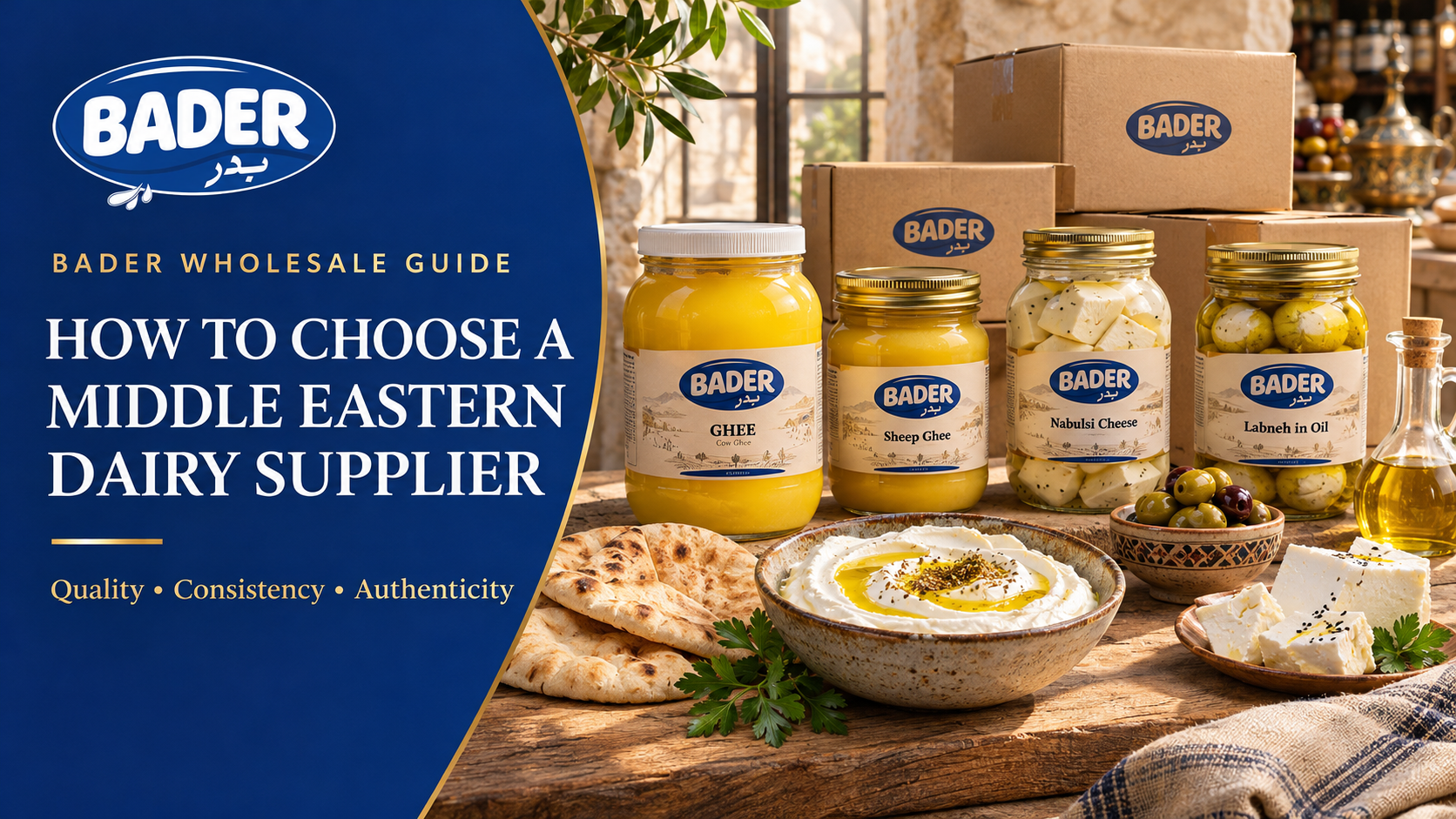
Our product collection includes cow ghee, sheep ghee, Nabulsi cheese, fresh labneh, labneh in olive oil, jameed, hand-churned cow butter, and hand-churned goat butter.
We work with businesses interested in carrying traditional Jordanian dairy, including grocery stores, specialty markets, restaurants, and distributors.
Our wholesale inquiry process allows prospective partners to identify their businesses, locations, and products of interest.
The next step is to discuss current product specifications, pricing, case sizes, samples, and available ordering arrangements.
No retailer needs to guess at minimum orders, delivery coverage, or specific commercial terms before contacting the team.
Request Wholesale Information From Bader Dairy
Frequently Asked Questions
How do I find a reliable Middle Eastern dairy supplier?
Start by identifying manufacturers or distributors offering the products you need. Verify specifications, food-safety documentation, storage requirements, wholesale terms, and delivery capabilities. Request samples and consider a trial order.
What documents should a dairy supplier provide?
Depending on the products and purchasing relationship, buyers may request product specifications, ingredient and allergen statements, labeling, shelf-life information, traceability details, and applicable regulatory or certification documentation.
Is buying directly from a dairy manufacturer better?
Not necessarily. Direct manufacturing may offer closer access to production information, while distributors can simplify consolidated purchasing. The better choice depends on product availability, logistics, pricing, and service.
How do I compare wholesale dairy prices?
Calculate landed cost, including the product price and applicable freight or handling expenses. Also consider waste, shelf life, and inventory turnover.
What is the minimum wholesale dairy order?
Minimum order requirements vary by supplier. Ask about case quantities, total order thresholds, and any different requirements for delivery or initial orders.
Should I request dairy samples before ordering?
Samples are useful for evaluating flavor, texture, packaging, and suitability. They do not replace documentation and food-safety verification.
Do Middle Eastern dairy products require refrigeration?
Many do, including fresh labneh and Nabulsi cheese. Other products have different requirements. Follow product-specific labeling and applicable regulations.
How can I evaluate a new supplier’s reliability?
Review order accuracy, delivery performance, product condition, communication, documentation, and the supplier’s handling of issues during a trial period.
What traditional Jordanian dairy products can grocery stores carry?
Options include Nabulsi cheese, labneh, labneh in oil, cow and sheep ghee, jameed, and traditional butter. The appropriate assortment depends on customer demand and store capabilities.
Can restaurants purchase Middle Eastern dairy wholesale?
Yes. Some specialty dairy manufacturers and distributors serve restaurants and food-service businesses. Bader Dairy accepts inquiries from these buyers.
Does Bader Dairy offer wholesale inquiries?
Yes. Grocery stores, specialty retailers, restaurants, and distributors can submit inquiries through the company’s wholesale page.
Where is Bader Dairy located?
Bader Dairy manufactures and packages its traditional Jordanian dairy products in Worth, Illinois.
Build a Better Specialty Dairy Supply Relationship
Choosing a dairy supplier is a long-term business decision.
Product flavor and pricing matter, but so do specifications, food safety, delivery reliability, communication, and the ability to support repeat orders.
A thoughtful evaluation process helps retailers avoid preventable problems and build a product assortment that meets customers’ expectations.
For businesses interested in traditional Jordanian dairy, Bader Dairy offers a specialized product collection made and packaged in Illinois.
Explore the Bader Dairy Products and review our Grocery Store Stocking Guide to learn more about the range and how it may fit your store.
Ready to explore a wholesale partnership?
Submit a Wholesale Inquiry to discuss your business, products of interest, and next steps.
Bader Dairy
6903 W 111th St, Worth, IL 60482
Phone: (708) 827-5174
Email: info@baderdairy.com
Website: baderdairy.com
Traditional Jordanian dairy, made in Illinois.