By Bader Dairy | Traditional Jordanian Dairy Producers in Worth, Illinois
Published: November 3, 2026 | Reading Time: Approximately 11 minutes
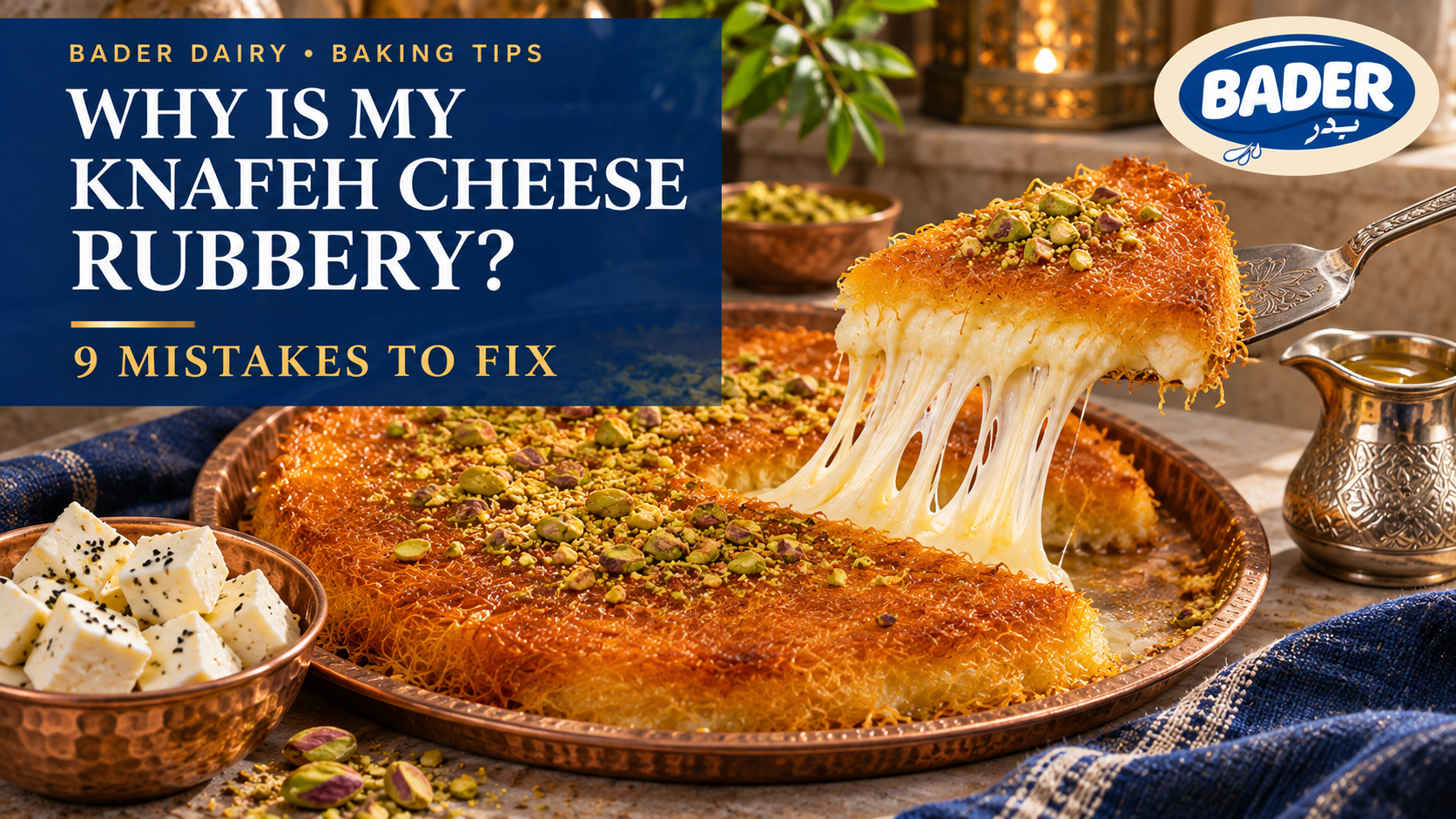
Few things are as satisfying as cutting into a freshly baked knafeh and seeing the warm cheese stretch beneath a golden layer of pastry. The combination of crisp dough, soft cheese, fragrant syrup, and buttery richness makes knafeh one of the most recognizable desserts in Middle Eastern cuisine.
But homemade knafeh doesn’t always turn out as expected.
Sometimes the cheese becomes rubbery. Other times, it stays firm instead of stretching, releases too much water, or develops an unpleasantly chewy texture. The pastry might look beautiful on top while the cheese underneath feels completely wrong.
What causes these problems, and how can you prevent them?
Knafeh cheese can become rubbery because of the cheese variety, moisture and salt balance, heating conditions, or excessive cooking. Some cheeses are naturally more resistant to melting than others. Even traditional Nabulsi cheese can produce different results depending on how it is prepared and heated.
The solution is to choose a cheese suited to knafeh, prepare it appropriately, control moisture, and cook the dessert until the filling reaches the desired texture without unnecessary overheating.
In this guide, we’ll explain the most common knafeh cheese problems, the science behind melting and stretching, and the practical steps that can help you achieve a better result.
Why Does Knafeh Cheese Become Rubbery?
Knafeh cheese becomes rubbery when its structure stays too firm or develops an overly chewy texture during heating.
Cheese contains networks of milk proteins, including casein. These networks interact with water, fat, minerals, and salt.
When cheese is heated, its behavior depends on how those components are arranged.
Some cheeses soften and flow easily. Others maintain a relatively firm structure even at high temperatures.
Nabulsi cheese has traditionally been used for knafeh because appropriately prepared varieties can soften and become elastic while contributing a distinctive dairy flavor.
However, not every cheese labeled Nabulsi behaves identically, and preparation matters.
Quick guide to common knafeh problems
| Problem | Possible cause | What to try next time |
|---|---|---|
| Rubbery cheese | Cheese variety or excessive heating | Use suitable cheese and control cooking |
| Cheese won’t stretch | Protein structure, moisture, temperature | Check cheese choice and serve warm |
| Knafeh is too salty | Insufficient desalting | Soak cheese according to the recipe |
| Filling is watery | Inadequate draining | Drain prepared cheese thoroughly |
| Pastry is soggy | Excess moisture or syrup | Control cheese moisture and syrup quantity |
| Pastry is dry | Uneven fat coating or excessive baking | Distribute ghee evenly |
| Cheese is hard | Cooling or overcooking | Serve promptly and avoid excessive heat |
| Filling separates | Cheese composition or overheating | Test the cheese and cooking method |
| Bottom burns | Excessive bottom heat | Use suitable cookware and temperature |
The solution depends on the actual problem. Adding more syrup, more butter, or more cheese won’t necessarily correct the underlying issue.
Mistake #1: Choosing the Wrong Cheese for Knafeh
One of the biggest reasons homemade knafeh turns rubbery is the cheese itself.
Different cheeses have different melting characteristics.
Halloumi, feta, mozzarella, Akkawi, and Nabulsi may look somewhat similar in the grocery store, but they do not behave identically when heated.
Why cheese selection matters
The way cheese melts depends on several factors, including:
- Moisture content
- Acidity
- Salt concentration
- Calcium balance
- Protein structure
- Manufacturing process
- Age and storage conditions
A cheese that performs beautifully when grilled may not create the soft filling expected in knafeh.
Why halloumi may produce a rubbery filling
Halloumi is particularly well known for holding its shape during grilling and frying.
That quality is useful for savory dishes, but it may be less suitable for a dessert that depends on a soft cheese layer.
Replacing Nabulsi with halloumi without adjusting the recipe can create a firmer, chewier result.
What about mozzarella?
Mozzarella can provide stretch in certain knafeh recipes, but its flavor is different from traditional Nabulsi cheese.
Its moisture content also varies considerably between fresh mozzarella and lower-moisture varieties.
A direct substitution may therefore change both the texture and flavor.
Why use Nabulsi cheese?
Nabulsi cheese is traditionally associated with knafeh, particularly the famous Nabulsi style.
When appropriately prepared, a suitable Nabulsi cheese can contribute the balance of softness, elasticity, and characteristic dairy flavor the dessert requires.
Bader Dairy produces traditional Nabulsi Cheese in Worth, Illinois.
For a broader explanation of its characteristics, read What Makes Nabulsi Cheese Different.
Mistake #2: Not Removing Enough Salt From Nabulsi Cheese
Nabulsi cheese is traditionally stored in brine.
That gives it a distinctive salty flavor, but cheese intended for a sweet dessert often needs preparation before use.
If you add highly salted Nabulsi directly to knafeh, the resulting dessert may taste too salty.
Salt also influences the interactions between cheese proteins and moisture, although removing salt does not guarantee improved melting.
How to prepare Nabulsi cheese for knafeh
Bader Dairy’s knafeh recipe uses the following method:
- Remove the cheese from its brine.
- Cut it into smaller slices.
- Place the slices in cold drinking water.
- Refrigerate while soaking for approximately two hours.
- Change the water three times.
- Taste a small piece to check the saltiness.
- Continue soaking if the cheese is still too salty.
- Drain thoroughly before adding it to the pastry.
The goal is cheese that tastes only mildly salty before being incorporated into the dessert.
Different Nabulsi products may need different preparation times.
Can soaking fix rubbery cheese?
Not necessarily.
Soaking can reduce salt and change moisture content, but the cheese’s heating behavior also depends on how it was manufactured.
If a particular cheese is naturally very resistant to melting, prolonged soaking may not transform it into the desired filling.
The better approach is to begin with cheese suited to the recipe.
Mistake #3: Leaving Too Much Water in the Cheese
After soaking Nabulsi cheese, some cooks transfer it directly from the water into the pastry.
This can introduce excess moisture into the dessert.
When heated, the liquid may collect around the cheese or move into the pastry.
The result can be a soggy bottom, uneven filling, or excessive moisture in the finished knafeh.
Why excess water causes problems
Knafeh depends on a contrast between crisp pastry and soft cheese.
Too much free moisture can interfere with that contrast.
Instead of crisping properly, the pastry may absorb liquid.
How to drain cheese correctly
After soaking:
- Transfer the cheese into a clean strainer.
- Allow the free water to drain.
- Gently press or pat the surface if appropriate for the recipe.
- Chop or grate the cheese.
- Check for excess liquid before assembling the dessert.
The cheese should retain its normal internal moisture. The goal is to remove unwanted soaking water, not to dry out the cheese completely.
Should you squeeze Nabulsi cheese?
Avoid aggressively squeezing it unless a tested recipe specifically requires that technique.
Excessive pressure can change the cheese’s structure and remove more moisture than intended.
Gentle draining is usually a better starting point.
Mistake #4: Overcooking the Cheese Filling
Heat is essential for knafeh, but more heat does not always produce better stretch.
Cheese proteins respond to temperature in different ways.
Some cheeses soften considerably when heated, but prolonged cooking can also cause moisture loss and changes in texture.
Why excessive heating can make cheese tough
As cheese heats, fat and moisture become more mobile while its protein structure changes.
Under unfavorable conditions, extended heating can contribute to an overly firm or chewy texture.
The precise result depends on the cheese.
How to avoid overcooking
Start with a tested recipe and suitable cookware.
Monitor the pastry’s color and the filling’s condition rather than relying only on the clock.
Bader Dairy’s published knafeh recipe calls for baking at 200°C (392°F) for approximately 30–35 minutes in a 30 cm pan.
Those instructions are a reference for that particular recipe, not a universal rule for every knafeh variation.
Ovens and pans differ.
Can you fix overcooked cheese?
Sometimes gently warming a cooled filling can improve its softness, but severely overcooked cheese may not return to its original texture.
It is usually better to prevent excessive cooking than to attempt to reverse it.
Mistake #5: Expecting Cold Knafeh to Stretch Like Fresh Knafeh
Temperature makes a major difference in how cheese behaves.
A warm cheese filling may be soft and elastic.
As it cools, fat begins solidifying and the protein structure becomes less flexible.
This can make the cheese feel firmer.
Why fresh knafeh is usually served warm
Freshly prepared knafeh is traditionally enjoyed while the cheese is still warm and the pastry retains its intended texture.
As the dessert cools, the cheese may become less elastic and the pastry can soften as it absorbs moisture.
How to serve knafeh for better texture
Prepare the syrup and garnishes before the dessert finishes cooking.
When the pastry is ready, assemble and serve according to the recipe.
Avoid leaving the finished dessert standing unnecessarily before serving.
Can you reheat leftover knafeh?
Yes, provided it was cooled and refrigerated safely.
Reheat thoroughly using an appropriate method, following food-safety guidance for leftovers.
An oven can help maintain more of the pastry’s texture than some other methods.
However, reheated knafeh may not be identical to freshly prepared knafeh.
If the cheese was rubbery from the beginning, reheating alone may not solve the problem.
Mistake #6: Using Too Much or Too Little Ghee
Ghee plays an important role in traditional knafeh.
It coats the pastry, contributes flavor, and supports browning.
But using the wrong quantity or distributing it unevenly can affect the finished dessert.
What happens when there isn’t enough ghee?
The pastry may cook unevenly or develop dry patches.
Some areas may remain pale while others brown too quickly.
What happens when there’s too much?
The finished pastry may become excessively greasy.
A larger amount of fat does not automatically improve crispness or cheese texture.
How to distribute ghee properly
Melt the required amount gently.
Work it evenly through the pastry before pressing the dough into the pan.
Make sure the coating reaches different sections rather than collecting in one area.
Bader Dairy’s knafeh recipe uses 150 g of cow ghee for 400 g of knafeh dough.
That ratio belongs to the published recipe and should be evaluated within the complete formulation.
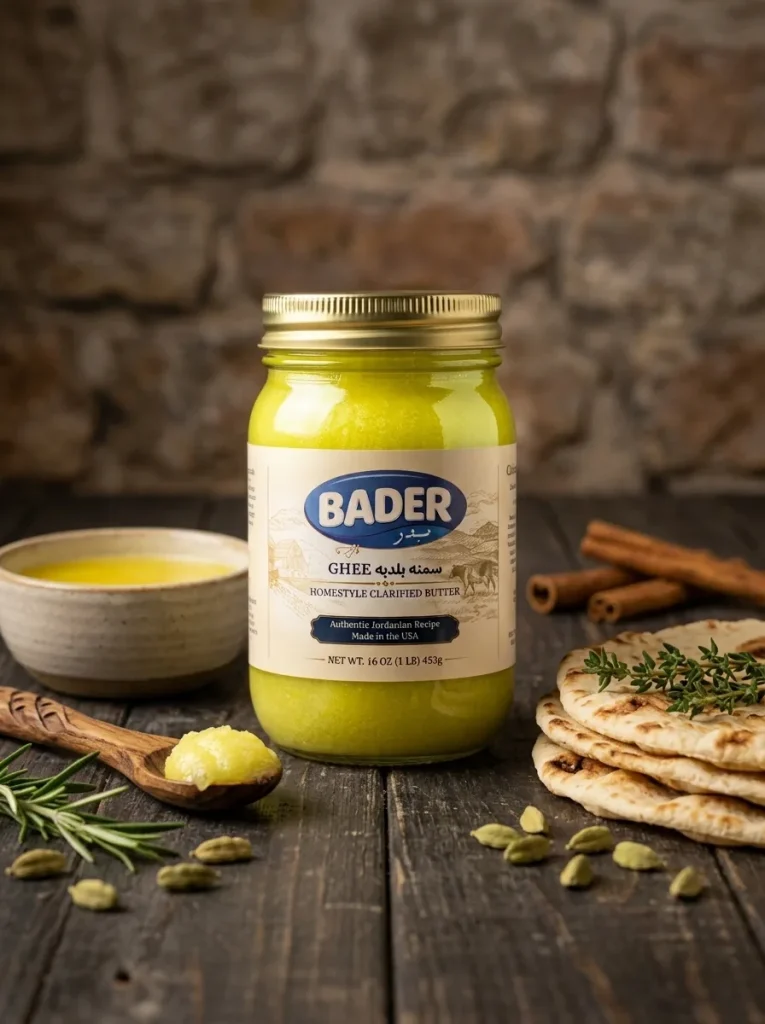
Explore Bader Dairy Cow Ghee for more information about the traditional ingredient.
For a broader explanation of its cooking characteristics, see Why Jordanian Kitchens Cook With Samneh Baladi.
Mistake #7: Adding Syrup Incorrectly
Syrup is a defining part of knafeh, but how and when it is added can affect the finished pastry.
If syrup is distributed unevenly, some areas may become overly wet while others remain comparatively dry.
Adding too much syrup may overwhelm the pastry’s texture.
What syrup should do
The syrup should contribute sweetness and aroma while complementing the cheese and pastry.
It is not intended to compensate for an incorrectly prepared filling.
Follow the temperature instructions
Different knafeh recipes use different approaches to syrup temperature.
Bader Dairy’s recipe instructs cooks to prepare and cool the syrup before pouring it over the hot knafeh.
Follow the method specified for your recipe rather than combining techniques from several unrelated versions.
Can syrup fix rubbery cheese?
No.
Syrup adds moisture and sweetness to the dessert but does not fundamentally change the manufacturing properties of the cheese.
If the filling is too rubbery because of the cheese variety, adding syrup will not transform it into a softer melting cheese.
Mistake #8: Using an Unsuitable Pan or Uneven Heat
Knafeh is sensitive to how heat reaches the pastry.
A pan that heats unevenly can create a dessert with a burnt bottom and underheated filling.
Why pan material matters
Different cookware materials transfer and retain heat differently.
A heavy pan may distribute heat differently from a lightweight baking dish.
Pan diameter also changes the thickness of the dessert.
Why thickness matters
A deep, thick knafeh may require a different baking approach from a thin one.
If the pastry layer is too thick, the outside may brown before the center is fully heated.
If the layer is very thin, the pastry may dry out more quickly.
How to improve consistency
Use the pan size recommended in your recipe.
Press the pastry evenly.
Distribute the cheese filling consistently across the base.
Avoid overcrowding one area with cheese while leaving another area nearly empty.
For Bader Dairy’s published version, the recipe specifies a 30 cm round pan.
Mistake #9: Changing Too Many Ingredients at Once
It’s common to make substitutions when preparing a traditional dessert at home.
You may use a different cheese, less ghee, more syrup, or a new pastry brand.
Each change can affect the result.
When multiple ingredients are changed simultaneously, it becomes difficult to identify what caused a problem.
Why consistent testing matters
Suppose the first batch is rubbery.
For the second batch, you change the cheese, reduce the baking time, alter the syrup, and use a different pan.
If the result improves, which change made the difference?
You can’t know with confidence.
A better method
Change one major variable at a time.
For example:
- First test a more suitable cheese.
- Next evaluate the soaking and draining process.
- Then adjust baking time if necessary.
- Finally refine the pastry and syrup balance.
This approach is useful for home cooks and professional kitchens developing consistent recipes.
What Makes Knafeh Cheese Stretch?
Cheese stretch depends on the way its protein network responds to heat.
The most important factors include protein structure, moisture, acidity, salt, and calcium interactions.
Protein structure
Milk proteins form networks within cheese.
When the cheese is heated, those networks may become more flexible, allowing the cheese to stretch.
Moisture
Moisture contributes to texture and mobility within the cheese.
Too little moisture can make some cheeses excessively firm.
Too much free water can create other preparation problems.
Acidity
Acidity affects interactions within the protein structure.
Different cheese manufacturing methods produce different acid and mineral balances, influencing heating behavior.
Salt and minerals
Salt and calcium interactions also affect cheese texture.
The relationship is complex, which is why simply removing more salt does not guarantee better stretch.
Cooking temperature
The cheese must reach a suitable temperature to soften.
But prolonged excessive heating may reduce the quality of the finished texture.
The key lesson: Stretch depends on the cheese itself as much as the cooking method.
Can You Use Nabulsi Cheese for Both Frying and Knafeh?
Yes, but the preparation goals are different.
For frying, you may want slices that maintain their shape while developing a golden exterior.
For knafeh, you generally want a softer cheese filling beneath the pastry.
A particular Nabulsi product may perform well in one application and differently in another.
Fried Nabulsi
The cheese is usually sliced, rinsed if desired, drained, and cooked in a pan.
Some of its traditional saltiness may be retained.
Nabulsi for knafeh
The cheese is commonly soaked more thoroughly to reduce excess salt.
It is then drained, chopped or grated, and incorporated into the dessert.
The goal is an appropriate balance of flavor and texture.
For a savory preparation, see Bader Dairy’s Fried Nabulsi Cheese Recipe.
For dessert, follow the Knafeh with Nabulsi Cheese Recipe.
Can You Prepare the Cheese Ahead of Time?
Preparing ingredients ahead can make baking easier, but dairy must be handled safely.
Nabulsi cheese is a refrigerated dairy product.
Bader Dairy’s product page specifies storage at 40°F (4°C) or below.
If you’re soaking cheese to reduce salt, keep it refrigerated during the soaking period.
After draining, maintain appropriate refrigeration until you’re ready to assemble the dessert.
Should you leave soaked cheese on the counter?
No.
Do not leave perishable cheese at room temperature for extended periods.
For general food safety, perishable foods should not remain in the temperature danger zone beyond applicable limits.
Can you soak the cheese overnight?
Some especially salty products may need extended refrigerated soaking.
However, the correct duration depends on the cheese and recipe.
Excessive soaking can alter the cheese’s salt and moisture balance.
Check the product and intended recipe rather than assuming longer is always better.
Knafeh Troubleshooting Checklist Before Baking
If you’ve had problems with knafeh in the past, use this checklist before your next attempt.
| Check | What you’re looking for |
|---|---|
| Cheese choice | Suitable Nabulsi or other recipe-tested cheese |
| Saltiness | Mild enough for the intended dessert |
| Moisture | Excess soaking water drained |
| Cheese distribution | Even layer across the pastry |
| Ghee | Proper amount, evenly distributed |
| Pan | Appropriate diameter and material |
| Oven | Properly preheated |
| Baking time | Based on recipe and actual doneness |
| Syrup | Correct quantity and preparation |
| Serving | Served while appropriately warm |
This checklist can prevent several common mistakes before they affect the finished dessert.
Why Nabulsi Cheese Matters in Traditional Knafeh
Knafeh is strongly associated with Nablus, Palestine, and has become an important dessert throughout Jordan and the wider Levant.
Although different regions and households prepare it differently, the combination of cheese, pastry, and syrup is central to many traditional versions.
The cheese contributes more than stretch.
It also provides dairy flavor and the contrast between savory and sweet ingredients.
Nabulsi cheese is particularly important because of its regional history and traditional culinary applications.
Some varieties include aromatic ingredients such as mahlab, mastic, or black seed.
These ingredients contribute their own character to the cheese.
However, cooks should select cheese according to the recipe’s flavor and texture requirements.
For more background, explore Bader Dairy’s Traditional Jordanian Dairy Guide.
Frequently Asked Questions
Why is my knafeh cheese rubbery?
Possible causes include using a cheese that resists melting, excessive heating, or a moisture and protein structure that produces a firm texture. Start by evaluating the cheese variety and cooking method.
Why doesn’t my knafeh cheese stretch?
Stretch depends on the cheese’s protein network, moisture, acidity, salt, and heating behavior. A cheese that works well for grilling may not create the desired knafeh filling.
Is Nabulsi cheese good for knafeh?
Yes. Nabulsi cheese is traditionally associated with Nabulsi-style knafeh. The exact result depends on the cheese and its preparation.
Does soaking Nabulsi cheese help it melt?
Soaking reduces salt and changes moisture, but it does not guarantee a particular melting texture. Cheese manufacturing properties remain important.
How long should you soak Nabulsi cheese for knafeh?
Bader Dairy’s knafeh recipe calls for approximately two hours with three water changes. Actual preparation needs can vary.
Why is my knafeh too salty?
The cheese may not have been desalted sufficiently. Follow an appropriate refrigerated soaking method and taste before assembling the dessert.
Can I use halloumi in knafeh?
Halloumi can be used in some adapted recipes, but it may produce a firmer, chewier filling than expected. It is not always an ideal direct substitute for Nabulsi.
Why is my knafeh watery?
Excess moisture in the cheese or other ingredients may contribute. Drain soaked cheese thoroughly and follow the recipe’s proportions.
Why is my knafeh pastry soggy?
Possible causes include excess water in the cheese, uneven baking, or too much syrup. Check ingredient preparation and cooking technique.
Why is my knafeh hard after cooling?
As cheese cools, its texture can become firmer. The pastry also changes as moisture moves through the dessert. Knafeh is often best served warm.
Can I reheat knafeh?
Yes, if it was cooled and stored safely. Reheat thoroughly using an appropriate method, understanding that the texture may differ from freshly made knafeh.
What kind of ghee is used for knafeh?
Traditional recipes may use clarified dairy fat such as cow ghee. Bader Dairy’s knafeh recipe specifies its cow ghee.
Does more ghee make knafeh softer?
Not automatically. Ghee contributes to pastry coating, flavor, and browning, but excessive amounts can make the dessert greasy.
Can I prepare Nabulsi cheese the night before?
Yes, certain preparation steps can be completed ahead of time under appropriate refrigeration. Follow the recipe and handle soaked cheese as perishable dairy.
Where can I find Nabulsi cheese for knafeh in Illinois?
Bader Dairy produces Nabulsi cheese in Worth, Illinois. Visit its product and availability pages to inquire about purchasing.
Make Better Knafeh With Traditional Ingredients
Rubbery knafeh cheese can be frustrating, especially when the pastry looks perfectly golden.
But the solution usually begins before the dessert enters the oven.
Choosing suitable cheese, reducing excess salt where needed, draining properly, distributing the filling evenly, and managing cooking conditions can make a significant difference.
Traditional Nabulsi cheese has an important place in knafeh, and understanding how it behaves helps cooks prepare the dessert more confidently.
At Bader Dairy, we produce traditional Jordanian dairy products in Worth, Illinois.
Our collection includes Nabulsi cheese and cow ghee, two ingredients featured in our published knafeh recipe.
Continue exploring:
- Bader Dairy Nabulsi Cheese
- Bader Dairy Cow Ghee
- Knafeh with Nabulsi Cheese — Complete Recipe
- What Makes Nabulsi Cheese Different
- Traditional Jordanian Dairy Guide
Looking for Bader Dairy products?
Visit Where to Find Bader to inquire about product availability.
Are you a grocery store owner, restaurant operator, or distributor?
Visit our Wholesale Inquiry page to ask about carrying Bader Dairy products.
Bader Dairy
6903 W 111th St, Worth, IL 60482
Phone: (708) 827-5174
Email: info@baderdairy.com
Website: baderdairy.com
Traditional Jordanian dairy, made in Illinois.