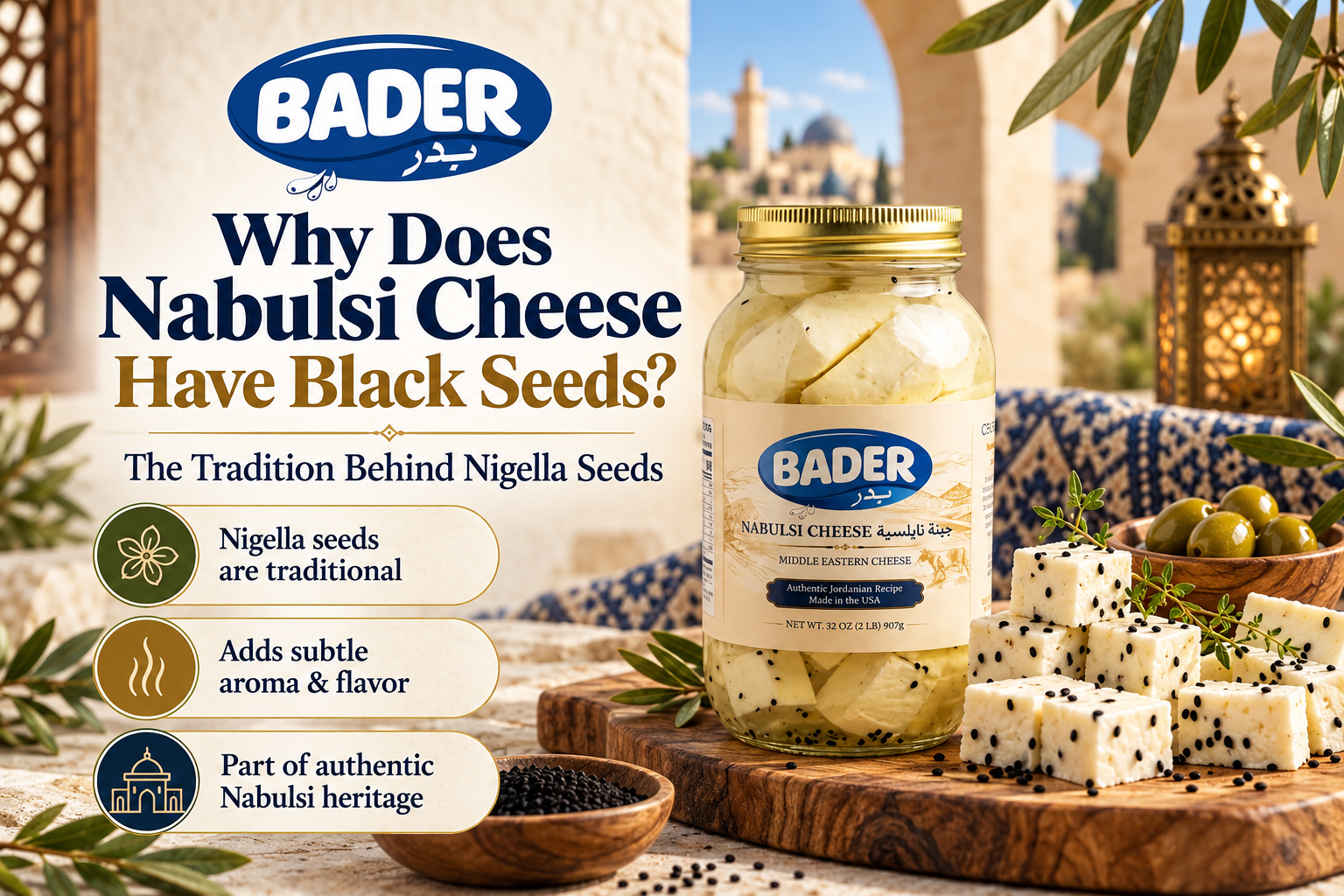
By Bader Dairy | Traditional Jordanian Dairy Producers in Worth, Illinois
Published: October 26, 2026
Reading time: Approximately 10 minutes
If you’ve ever opened a jar of traditional Nabulsi cheese, you may have noticed small black seeds scattered throughout the white cheese or floating in its brine.
For someone unfamiliar with this traditional Middle Eastern cheese, those seeds can raise a few questions. Are they supposed to be there? Are they black sesame seeds? Do they change the flavor? And why do some Nabulsi cheeses contain them while others don’t?
The answer is rooted in the culinary traditions of Palestine, Jordan, and the wider Levant.
The black seeds found in some varieties of Nabulsi cheese are nigella seeds (Nigella sativa), also known as black seed or habbat al barakah. They are an intentional traditional ingredient used to contribute a subtle peppery, herbal, and slightly bitter flavor.
Not every Nabulsi cheese contains black seed, but it is a familiar ingredient in certain traditional preparations.
At Bader Dairy, our Nabulsi Cheese includes black seed as part of a recipe that also contains mahlab and mastic gum.
Understanding these ingredients helps explain why traditional Nabulsi cheese can taste different from ordinary white cheese.
What Are the Black Seeds in Nabulsi Cheese?
The small black seeds in some Nabulsi cheeses come from a flowering plant called Nigella sativa.
The seeds are commonly referred to as:
- Nigella seeds
- Black seed
- Habbat al barakah
- Habbatul barakah
- Black cumin, in some markets
- Kalonji, particularly in South Asian cooking
Although the names vary, they commonly refer to the same culinary spice.
Nigella seeds are generally small, angular, and dark black, with a slightly rough appearance.
They are used in several food traditions across the Middle East, Mediterranean, and South Asia.
In addition to cheese, they may appear in breads, savory pastries, pickles, and spice mixtures.
Are nigella seeds the same as black sesame seeds?
No.
Nigella and black sesame come from different plants.
Black sesame seeds generally have a familiar nutty sesame flavor.
Nigella seeds have a more distinctive peppery and herbal character, sometimes described as slightly bitter.
Their shapes also differ.
Black sesame seeds are typically smoother and more oval, while nigella seeds have an angular appearance.
Understanding this distinction matters because the two ingredients don’t necessarily produce the same flavor in a recipe.
Why Are Nigella Seeds Added to Nabulsi Cheese?
Traditional Nabulsi cheese is known for its salty dairy flavor, firm texture, and ability to be served both cold and cooked.
Nigella seeds can contribute another layer of aroma.
The seeds are generally used in relatively small amounts, so they are not intended to overpower the cheese.
Instead, they complement its dairy character.
1. They add traditional flavor
Nigella seeds provide peppery, slightly bitter, and herbal notes.
These flavors can complement the saltiness of Nabulsi cheese.
When combined with other traditional seasonings, they contribute to a more distinctive finished product.
2. They contribute to the cheese’s appearance
The contrast between white cheese and tiny black seeds is recognizable.
For someone who grew up eating traditionally seasoned Nabulsi cheese, the appearance may be associated with familiar family meals.
However, appearance alone does not establish a cheese’s authenticity or quality.
3. They reflect regional food traditions
Traditional cheese recipes vary across households, communities, and producers.
Some use nigella seeds, while others rely primarily on dairy, salt, and the cheesemaking process.
Additional aromatic ingredients may be used depending on the recipe.
This variation is part of the culinary history of the Levant.
4. They complement other aromatic ingredients
In Bader Dairy’s Nabulsi recipe, black seed appears alongside mahlab and mastic gum.
Each ingredient has a different flavor profile.
Together, they help distinguish the recipe from a plain brined white cheese.
What Do Black Seeds Taste Like?
Nigella seeds have a flavor that is difficult to describe using only one familiar spice.
They are often characterized as:
| Flavor characteristic | Description |
|---|---|
| Peppery | A gentle pungency |
| Herbal | Subtle savory plant notes |
| Slightly bitter | A distinct background bitterness |
| Toasty | Notes that may become more pronounced when heated |
| Aromatic | A recognizable seasoning character |
Their flavor depends on the quality, quantity, and preparation of the seeds.
When used in cheese, their effect is influenced by the dairy, salt, and other seasonings.
Do black seeds make Nabulsi cheese spicy?
Not in the same way chili peppers do.
Nigella contributes flavor and mild pungency, but it does not typically create intense chili-like heat.
The quantity used also affects how noticeable the flavor becomes.
Do they make the cheese bitter?
They may contribute slight bitterness.
However, in a balanced traditional cheese recipe, that characteristic can complement the richness and saltiness of the dairy.
A cheese should not be assumed defective simply because the nigella seeds contribute a mild bitter note.
Are Black Seeds Supposed to Be in Nabulsi Cheese?
Yes, in varieties that intentionally include nigella.
Black seed is a traditional ingredient in some Nabulsi cheese recipes.
However, not all Nabulsi cheeses contain it.
A recipe without black seed is not automatically inauthentic, and a recipe with black seed is not automatically higher quality.
Nabulsi cheese has a long regional history, and its preparation varies between producers.
The important distinction is whether the ingredients accurately reflect the recipe and labeling of the specific product.
How can you tell whether a cheese contains nigella?
Check the ingredient statement.
It may identify the ingredient as black seed, nigella seed, or Nigella sativa.
For Bader Dairy, black seed is explicitly listed among the Nabulsi cheese ingredients.
If you notice unexpected dark particles in a cheese that does not list such ingredients, do not automatically assume they are nigella. Refer to the label and contact the manufacturer if needed.
Where Does Nabulsi Cheese Come From?
Nabulsi cheese originates in Nablus, a city in Palestine.
Over generations, the cheese became widely known and consumed throughout neighboring Jordan and the wider Levant.
Its historical preparation is associated with milk, cheesemaking techniques, salt, brining, and, in some varieties, aromatic ingredients.
Traditionally, sheep and goat milk have been important in regional cheesemaking.
Modern versions may also use cow milk or combinations of different dairy sources.
Nabulsi cheese is now enjoyed by families across the Middle East and in communities around the world.
Why is Nabulsi cheese popular in Jordan?
Jordanian and Palestinian food traditions share many ingredients, preparation techniques, and family recipes.
Nabulsi cheese is commonly served for breakfast and used in cooked dishes.
It is also associated with knafeh, the traditional cheese-based dessert.
For a broader look at the region’s dairy traditions, explore our Traditional Jordanian Dairy Guide.
What Are Mahlab and Mastic Gum in Nabulsi Cheese?
Black seed is not the only aromatic ingredient used in certain traditional Nabulsi recipes.
Bader Dairy’s product label also lists mahlab and mastic gum.
These ingredients contribute different characteristics.
What is mahlab?
Mahlab, also spelled mahleb, is an aromatic ingredient obtained from the kernels of certain cherry species, commonly associated with the St. Lucie cherry.
It is used in Middle Eastern and Mediterranean cooking, particularly in breads and baked goods.
Mahlab is often described as having a distinctive aroma with nutty, slightly floral, and cherry-like notes.
Its effect in cheese depends on the quantity and preparation.
What is mastic gum?
Mastic is an aromatic resin obtained from the mastic tree.
It has a long history in Mediterranean and Middle Eastern cooking.
Its flavor is sometimes described as resinous, pine-like, or subtly herbal.
Mastic is used in different traditional foods, including selected dairy preparations and desserts.
Why combine these ingredients?
Traditional recipes sometimes build flavor through small quantities of multiple aromatic ingredients.
Nigella brings peppery and herbal characteristics.
Mahlab contributes its own distinctive aroma.
Mastic can add resinous notes.
The balance depends on the individual recipe.
Bader Dairy’s Nabulsi Cheese product page lists all three ingredients.
How Is Nabulsi Cheese Traditionally Served?
Nabulsi cheese is versatile because it can be enjoyed in several ways.
Its salty character makes it suitable for savory dishes, while properly desalted varieties can also be used in desserts.
Fresh with warm bread
One familiar preparation is to serve Nabulsi cheese alongside:
- Warm pita or other flatbread
- Cucumbers
- Tomatoes
- Olives
- Fresh mint
- Olive oil
The fresh vegetables help balance the cheese’s salty taste.
This style of breakfast is common across the Levant.
For a complete serving idea, explore Bader Dairy’s Nabulsi Cheese Breakfast Recipe.
Pan-fried Nabulsi cheese
Nabulsi cheese can be sliced and cooked in a pan.
Depending on the product and cooking method, the outside may develop a golden surface while the interior softens.
Nigella seeds can remain part of the cheese’s seasoning profile during cooking.
Use moderate heat and avoid cooking the cheese longer than necessary.
Grilled Nabulsi cheese
Suitable varieties can also be grilled.
Drying the cheese’s surface helps with browning.
A grill pan can be useful if the cheese softens too much for open grill grates.
Nabulsi cheese in knafeh
For knafeh, Nabulsi cheese is typically soaked to reduce excess salt.
The preparation requirements differ from those for a savory breakfast.
Some dessert recipes specify a particular cheese variety or flavor profile.
For instructions, read our Guide to Removing Salt From Nabulsi Cheese.
Should You Remove the Black Seeds Before Eating Nabulsi Cheese?
Generally, no.
When nigella seeds are intentionally included in a ready-to-eat cheese, they are part of the food.
They are not normally treated as an unwanted contaminant.
However, individual preferences vary.
Some people enjoy their flavor, while others prefer cheeses without aromatic seeds.
Can you eat nigella seeds?
Yes. Nigella seeds are used as culinary ingredients in many traditional foods.
They are commonly eaten in breads, seasonings, and certain cheeses.
That does not mean large supplemental doses or concentrated black-seed oils are equivalent to ordinary culinary use.
Can you rinse the seeds away?
You may remove some loose seeds when rinsing the cheese, but seeds embedded in the cheese will remain.
Rinsing is usually performed to remove surface brine or reduce saltiness, not to remove traditional flavoring ingredients.
Why Is Nabulsi Cheese Stored in Brine?
Nabulsi cheese is traditionally associated with salted brine.
Brining affects several aspects of the cheese:
- Flavor
- Salt distribution
- Moisture movement
- Texture
- Product characteristics during storage
Salt contributes to the cheese’s familiar taste and influences the behavior of its proteins and moisture.
However, brining is not a substitute for proper refrigeration.
Bader Dairy instructs customers to refrigerate its Nabulsi cheese at 40°F (4°C) or below.
Do black seeds preserve Nabulsi cheese?
Nigella has been studied for various chemical and biological properties.
However, the presence of black seed in cheese does not establish that the finished product can be safely stored without refrigeration or that it has a particular shelf life.
Commercial dairy preservation depends on the entire validated production and packaging process.
Follow the specific product’s labeling.
Should you replace the brine after opening?
Do not improvise a replacement brine unless the manufacturer provides instructions.
Changing the original salt concentration can affect the product.
Use clean utensils, close the container properly, and follow the packaging directions.
Is Black Seed the Same as Black Cumin?
The terminology can be confusing.
Nigella sativa is sometimes sold under the common name black cumin.
However, it is not botanically the same as ordinary cumin, Cuminum cyminum.
The two come from different plants.
They also have different flavors and culinary applications.
This is why scientific names can be useful when identifying ingredients.
| Name | What it refers to |
|---|---|
| Nigella | Nigella sativa |
| Black seed | Common name for nigella |
| Habbat al barakah | Arabic name commonly used for nigella |
| Black cumin | Ambiguous common name often used for nigella |
| True cumin | Cuminum cyminum, a different spice |
| Black sesame | Sesame seed variety, not nigella |
When following a traditional recipe, make sure you’re using the intended ingredient.
Are There Health Benefits to Black Seeds in Cheese?
Nigella seeds have a long history in traditional food and medicinal practices.
Researchers have investigated compounds found in Nigella sativa, including thymoquinone.
However, research into isolated compounds, supplements, or concentrated extracts should not be confused with the nutritional effects of eating a small amount of nigella in cheese.
There is not sufficient evidence to claim that eating Nabulsi cheese containing black seed treats or prevents medical conditions.
The primary purpose of this article is to explain black seed as a culinary ingredient.
Nabulsi cheese also contains dairy and may be relatively high in sodium, depending on its formulation.
People with dietary restrictions should consult the complete product labeling.
How to Choose Traditional Nabulsi Cheese
If you’re purchasing Nabulsi cheese for the first time, start with the intended recipe.
For breakfast
Choose a cheese that can be sliced and served with vegetables and bread.
A seasoned variety containing nigella may offer additional aromatic character.
For frying
Look for a cheese suitable for pan-frying.
Its firmness, moisture content, and manufacturing process influence how well it holds together.
For knafeh
Choose a cheese appropriate for a traditional dessert recipe.
You may need to reduce its salt content before use.
For traditional flavor
Read the ingredient label.
Some Nabulsi cheeses include black seed, mahlab, mastic, or other aromatic ingredients.
Others use simpler recipes.
For reliable storage
Check refrigeration requirements, packaging integrity, and date information.
Avoid purchasing damaged packages or products that have not been stored appropriately.
How Bader Dairy Makes Traditional Nabulsi Cheese Available in Illinois
Bader Dairy is a Jordanian dairy producer based in Worth, Illinois.
Our company brings traditional family recipes into a local American manufacturing setting.
Our Nabulsi cheese is one of eight traditional dairy products in the collection.
Its listed ingredients include:
- Cow milk
- Goat milk
- Salt
- Mahlab
- Rennet
- Mastic gum
- Black seed
The product is offered in 32 oz glass and plastic jars.
Bader Dairy’s Nabulsi cheese can be enjoyed as part of a traditional breakfast, pan-fried, or prepared for selected Middle Eastern recipes.
We also produce labneh, labneh in olive oil, ghee, jameed, and traditional butter.
Learn more about our company’s heritage and production at Our Story.
Frequently Asked Questions
What are the tiny black seeds in Nabulsi cheese?
They are typically nigella seeds, also known as black seed or habbat al barakah, when intentionally included in the cheese recipe.
Are black seeds supposed to be in Nabulsi cheese?
Yes, in varieties made with nigella. However, not every Nabulsi cheese recipe includes them.
What is habbat al barakah?
Habbat al barakah is an Arabic name commonly used for black seed, Nigella sativa.
Do black seeds change the taste of cheese?
They can add subtle peppery, herbal, and slightly bitter notes.
Are nigella seeds spicy?
They have some pungency but generally do not create the same type of heat as chili peppers.
Are black seeds the same as black sesame?
No. They come from different plants and have different flavors.
Are nigella seeds edible?
Yes. They are used as a food ingredient in many traditional culinary preparations.
Can you fry Nabulsi cheese with the seeds still in it?
Yes, when the product is intended for cooking. The seeds are part of the recipe.
Does every Nabulsi cheese contain black seed?
No. Traditional recipes vary by producer and region.
Is black cumin the same as nigella?
The common name black cumin is sometimes used for nigella, but nigella is not the same plant as ordinary cumin.
Why is Bader Dairy Nabulsi cheese flavored?
Bader Dairy’s ingredient list includes black seed, mahlab, and mastic gum as part of its traditional recipe.
Does Nabulsi cheese need refrigeration?
Yes. Bader Dairy instructs customers to keep its Nabulsi cheese refrigerated at 40°F (4°C) or below.
Can black seed make cheese shelf-stable?
No such assumption should be made. The product’s safety and shelf life depend on its validated manufacturing, packaging, and storage conditions.
Where can I find Nabulsi cheese with black seed in Illinois?
Bader Dairy produces traditional Nabulsi cheese in Worth, Illinois. Customers can contact the company to ask about product availability and nearby retailers.
Discover Traditional Nabulsi Cheese From Bader Dairy
The black seeds in traditional Nabulsi cheese are more than an unusual visual detail.
They reflect a familiar ingredient used across Middle Eastern food traditions.
Nigella adds subtle flavor and contributes to the character of certain Nabulsi recipes.
Together with ingredients such as mahlab and mastic, it helps create a cheese with a distinctive traditional identity.
At Bader Dairy, our Nabulsi cheese is made and packaged in Worth, Illinois, using a recipe that includes these aromatic ingredients.
Explore Bader Dairy Nabulsi Cheese to learn about the product.
For additional information, read:
- What Makes Nabulsi Cheese Different
- How to Remove Salt From Nabulsi Cheese
- Traditional Jordanian Dairy: A Complete Guide
Explore traditional recipes in our Recipes & Inspiration section.
Looking for Bader Dairy products?
Visit Where to Find Bader to inquire about availability.
Interested in carrying our products in your store?
Visit our Wholesale Inquiry page to connect with our team.
Bader Dairy
6903 W 111th St, Worth, IL 60482
Phone: (708) 827-5174
Website: baderdairy.com
Traditional Jordanian dairy, made in Illinois.